
New Jersey buyer guide
Outsourcing software development from New Jersey
A New Jersey buyer guide to international software and AI outsourcing: privacy instructions, clinical and quality records, audit trails, validation, continuity, and exit.
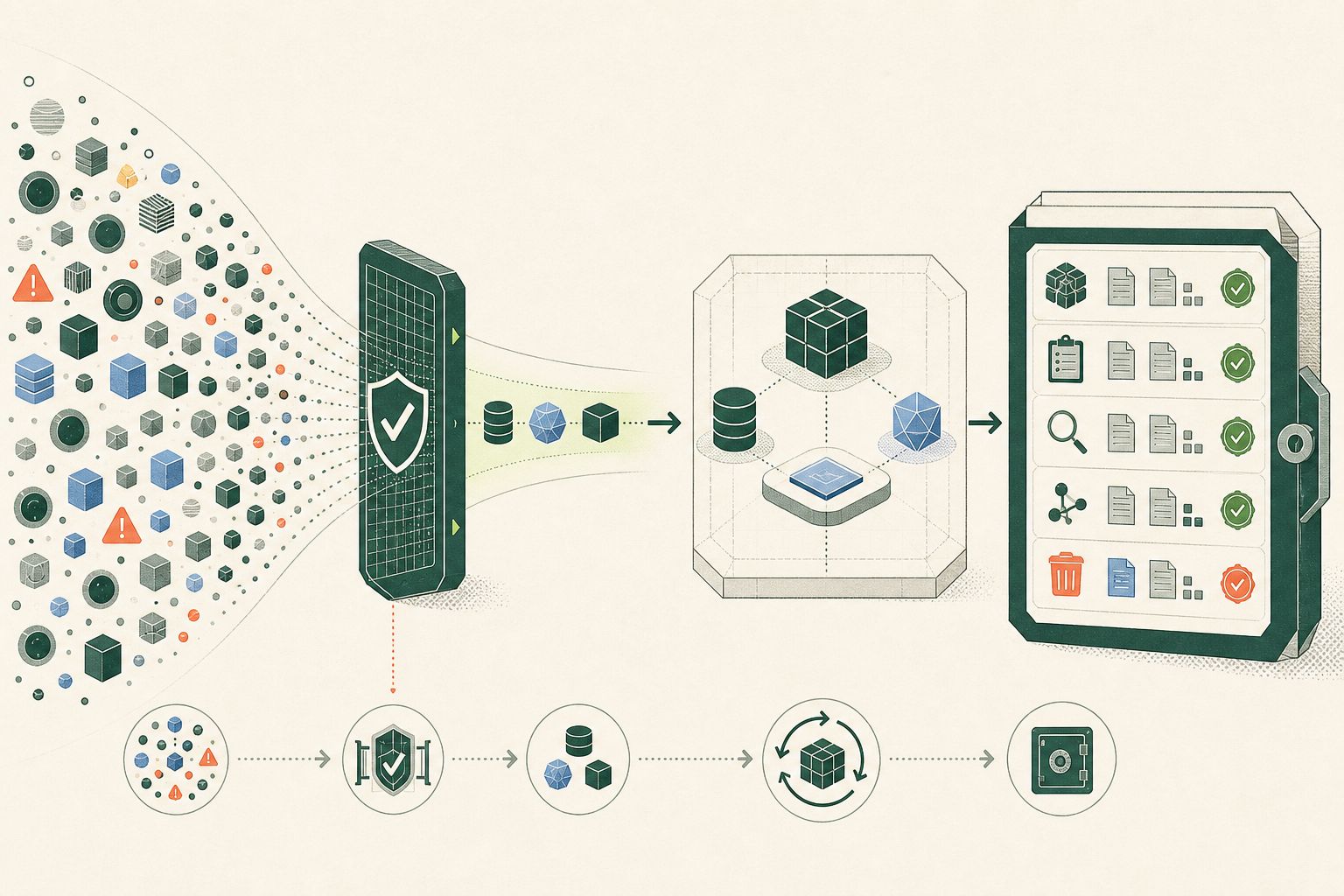
New Jersey outsourcing at a glance
| New Jersey buyer condition | Decision before supplier access | Evidence to retain |
|---|---|---|
| Supplier builds ordinary commercial software without regulated records | Define the outcome, data, environments, accounts, acceptance, support, and handover without importing irrelevant FDA language | Brief, responsibility matrix, named team, buyer-owned repository, tests, release record, cost model, support, and exit test |
| Supplier processes personal data within an applicable NJDPA path | Record the controller, processor, data, disclosed purpose, instructions, rights support, sensitive-data or minor decision, assessment, opt-out behavior, subprocessors, security, deletion, and change trigger | Scope memo, field-and-purpose map, contract, consent or opt-out record where applicable, rights test, assessment inputs, security evidence, processor removal, and deletion result |
| System creates, modifies, maintains, archives, retrieves, or transmits clinical-investigation records | Determine the exact regulated entity, study, record, system, intended use, predicate requirements, risk, and service-provider role | System and record inventory, requirements, risk assessment, validation evidence, authorized-user history, audit trails, metadata, backup, recovery, inspection export, retention, and decommissioning plan |
| Automation supports medical-device production or a quality management system | Use a current, risk-based software-assurance rationale tied to the automated process and quality consequence | Process and intended use, risk analysis, supplier evidence, configuration, tests or other assurance activities, objective results, deviations, approvals, change control, support, and retirement |
| Hosted platform or overseas provider may be replaced | Design record reconstruction and evidence custody before the contract starts | Export specification, data-element linkage, metadata, audit trail, human-readable and machine-usable copies, schemas, calculations, signatures, identities, configuration, hashes, retrieval test, retention owner, and exit acceptance |
| Team operates outside New Jersey’s Eastern-time business day | Protect privacy, clinical, quality, incident, change, and acceptance authority while allowing sustainable asynchronous work | Named cities and IANA zones, project dates, protected overlap, written handoff, authority calendar, backup owners, daylight-transition test, and off-hours escalation |
This guide does not decide whether the NJDPA applies, a research exemption covers a data path, a system or record falls under an FDA requirement, a device or automation is validated, or a particular contract, consent, assessment, submission, notice, retention period, or regulatory action is required.
Separate four systems that procurement often blends together
“Life-sciences software” is too broad to set controls. A public marketing site, a customer portal, a research data-capture service, and software automating a production-quality process may be purchased by the same New Jersey company while serving different purposes and authorities.
Classify each work package into one or more lanes:
- Commercial lane: websites, internal tools, finance, collaboration, ordinary analytics, and other systems that do not create or control regulated records or processes.
- Consumer-data lane: processing that requires an NJDPA applicability, exemption, role, purpose, rights, assessment, consent, opt-out, processor, or security decision.
- Clinical-record lane: electronic systems that create, modify, maintain, archive, retrieve, or transmit records for a clinical investigation under the buyer’s identified requirements.
- Production-and-quality lane: automation used as part of a medical-device production process or quality management system, where confidence in the software relates to product quality and the applicable quality-system framework.
A system can cross lanes. A participant-facing application can involve consumer data, clinical records, a digital health technology, and third-party analytics. A general collaboration tool can become a regulated record repository when a team uses it to approve or preserve evidence. A production dashboard can move from informational to decision-making when it changes a release, inspection, or process action.
For every lane record the buyer legal entity, product or study, system owner, data owner, privacy owner, clinical or quality owner where relevant, security owner, supplier entity, named people, countries, intended use, records, interfaces, privileges, applicable requirements, evidence, acceptance authority, retention, and transition trigger.
New Jersey’s Department of Labor and Workforce Development identifies substantial life-sciences, manufacturing, healthcare, and technology sectors in its current industry analysis. That evidence supports a regulated-system guide as a useful New Jersey research artifact. It does not imply that every New Jersey buyer is FDA-regulated or that Outsourcing.ai has served a particular local organization.
Build an intended-use and record-obligation map
Controls should follow what the system is intended to do and what evidence must survive. Start with a one-page intended-use record:
- user and business or regulated process;
- decision, action, or record the system supports;
- data sources, transformations, calculations, and destinations;
- interfaces, devices, instruments, models, and external services;
- conditions and limits of use;
- consequences of incorrect, missing, delayed, changed, or unavailable output;
- required review, signature, or human authority;
- applicable records, metadata, audit trails, and retention;
- system owner, process owner, supplier role, and acceptance owner; and
- changes that require reassessment.
Then build a record-obligation map. For each record class identify the source, data element, identifier, meaning, creator or originator, timestamp and time standard, authorized actions, prior values, reason for change, signature or approval, related requirement or protocol, storage, metadata, audit trail, calculation, report, backup, retention, inspection format, and final custody.
Do not use the phrase “Part 11 compliant” as a substitute for this analysis. FDA’s electronic-systems guidance distinguishes different records and contexts, recommends a justified risk-based approach, and identifies service-provider and system-lifecycle considerations. Qualified owners should map the exact predicate requirements and guidance to the actual system.
The supplier work order should point to the intended-use and record maps. A developer cannot preserve record meaning, attribution, or retrieval when the project brief only lists screens and integrations.
Create an evidence-continuity packet
Every accepted regulated-system change should return an evidence-continuity packet that a buyer can retain independently of the supplier. The packet is not a ceremonial validation binder; it is the current, navigable evidence needed to understand and reconstruct the system and its records.
Include, as applicable:
- approved intended use, process, protocol, user, requirement, and acceptance criteria;
- risk assessment connecting failure or misuse to participant safety, data reliability, product quality, privacy, security, and operations;
- architecture, data flow, interfaces, configurations, environments, external services, and trust boundaries;
- source revision, components, dependencies, software and hardware versions, build or deployment provenance, and generated artifacts;
- supplier and buyer identities, roles, privileges, training or qualification record where required, and access history;
- test plan or other assurance method, representative data, objective results, deviations, issues, review, and approval;
- audit-trail design and review, metadata dictionary, time synchronization, electronic-signature or authority behavior, and prior-value preservation;
- backup, recovery, continuity, incident, vulnerability, change, and support procedures;
- known limitations, residual risk, accepted exceptions, monitoring, and re-evaluation triggers;
- record export, human-readable representation, machine-usable data, schemas, queries, calculations, linkage method, and integrity evidence; and
- retention owner, decommissioning plan, replacement path, final export, deletion, and exit acceptance.
Keep the packet in a buyer-controlled repository or evidence store with protected history. Link every artifact to the accepted system version and change. Prevent the supplier from silently rewriting evidence after approval. A PDF summary alone is insufficient when record reconstruction depends on schemas, metadata, audit trails, source, configurations, or executable retrieval logic.
NIST’s Secure Software Development Framework can organize development-environment protection, provenance, secure production, and vulnerability response. Use it as a common language, not as a claim that a provider is certified or that an FDA decision has been satisfied.
Apply risk-based assurance to production and quality automation
FDA’s February 2026 final guidance addresses computer software assurance for automation used in medical-device production or the quality management system. It describes a risk-based approach to establish confidence and supersedes the September 2025 version. A proposal or checklist based on the older title should be reviewed against the current guidance and the amended quality-system context.
Start with the automated process and intended use. Identify what the software controls or records, foreseeable failures, quality and operational consequences, existing process controls, detectability, and the evidence needed for confidence. Scale rigor to risk rather than the price or novelty of the software.
The buyer should decide:
- which functions are higher process risk and why;
- which supplier, configured, custom, infrastructure, data, interface, and human elements affect those functions;
- which unscripted, scripted, automated, inspection, review, or other assurance activities are appropriate;
- what objective evidence demonstrates the result;
- which deviations or unexpected outcomes require investigation;
- who accepts the assurance rationale and residual risk; and
- how configuration, updates, patches, integrations, models, or process changes trigger reassessment.
Do not require voluminous screenshots merely because they look formal. Do not omit evidence because a vendor calls its service standard software. Record the assurance method, result, reviewer, and conclusion in a form that supports the buyer’s actual quality system and current requirements.
For an overseas team, include the named people, environment, tools, test data, access, time zone, and evidence-custody path. Ensure that a supplier can reproduce the accepted configuration and that the buyer can obtain the necessary evidence when a release, inspection, deviation, or investigation occurs after the project team changes.
Preserve clinical records beyond the hosted contract
FDA’s electronic-systems guidance says regulated entities may use systems from IT service providers for clinical-investigation activities and recommends that the systems be fit for purpose with implementation proportionate to participant-safety and result-reliability risks. It also addresses secure, traceable preservation, metadata, audit trails, backup, recovery, inspection, and decommissioning.
The exit requirement is unusually concrete: when a system is decommissioned or a hosted-system contract ends, the sponsor should ensure relevant metadata are obtained, retained, and linked to each corresponding data element. Procurement should design that outcome before the provider controls years of records.
Define an exit export contract:
| Export element | Acceptance question |
|---|---|
| Records | Are all required original, derived, corrected, signed, and superseded records included without losing meaning? |
| Metadata | Can the buyer link origin, identity, date and time, context, status, and other required metadata to each corresponding element? |
| Audit trails | Can an authorized reviewer reconstruct creation, modification, deletion, prior value, actor, time, and reason where applicable? |
| Calculations and transformations | Are algorithms, versions, parameters, units, mappings, query logic, and derived-data relationships preserved? |
| Human-readable copies | Can qualified reviewers and inspectors read the complete record and associated history without the retired supplier interface? |
| Machine-usable copies | Are documented formats, schemas, relationships, encodings, and integrity controls available for continued retrieval or migration? |
| Security and signatures | Are identity, authority, signature meaning, access history, and integrity evidence preserved without exposing live credentials? |
| Retention and retrieval | Is the buyer able to store, search, retrieve, render, back up, and protect the evidence for the required period? |
Run the export while the system is active. Select representative records, corrections, signatures, attachments, derived values, unusual characters, time zones, and audit events. Reconstruct them outside the supplier’s primary application. Record gaps and repeat until the buyer accepts the result.
Contract for transition assistance, complete exports, documentation, schema and version changes, reasonable retrieval performance, post-termination access, deletion after accepted custody, and cooperation with inspection or investigation. Avoid fees or proprietary formats that make required record access economically or technically impractical.
Operate the New Jersey privacy lane separately
The enacted New Jersey Data Privacy Act defines controllers and processors and addresses applicability, rights, purpose limitation, data minimization, security, sensitive data, consent revocation, universal opt-out mechanisms, heightened-risk assessments, processor relationships, exemptions, and enforcement. Qualified reviewers should determine the actual scope and interaction with other laws.
Build a processing-path record for each supplier operation:
- controller entity, product or service, consumer context, and applicability decision;
- data field and inference, source, subject, purpose, necessity, and disclosed use;
- controller instruction, processor action, system, person, country, and subprocessor;
- sensitive-data, child or teen, targeted-advertising, sale, profiling, or heightened-risk decision;
- consent, revocation, universal opt-out, rights, appeal, and authentication behavior where applicable;
- security, retention, deletion, return, incident, assessment, and compliance evidence; and
- change in purpose, data, model, service, entity, or recipient that stops work for review.
The Act contains exemptions and data-specific exclusions, including research-related language. Do not turn a data-path exemption into a blanket entity claim. A life-sciences company can operate exempt and non-exempt processing paths at the same time. Marketing, website analytics, patient-support, recruiting, commercial, research, safety, and product records need their own classification.
The New Jersey Attorney General announced proposed implementation rules in June 2025 and said an adoption process was expected in 2026. The proposal is a review trigger, not final operative text. Before production launch or a material privacy decision, check the official New Jersey Register and Administrative Code for adoption, changes, effective dates, and authoritative wording. This guide uses a short review interval because that status can change.
Test the real supplier chain with synthetic requests: access, correction, deletion, portability, consent revocation, opt-out, appeal, and processor deletion as applicable. Verify identity and authorization without collecting unnecessary new data. Record what was found, changed, retained, excluded, or escalated and why.
Control identities, audit trails, metadata, and time
Use individual identities and role-based authority. Record each authorized person’s name, role, organization, country, system, privilege, training or qualification requirement where applicable, approval, start, review, and removal. Keep a historical access record; today’s user list cannot reconstruct who had authority six months ago.
Prevent shared developer, administrator, reviewer, or signature accounts. Separate configuration, data entry, correction, review, approval, deployment, audit-trail review, and evidence-administration duties according to risk. A supplier should not create a record, alter its own history, approve the change, and control the only audit export.
Define audit events before implementation: authentication, authorization, record creation, prior and new value, correction, deletion, reason, signature, configuration, role, export, integration, clock, and system change as relevant. Protect audit trails from ordinary alteration and set a review process based on risk and event.
Normalize timestamps using maintained clocks, recorded time zones, and a documented display rule. New Jersey operations commonly use America/New_York, while overseas teams and hosted services may record UTC or local time and change daylight clocks on different dates. Preserve the raw event time, offset or zone context, and normalized representation needed to order events accurately.
Test a daylight transition, a supplier transition on another date, a corrected record, an account-role change, a failed integration, and an export. Confirm that record meaning, event order, actor, prior state, and approval remain reconstructable.
Govern AI, analytics, and derived records
Inventory coding assistants, hosted models, agents, statistical tools, digital health technologies, analytics, transcription, imaging, decision support, and automated quality or clinical functions. Record provider, model and service version, legal entity, region, data, purpose, input, output, derived record, training or improvement use, retention, access, subprocessors, evaluation, monitoring, incident path, and replacement.
Determine whether an output is exploratory, advisory, source data, a derived clinical record, quality evidence, a product function, or an automated action. Define the human authority and record status. Prevent a model from overwriting original data or collapsing source, correction, inference, and final decision into one value.
For each material output retain the necessary input reference, model or algorithm version, configuration, prompt or instruction where appropriate, timestamp, actor, output, review, correction, acceptance, and downstream use. Protect participant or consumer privacy and confidential product information. Do not send regulated or sensitive material to an unapproved personal AI account.
Evaluate intended performance, important subgroups, missing and erroneous data, uncertainty, unauthorized use, manipulation, drift, unavailable service, changed model, auditability, security, and rollback. A convincing demonstration is not evidence that a system is fit for a clinical, quality, or production purpose.
FDA maintains a current digital-health guidance index. Use it to identify relevant current material for the actual device, software, clinical, cybersecurity, and AI perimeter; do not rely on a static article that treats all digital health as one rule set.
Design incident and data-integrity handoffs
A supplier event can threaten confidentiality, record reliability, participant safety, product quality, system availability, or several at once. Build parallel decision paths rather than waiting for a single legal label.
Require immediate preliminary escalation for suspected unauthorized access, changed or missing records, unavailable audit trails, clock defects, corrupt exports, failed backups, compromised build or administrator identity, unapproved model or subprocessor, validation or assurance failure, product-quality concern, or loss of a hosted service.
The first handoff should include discovery time and zone, reporter, supplier entity, affected system and version, study or process, environment, service status, identities, records and data categories, suspected actions, participant or product consequence, provider and subprocessor involvement, preservation, containment, buyer decisions, and next update. Unknown is acceptable when clearly identified.
The buyer’s qualified clinical, quality, product, privacy, security, legal, and operational owners decide investigation, response, reportability, notices, corrections, product or study action, communications, and recovery. The provider should not wait for root cause or make external statements without authority.
Preserve source, build, deployment, configuration, identity, application, database, audit, metadata, interface, endpoint, cloud-control-plane, support, backup, export, and model-service evidence as applicable. Test recovery from a trusted state and verify record completeness and meaning after restoration.
Choose the provider and engagement model
For managed delivery, define the accepted system or milestone, intended use, evidence packet, delivery lead, named team, countries, access, service levels, changes, support, record custody, vulnerability response, and exit. The provider operates the agreed delivery system; the buyer retains privacy, clinical, quality, product, incident, and acceptance authority that the agreement does not delegate.
For staff augmentation, the buyer generally carries more daily supervision, architecture, requirements, validation or assurance planning, evidence assembly, integration, and continuity. Record each person, contributor entity, actual supervision, allocation, access, replacement, and offboarding. Obtain qualified employment, classification, tax, and permanent-establishment advice for the real relationship.
For a specialist, constrain access to a bounded outcome: an export validator, test-automation component, data map, interface review, or non-production prototype. A specialist should not inherit production-record or quality authority because the engagement is short.
Evaluate the proposed people and delivery system. Ask for legal identity, ownership, financial and insurance evidence, relevant references that can be verified and named, countries, subprocessors, secure development, clinical or quality system experience without accepting vague compliance claims, validation or assurance artifacts, audit and export capabilities, continuity, incident handling, conflicts, commercial terms, and a representative paid pilot.
No company, client, partner, or prior-team relationship should be named publicly without evidence and written naming permission. Outsourcing.ai can deliver a defined software or AI project directly, coordinate disclosed specialists, or support an independent provider selection. The proposal identifies the contracting entity, relationship, countries, responsibilities, data and record paths, commercial connections, intellectual-property terms, acceptance, and exit.
Protect source, records, accounts, and contributor rights
Separate buyer background materials, provider background tools, new deliverables, open-source components, third-party services, data, records, metadata, models, generated output, configurations, tests, documentation, and operational evidence. Identify every contributor and the legal entity responsible for confidentiality and rights.
WIPO’s directory helps locate official destination-country intellectual-property sources; it does not prove that a provider owns or can assign a deliverable. Obtain advice for the actual countries, people, relationship, inventions, software, data, records, and contract.
Keep source repositories, cloud organizations, domains, package and artifact registries, regulated-system tenants, signing or release keys, monitoring, evidence stores, backups, exports, and recovery under buyer governance. Require protected history, individual identities, review, provenance, reproducible releases, documented queries and calculations, and complete account inventory.
Test continuation after revoking the supplier. Rebuild or redeploy a representative version, retrieve and render records, reconstruct an audit history, restore configuration, verify integrity, and assign the next change to a backup owner. Source delivery alone is not continuity when the evidence or record meaning remains trapped in the provider’s platform.
Normalize complete cost and downside
Compare proposals for the same intended use, record perimeter, evidence packet, service level, support, and exit. Include labor, delivery leadership, buyer product and process ownership, privacy and security review, clinical or quality review, assurance or validation work, test environments and data, cloud and model usage, licenses, shifted hours, travel, currency, payment, insurance, inspection assistance, incident response, record migration, rework, replacement, and retention.
Show uncertainty as a range with a validation step. Legacy integrations, undocumented calculations, poor metadata, inaccessible audit trails, data cleanup, unusual signatures, multiple studies or product variants, custom hosted exports, model changes, and long retention can materially change effort.
Model downside: the hosted platform ends with incomplete metadata; a record correction cannot be reconstructed; a supplier administrator changes audit evidence; an AI service changes without evaluation; a production-quality automation produces unreliable output; a privacy request cannot reach a subprocessor; or an inspection requires records that only the former provider can render. A low hourly rate is not cheaper when evidence continuity fails.
Use staged funding: classification and intended use, record and risk map, representative configuration or implementation, assurance and export test, then scale. Tie acceptance to objective evidence and custody—not hours or feature demonstrations alone.
When a contracting or platform entity is Delaware-formed, the Delaware outsourcing guide provides a separate crosswalk for formation, registered agent, actual operations, controller and processor roles, supplier systems, signatory authority, and exit. It prevents a Delaware address from being mistaken for the New Jersey operating or regulated-record perimeter.
Run a New Jersey evidence-continuity pilot
Choose a paid milestone that resembles the intended work while minimizing real participant, consumer, production, or quality exposure. Use synthetic or carefully governed representative records where appropriate.
Require the named team to deliver one evidence-continuity packet. Then exercise:
- Intended use: connect the process, requirement, risk, user, record, and acceptance authority.
- Access history: show current and historical identities, roles, privileges, approvals, and removal.
- Record change: create, correct, review, approve, and retrieve a representative record with prior value, reason, metadata, and audit history.
- Assurance: execute the risk-based tests or other activities and preserve objective results, deviation, review, and conclusion.
- Privacy path: run a synthetic right, consent-revocation, opt-out, assessment, or processor-deletion case when applicable.
- Incident handoff: escalate a suspected integrity, access, hosted-service, or quality event immediately with preliminary facts and preserved evidence.
- Hosted exit: export representative records, metadata, audit trails, schemas, calculations, signatures, and human-readable copies; reconstruct them outside the primary application.
- Recovery and replacement: revoke the supplier’s primary administrator, restore a trusted state, and continue with a buyer or backup owner.
- Clock transition: test the New Jersey and supplier daylight calendars plus off-hours clinical, quality, privacy, or incident authority.
End with a written continue, revise, or stop decision. Do not scale when intended use is ambiguous, the supplier owns the only evidence, audit history can be altered, assurance is detached from risk, a hosted export cannot reconstruct records, privacy instructions do not reach subprocessors, or recovery depends on the provider being investigated.
New Jersey buyer red flags
- The provider calls every life-sciences application “FDA compliant” without naming the regulated entity, system, record, intended use, requirement, evidence, and qualified owner.
- The 2025 NJDPA rule proposal is represented as adopted final text without checking the official adoption record.
- A research-related data exemption is applied to the entire company or every vendor workflow.
- Screenshots replace metadata, audit trails, schemas, calculations, provenance, or reproducible evidence.
- The hosted-system contract contains no accepted record-reconstruction test before termination.
- Shared administrator, reviewer, or signature accounts prevent attribution.
- The supplier can change its own audit evidence or approve its own material record correction without independent authority.
- AI outputs overwrite original data or enter clinical, product, or quality decisions without status, version, review, and rollback.
- “Eastern-time coverage” depends on an undisclosed permanent night shift or lacks an off-hours decision owner.
- Repository, system tenant, evidence store, export, backup, signing key, or recovery remains supplier-owned.
Frequently asked questions
Does every New Jersey life-sciences company need the same outsourcing controls?
No. Classify the exact entity, product, study, process, system, record, data, intended use, and supplier role. Ordinary commercial software should receive proportionate software, privacy, security, contract, and continuity diligence without being labeled FDA-regulated.
Is the New Jersey Data Privacy Act rule proposal final law?
The Act is enacted. The Attorney General’s June 2025 announcement describes implementation rules as proposed and anticipated an adoption process in 2026. Check the official New Jersey Register and Administrative Code for the current adoption status, changes, and effective dates before relying on rule text.
Can a New Jersey clinical sponsor use an overseas hosted-system provider?
This guide does not decide whether a particular service or location is permitted. Map the applicable study, record, privacy, security, contractual, transfer, inspection, retention, and FDA requirements with qualified owners. If approved, ensure the system is fit for purpose and the buyer can obtain and retain complete records, metadata, audit trails, and linked evidence through exit.
What should happen when a clinical-system hosting contract ends?
FDA’s electronic-systems guidance recommends ensuring that relevant metadata are obtained, retained, and linked to corresponding data elements when a hosted-system contract ends. Define and test complete record, metadata, audit-trail, calculation, schema, signature, human-readable, and machine-usable exports before termination.
Does FDA’s 2026 computer software assurance guidance apply to every internal tool?
No. The guidance addresses computer software assurance for automation used in medical-device production or the quality management system. Qualified owners should classify the actual process and current requirements, then use a risk-based approach appropriate to the intended use.
What is the best outsourcing country for a New Jersey buyer?
There is no universal best country. Define the skills, data and record perimeter, live authority, time geometry, engagement model, intellectual-property and transfer constraints, complete cost, evidence, incident path, retention, and exit. Compare named teams in eligible countries through the same pilot.
What should a New Jersey outsourcing pilot prove?
It should prove the named team’s delivery, intended-use trace, individual access, objective assurance, record attribution, privacy support, immediate incident handoff, hosted exit, reconstruction, sustainable schedule, revocation, trusted recovery, and replacement.
Is Outsourcing.ai located in New Jersey or FDA approved?
No New Jersey location, local workforce, FDA approval, clinical or quality certification, or New Jersey client history is claimed. This is an online buyer guide and delivery service, not a New Jersey local-business listing, regulator, clinical sponsor, quality authority, or certification body.
Evidence ledger
Sources used on this page
- IANA Time Zone Database — Internet Assigned Numbers Authority. Supports: Maintained time-zone identifiers and transition data for calculating actual overlap between New Jersey buyer locations and proposed international delivery cities. Direct source; independently sourced; commercial relationship: none. Verified 8/15/2026 by Outsourcing.ai Editorial Team. Accessed 8/15/2026.
- P.L. 2023, c.266 — New Jersey Data Privacy Act — New Jersey Legislature. Supports: Official enacted text for applicability, consumer rights, data minimization and purpose boundaries, consent, universal opt-out mechanisms, assessments, controller and processor duties, exemptions, enforcement, and rulemaking authority. Direct source; independently sourced; commercial relationship: none. Verified 8/15/2026 by Outsourcing.ai Editorial Team. Accessed 8/15/2026.
- Proposed rules establishing comprehensive consumer data privacy protections — New Jersey Office of the Attorney General. Supports: Official announcement identifying the June 2025 NJDPA rules as proposed and describing the anticipated adoption process; the proposal is monitored as a change trigger, not represented as final operative text. Direct source; independently sourced; commercial relationship: none. Verified 8/15/2026 by Outsourcing.ai Editorial Team. Accessed 8/15/2026.
- Industry Sector Focus — New Jersey Department of Labor and Workforce Development. Supports: Current state evidence for New Jersey's life-sciences, manufacturing, healthcare, and technology sectors; it supports the regulated-system research lens rather than a claim about any individual buyer. Direct source; independently sourced; commercial relationship: none. Verified 8/15/2026 by Outsourcing.ai Editorial Team. Accessed 8/15/2026.
- Computer Software Assurance for Production and Quality Management System Software — U.S. Food and Drug Administration. Supports: Current February 2026 final guidance describing a risk-based approach to establish confidence in automation used for medical-device production or quality management systems. Direct source; independently sourced; commercial relationship: none. Verified 8/15/2026 by Outsourcing.ai Editorial Team. Accessed 8/15/2026.
- Electronic Systems, Electronic Records, and Electronic Signatures in Clinical Investigations: Questions and Answers — U.S. Food and Drug Administration. Supports: Current FDA guidance on risk-based electronic-system validation, authorized access, audit trails, metadata, backup, recovery, inspection, IT service providers, record reconstruction, and hosted-system contract exit. Direct source; independently sourced; commercial relationship: none. Verified 8/15/2026 by Outsourcing.ai Editorial Team. Accessed 8/15/2026.
- Guidances with Digital Health Content — U.S. Food and Drug Administration. Supports: Maintained official index for current digital-health, medical-device software, cybersecurity, clinical-data, and artificial-intelligence guidance that may change a product or project perimeter. Direct source; independently sourced; commercial relationship: none. Verified 8/15/2026 by Outsourcing.ai Editorial Team. Accessed 8/15/2026.
- Secure Software Development Framework — National Institute of Standards and Technology. Supports: Maintained secure-development framework for requirements, protected development environments, component provenance, secure production, and vulnerability response across supplier work. Direct source; independently sourced; commercial relationship: none. Verified 8/15/2026 by Outsourcing.ai Editorial Team. Accessed 8/15/2026.
- Directory of Intellectual Property Offices — World Intellectual Property Organization. Supports: Official destination-country intellectual-property office links for researching contributor and rights-chain questions without assuming one contract works in every jurisdiction. Direct source; independently sourced; commercial relationship: none. Verified 8/15/2026 by Outsourcing.ai Editorial Team. Accessed 8/15/2026.
Next scheduled review: September 30, 2026. Corrections: hello@outsourcing.ai.