
Software products and internal systems
New applications, workflow systems, integrations, modernization, and focused feature delivery where the buyer can name a user or operational outcome.
Software + AI delivery
Outsourcing.ai can scope, assemble, and manage software, AI, and automation delivery for U.S. clients using suitable talent inside or outside the United States.
Choose the relationship first
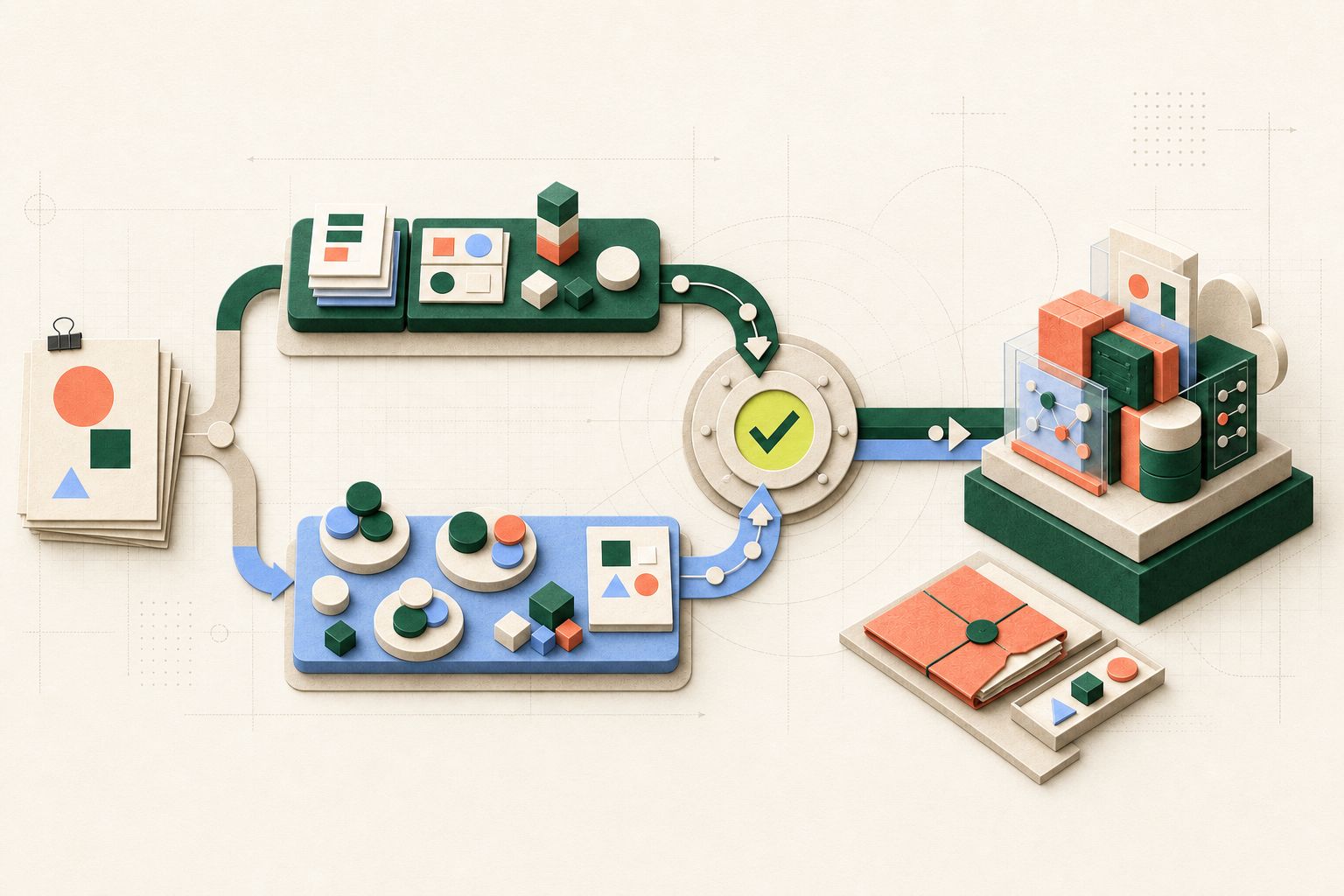
The word “outsourcing” hides materially different relationships. A buyer should know whether Outsourcing.ai is accountable for an accepted result, whether individual specialists are joining the buyer’s system, or whether the work is an independent provider search. We do not use vague network language to make those models look interchangeable.
| Model | What Outsourcing.ai does | What the buyer retains | Best opening step |
|---|---|---|---|
| Managed delivery | Scopes the engagement, proposes the team and work system, coordinates delivery, and presents acceptance evidence. | Product priority, material risk acceptance, production authority, and final acceptance. | Paid discovery or a bounded delivered pilot. |
| Embedded specialists | Helps define the role and working boundary, then supplies or coordinates named capacity under the agreed model. | Day-to-day direction, backlog, architecture authority, review capacity, and team integration. | A role scorecard plus a time-bounded trial objective. |
| Provider selection | Creates the brief, identifies candidates, normalizes evidence, and supports interviews or a pilot decision. | The provider contract, diligence decision, management model, and ongoing vendor relationship. | A comparable brief and weighted evaluation criteria. |
A project may move from one model to another, but the change should be deliberate. For example, discovery can reveal that the buyer already has enough product and engineering leadership for staff augmentation. It can also reveal that the buyer needs one accountable managed-delivery team rather than several individually managed contractors.
New applications, workflow systems, integrations, modernization, and focused feature delivery where the buyer can name a user or operational outcome.
Retrieval, classification, extraction, assistance, evaluation, and model-enabled workflows where data boundaries, failure handling, human review, and operating cost can be defined.
Process discovery, API integration, orchestration, review queues, observability, and exception handling—not merely a demonstration that works on the happy path.
Current-state mapping, risk reduction, prototype or technical spike, architecture options, backlog restructuring, and a continue, revise, or stop recommendation.
This list is a scope boundary, not proof that every request fits. We review the actual outcome, systems, data, timeline, budget, buyer availability, and risk before proposing work. Regulated, safety-critical, or highly specialized engagements may require independent qualified specialists or may be declined.
Related game-development specialty: For slot, casino, game-mathematics, gaming-platform, or certification-readiness work, we may propose Wizards, a related specialist studio under common ownership. That is a disclosed related-party path—not an independent provider recommendation—and the proposal must identify the contracting entity, named team, jurisdiction assumptions, delivery boundary, and commercial terms. Start with the game-development outsourcing guide to define the evidence gates first.
For most custom software and AI engagements, repositories, domains, cloud accounts, analytics, model-provider accounts, and other critical services should remain under client-governed ownership. Access should be role-based and removable. The agreement must state the actual intellectual-property, confidentiality, licensing, data-processing, support, and transition terms; a website page cannot substitute for the signed facts.
Delivery evidence should match the risk. That can include reviewed requirements, architecture decisions, code review, automated and exploratory test results, evaluation sets, security checks, dependency inventories, release records, observability, incident procedures, and an acceptance record. Our delivery approach is informed by the NIST Secure Software Development Framework and the CISA Software Acquisition Guide; the applicable controls still depend on the product and contract.
The target client is in the United States, but the right delivery capacity may be in any suitable country outside the U.S. We do not treat nationality as a quality score or promise that one location is universally cheapest. The decision should consider the exact overlap window, asynchronous handoff, communication demands, employment or contractor facts, data-transfer path, intellectual-property execution, language, holidays, currency mechanics, replacement process, and continuity plan.
Some projects benefit from nearshore overlap; others benefit from a deliberate overnight relay; still others need a specialist regardless of location. The proposal should name the actual people or roles and operating window rather than substituting a country label for a delivery plan. Use the country guides and U.S. buyer context to frame those questions.
We can describe verified capabilities, delivery methods, and engagement terms. We will not publish invented client counts, outcomes, certifications, rates, testimonials, or company relationships. A company name or logo appears only when the relationship is evidenced, the exact wording is accurate, the organization has granted naming permission, and a reviewer approves the specific release.
Prior experience also needs precise language. “A team member previously worked at Company X” is not the same as “Outsourcing.ai delivered for Company X.” A referral, technology account, informal collaboration, proposal, or shared industry does not create a client endorsement. This boundary protects both the buyer and the named organization.
We do not publish a universal project price. A credible budget depends on team allocation, duration, discovery, quality, security, infrastructure, buyer management, operations, handover, and uncertainty. The software development cost guide explains the complete model, while the cost calculator lets you use your own planning assumptions.
When uncertainty is high, the first commitment should buy evidence rather than pretend certainty: a discovery, prototype, integration spike, data assessment, evaluation baseline, or one accepted workflow. The result should enable a clear continue, revise, or stop decision.
Frequently asked questions
Both routes are possible. Outsourcing.ai can propose direct discovery or managed delivery, assemble disclosed specialists, or recommend an independent sourcing path. The proposal identifies the model before a paid engagement begins.
We serve U.S. buyers and can evaluate suitable delivery capacity in any country outside the United States. Location follows the project’s overlap, language, legal, data, security, continuity, and cost constraints rather than a universal country ranking.
No. Permission to respond is separate from permission to share with a third-party provider. If a disclosed partner or provider route fits, we identify that route and honor the sharing choice captured in the intake process.
Yes. A bounded paid discovery or pilot is often the most useful first commitment when requirements, data, integration feasibility, or delivery fit remain uncertain.
The preferred operating model places source repositories, domains, cloud accounts, analytics, and critical third-party services under client-governed ownership. The signed agreement must state the actual intellectual-property and access terms.
Only when the relationship is evidenced, the precise public claim is reviewed, and the organization has granted naming permission. No company name or logo is treated as proof merely because it appeared in a draft, proposal, or team member’s prior experience.
Start with fit
Share the outcome, current situation, timing, budget band, and material constraints. You do not need a finished specification or a preselected country.
Share the project