
Delaware buyer guide
Outsourcing software development from Delaware
A Delaware buyer guide to international software and AI outsourcing: entity facts, operating scope, processor roles, rights, incidents, authority, and exit.
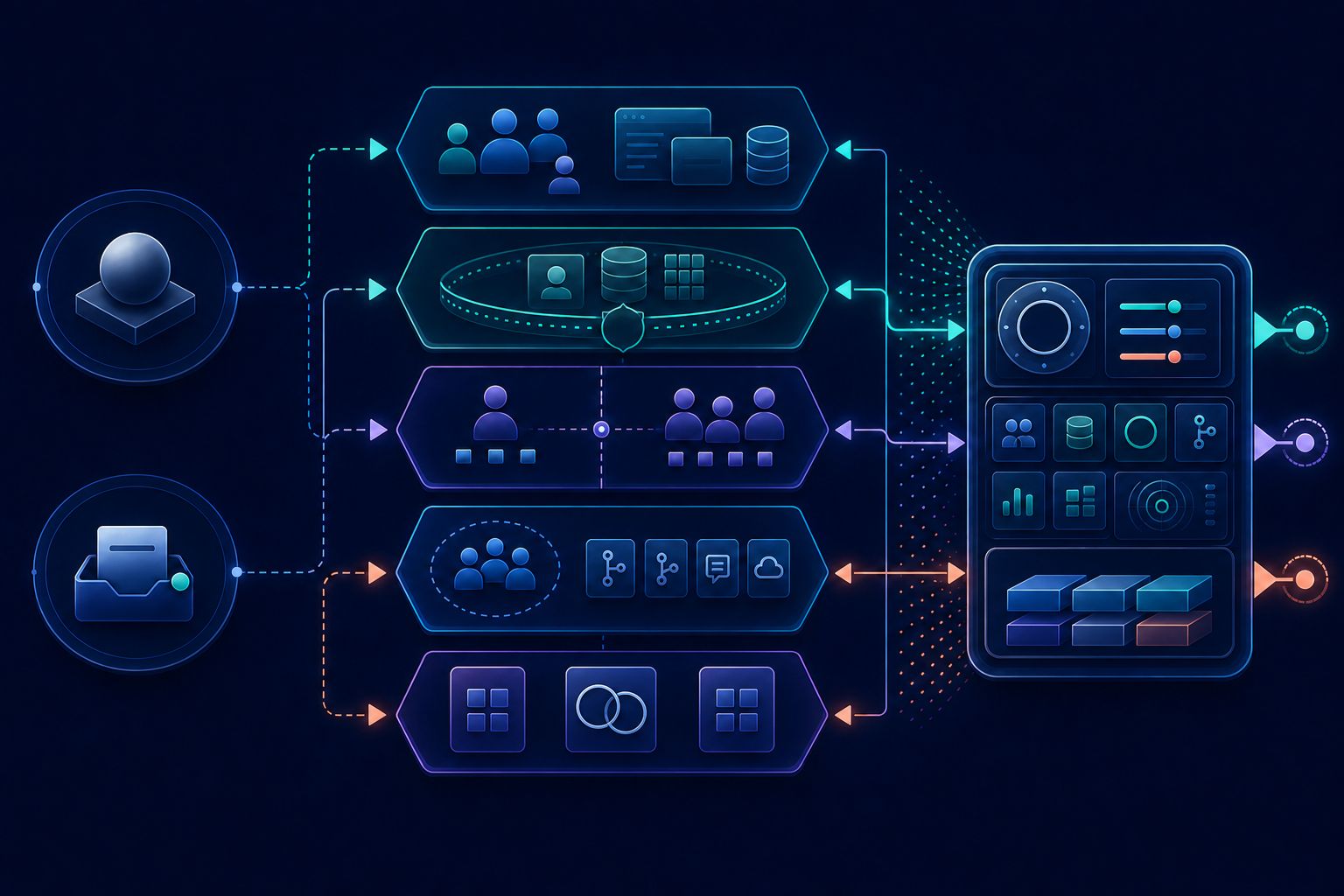
Delaware outsourcing at a glance
| Buyer condition | Decision before outside-U.S. work | Evidence to retain |
|---|---|---|
| An entity is formed in Delaware but operates elsewhere | Treat formation, status, registered agent, business location, workforce location, customer reach, and project delivery as separate facts | Exact legal name, file number, formation record, current status evidence where needed, registered-agent record, principal and operating locations, tax or licensing review owner, and dated source |
| A supplier proposal uses the buyer’s Delaware formation as its location | Replace the label with actual cities, people, systems, data sources, authority, and schedules | Buyer and provider entity graph, named-team roster, work-location manifest, system map, IANA zones, contract party, decision owners, and change log |
| The product reaches Delaware residents | Determine current Chapter 12D applicability, exemptions, data context, controller and processor roles, rights, consent, notices, assessments, and supplier terms with qualified review | Dated perimeter memo, annual thresholds, audience evidence, data inventory, role record, notice, request tests, opt-out test, consent record, assessment decision, and review trigger |
| A provider is intended to process personal data under instructions | Specify each operation and stop independent purpose or means changes | Binding processing schedule, purpose, fields, people, systems, retention, assistance, confidentiality, subprocessor objection and flow-down, assessment evidence, deletion or return, and actual configuration |
| The supplier uses coding assistants, models, analytics, monitoring, or ticketing services | Decide the role and authority of each service for each input and output; do not approve a category such as “AI tools” in the abstract | Tool inventory, account owner, provider terms, region, subprocessors, retention, training setting, input rules, output handling, logs, evaluation, deletion, replacement, and approval |
| A Delaware-resident request arrives | Route it through the controller’s authenticated or opt-out path while the provider performs only instructed search, correction, deletion, export, or suppression tasks | Receipt, identity or agent handling, system search, exceptions, actions, propagation, response, appeal, timing, approver, and evidence of continued suppression |
| A supplier detects a credible security event | Use an immediate operational alert and preserve evidence; do not wait for a final statutory conclusion or let the supplier make resident-notice decisions | Earliest signal, determination status, data and resident hypotheses, systems, identities, timestamps, evidence locations, containment, owner acknowledgement, scheduled updates, legal decisions, and notices |
| Production access or release authority crosses entities or countries | Give narrow, revocable authority over exact environments and immutable artifacts | Role grants, prerequisites, approvers, separation of duties, artifact digest, tests, provenance, deploy record, observation, rollback, revocation, exception, and acceptance |
| The engagement ends or a subprovider changes | Reconcile source, data, credentials, infrastructure, models, derived artifacts, records, and residual copies | Buyer export, dependency and secret rotation, access revocation, repository custody, data return/deletion, backup expiry, subprocessor confirmation, restore test, open-risk list, and buyer sign-off |
This table is operating triage. It does not conclude that a particular entity is in good standing, conducts business in Delaware, must qualify in another jurisdiction, is covered by Chapter 12D or 12B, has a particular controller or processor role, or can delegate a corporate decision. Those are fact-specific questions for the responsible qualified owners. The delivery system should make the facts legible enough for them to decide.
The distinct Delaware model: defeat the formation-state fallacy
Delaware appears in contracts, cap tables, financing records, vendor forms, app-store records, and privacy notices for companies whose workforces, customers, infrastructure, decision-makers, and suppliers may be distributed across many other places. That is not a defect. It is a warning against compressing several different facts into one convenient location label.
The formation-state fallacy occurs when a team treats “formed in Delaware” as proof of an operational fact it does not establish. Common examples include:
- putting Wilmington into a project plan even though no buyer decision-maker works there;
- scheduling supplier overlap from Eastern time because a Delaware registered agent has an address in the state;
- assuming a registered agent can accept product, privacy, security, release, or contract-change decisions;
- concluding that Chapter 12D applies solely because the buyer was formed in Delaware;
- concluding that Chapter 12D cannot apply because the buyer operates from another state;
- treating a formation record or free entity-search result as evidence of current status, good standing, ownership, officers, signatory authority, operating licenses, or physical operations;
- naming the contracting entity while leaving the entity that controls the product, data, infrastructure, or workforce unstated; and
- giving an overseas team access under a master agreement without identifying which buyer entity supplied the data, issued the instruction, accepted the release, or owns the deliverable.
Fix the problem with an entity-to-operation authority crosswalk. The crosswalk is a dated control record that connects each consequential project operation to the entity, role, person, place, system, data, authority, evidence, and exit path that actually govern it. It should be understandable by engineering, procurement, privacy, security, finance, and counsel without asking them to infer one domain from another.
Use seven fact layers
| Layer | What it answers | What it must not imply |
|---|---|---|
| Legal entity | Which exact entity exists and is proposed as a contract party? | Current good standing, beneficial ownership, operating location, license, authority, or project performance |
| Registered agent | Who receives service of process and specified entity communications at the required Delaware address? | General mailroom, customer support, privacy desk, security operations, product owner, signatory, or local delivery office |
| Operations | Where do the buyer’s people, systems, management, customers, and regulated activities actually sit? | That one headquarters address describes every employee, product, data set, or applicable rule |
| Product and people | Which individuals use or are represented in the service, and in what context? | That incorporation decides consumer residence, employment context, commercial context, or data sensitivity |
| Data role | Who determines purposes and means for each processing operation, and who acts under instructions? | A permanent role label for every service the supplier performs |
| Delivery | Which provider entity, named people, cities, tools, subprocessors, and environments perform each work package? | That a brand, marketplace profile, or sales office identifies the actual team or custody path |
| Authority and exit | Who can instruct, sign, approve, deploy, contain, notify, pay, accept, revoke, and close? | That one signatory owns every technical or statutory decision, or that access ends when an invoice ends |
The layers should link, but they should not collapse. If a supplier asks for “the Delaware address,” ask what decision the address supports. Service of process, tax registration, invoice delivery, privacy contact, breach notice, workplace, customer residency, data location, and project schedule can require different answers.
Build the crosswalk as an evidence graph
A spreadsheet can start the work, but a graph model reveals gaps. Use nodes for entities, people, work locations, systems, repositories, environments, datasets, consumer groups, provider tools, contracts, decisions, and evidence. Use explicit relationships such as:
- formed-as and represented-by-agent;
- operates-at, employs-at, and decides-from;
- offers-to, collects-from, and controls-operation;
- processes-for, instructed-by, and subcontracts-to;
- builds-in, accesses, deploys-to, and supports-from;
- may-sign, may-approve, may-release, and may-contain; and
- returns-to, deletes-from, revokes-at, and accepted-by.
Each relationship needs an owner, basis, effective date, evidence, review date, and invalidation trigger. A relationship is not true forever merely because it was true during procurement. A new operating city, product audience, data source, model host, provider affiliate, contributor, subprocessor, signatory, repository, or support path can change the graph.
The most useful output is a small number of unanswered questions. “Who is the controller?” is often too broad. “Which entity determines why support recordings are transcribed, which entity instructs the transcription provider, and who approves secondary model evaluation?” is answerable. The crosswalk should convert labels into operations that can be tested.
Separate formation, status, agent, and operations
The Delaware Division of Corporations explains that every Delaware business entity must maintain a registered agent in the state. Its formation guidance says the registered agent has a physical Delaware street address. The Division’s registered-agent page describes availability during normal business hours for accepting service of process. That is a precise and important function. It is not evidence that the entity has a product team, executive office, data center, engineering workforce, or delivery capability at the agent’s address.
The Division’s entity-information guidance also draws useful evidence boundaries. The free search returns limited entity details and includes active and inactive entities; the result itself does not provide entity status. A web status result is separately described and is not a certified good-standing record. Procurement should therefore match evidence strength to the decision rather than treating the easiest screenshot as universal proof.
Apply a decision-to-evidence ladder
| Decision | Minimum sensible evidence pattern | Additional verification when consequential |
|---|---|---|
| Normalize a proposal name | Exact legal name, jurisdiction, entity type, file or registration identifier, address source, and provider confirmation | Independent registry check and discrepancy resolution |
| Identify a Delaware formation | Division search details with date and the provider’s formation record | Appropriate certified copy or specialist review if the transaction requires it |
| Confirm current status for contracting | Current status evidence chosen for the commercial risk | Certified status or good-standing evidence when required by policy, financing, counterparty, or counsel |
| Identify the registered agent | Current official or filed agent record | Direct entity confirmation and routing test for a relevant communication |
| Prove operating location | Named-person roster, employment or contractor entity, city, work-system telemetry where proportionate, and management attestation | Independent diligence, site review, payroll/employment documentation, or specialist review when risk warrants |
| Prove signatory authority | Board, officer, delegation, power, or other applicable authority record reviewed by the right owner | Legal opinion, secretary certificate, incumbency evidence, or transaction-specific approval as advised |
| Prove delivery capability | Named team’s work sample, repository exercise, architecture discussion, security evidence, reference process, and paid milestone | Independent controls assessment, financial review, background checks, or customer reference with permission |
Do not ask for sensitive records without a reason. The buyer needs proportionate evidence, not an indiscriminate data room. Record who reviewed each item, what it proves, what it does not prove, when it expires, and which mismatch stops the deal.
Keep the registered agent out of the operating directory
Create separate directories for:
- Entity and service route: registered agent and any formal-notice destination required for corporate process.
- Commercial route: contracting, purchase order, invoice, insurance, and relationship owners.
- Product route: product owner, technical owner, architecture and acceptance owners.
- Privacy route: controller contact, request operations, appeals, assessments, consent, and notice owners.
- Security route: monitored alert channel, on-call responders, incident commander, evidence custodian, counsel, and communications owners.
- Release route: repository, build, infrastructure, production, rollback, and exception authority.
- Exit route: source, data, credentials, infrastructure, financial reconciliation, records, and final acceptance.
Test the routes. Send a non-sensitive exercise message, trigger an access review, simulate a rights request, revoke a temporary role, and run an incident tabletop. A correct address in a filing is not proof that the right operational owner will answer at 2 a.m.
Determine the privacy perimeter from conduct and people
The current Delaware Personal Data Privacy Act applies to persons that conduct business in Delaware or produce products or services targeted to Delaware residents and meet a preceding-calendar-year threshold: at least 35,000 consumers, excluding data processed solely to complete a payment transaction, or at least 10,000 consumers plus more than 20% of gross revenue from personal-data sales. The statute contains entity and data exemptions that require careful fact-specific review.
The formation state is not one of those threshold tests. A Delaware-formed company with no Delaware-targeted product may still face other state, federal, sector, contract, or destination-country duties. A company formed elsewhere may enter Chapter 12D’s perimeter through its Delaware conduct or resident-targeted product and threshold facts. Do not publish or engineer from either shortcut.
The Act defines a consumer as a Delaware resident acting outside listed commercial and employment contexts. That distinction belongs in the data inventory. A contact record can represent a shopper, account user, employee, applicant, contractor, business representative, child, patient, or another person. The same table may mix contexts. Ask what the individual was doing in the interaction; do not infer the answer from the email domain.
Write a dated perimeter memo
For each product or materially distinct service, record:
- exact buyer entities and their conduct or targeting relevant to Delaware;
- the preceding calendar year used and the method for counting consumers;
- payment-transaction-only exclusions in the threshold calculation, if relied upon;
- sale-related facts, revenue method, and review owner;
- consumer residence and individual-or-household context evidence;
- data categories, sensitive-data indicators, sources, purposes, recipients, and retention;
- entity, data, and activity exemptions being considered, with evidence and limitations;
- controller and processor conclusions by operation;
- rights, privacy-notice, consent, security, assessment, opt-out, contract, and incident capabilities;
- the legal reviewer, operational owner, source versions, conclusion date, and next review; and
- change events that reopen the decision.
Examples of change events include a Delaware marketing launch, an acquired customer list, a new consumer application, a loyalty program, targeted advertising, a data sale, a model that infers personal attributes, a precise-location feature, an under-18 audience, a processor that changes purpose, a new affiliate, or annual growth across a threshold.
Do not turn “not currently in scope” into permission for an uncontrolled supplier path. Data minimization, secure development, contractual instructions, incident readiness, and deletion evidence remain prudent and may be required by another source. A well-designed baseline is easier to activate than a rushed retrofit.
Classify controller and processor roles operation by operation
Chapter 12D defines a controller by purpose-and-means authority and a processor as a person processing on behalf of a controller. Its processor section makes the role determination expressly fact-based and contextual. A processor that starts determining purposes and means becomes a controller for that processing. This is why the crosswalk follows operations rather than vendor labels.
A software and AI supplier can occupy different roles in the same engagement:
| Supplier operation | Likely operating question | Evidence needed before role review |
|---|---|---|
| Implements a buyer-approved feature in a buyer repository with synthetic data | Is it acting only under documented build instructions? | Work order, data prohibition, repository permissions, design, tests, tool list, and access logs |
| Maintains a production database for the buyer | Which storage, support, backup, disclosure, and deletion choices are fixed by the buyer? | Processing schedule, architecture, regions, operators, subprocessors, retention, support logs, and return/deletion test |
| Sends errors to its own monitoring account | Is that recipient instructed and approved, and what data enters the logs? | Log schema, redaction test, account entity, purpose, retention, region, subprocessor, access, and deletion |
| Uses customer conversations to improve a provider model | Who decided that new purpose and the means? | Actual terms and settings, input lineage, consent or other authority analysis, role decision, disclosure, evaluation, and opt-out/deletion capability |
| Hosts an analytics dashboard under buyer instructions but benchmarks customers for its own product | Which processing remains instructed and which is independent? | Data separation, aggregation or de-identification controls, contract, public commitment, recipient constraints, and purpose records |
| Handles a consumer request for the buyer | Which actions can the supplier perform, and who makes exceptions or denials? | Request ticket, authentication boundary, system search, action instructions, evidence, exception owner, response owner, and appeal route |
The buyer should issue an instruction packet for every approved processing path. State the purpose, data, subjects, source, operations, systems, people, locations, duration, outputs, recipients, subprocessors, security, rights assistance, incident assistance, assessment support, return or deletion, prohibited uses, and change-control trigger. Then configure the technical system to match it.
Make the processor contract executable
The current statute calls for a binding controller–processor contract that states instructions, nature and purpose, data type, duration, and party rights and obligations. It also addresses confidentiality, controller-directed return or deletion, compliance information, subprocessor objection and written flow-down, and assessments. A clause alone cannot demonstrate that those controls work.
Map each term to an owner, system, evidence, and test:
| Contract promise | Operational owner | Proof exercise |
|---|---|---|
| Follow instructions | Product and privacy owners | Attempt an unapproved purpose or tool change and confirm the stop gate |
| Confidentiality | Provider entity and access owner | Reconcile named users to confidentiality and least-privilege records |
| Rights assistance | Privacy operations | Run access, correction, deletion, portability, third-party-category, opt-out, and appeal-related scenarios as applicable |
| Security and breach assistance | Security owners | Inject a credible event, preserve evidence, notify the buyer route, and produce scheduled updates |
| Assessment information | Privacy and assurance owners | Request the defined architecture, control, log, test, exception, and subprocessor evidence |
| Subprocessor control | Commercial and privacy owners | Propose a new subprocessor, exercise notice and objection, verify flow-down, and block access until approved |
| Return or delete | Data and exit owners | Export buyer data, delete approved locations, track backups and legal holds, and verify residual copies |
If the provider says a control is “standard,” ask for the actual tenant, account, environment, region, setting, owner, and test result. A policy can support evidence; it is not evidence that a particular delivery path follows the policy.
Build consumer rights as a production workflow
The current Delaware law describes rights to confirm and access processing, correct inaccuracies, delete data provided by or obtained about the consumer, obtain portable data in the covered circumstances, obtain categories of third parties to which data was disclosed, and opt out of targeted advertising, personal-data sale, and certain solely automated profiling. It generally requires a controller response without undue delay and no later than 45 days, subject to the statute’s extension and other conditions. A denied request enters an appeal process, with a response to the appeal no later than 60 days after receipt.
Those periods are outer legal concepts, not service-level targets for a supplier. If an international provider owns a data store or feature, waiting 44 days for its first search result leaves the controller little time to authenticate, resolve exceptions, review the response, propagate the action, and communicate. Contract for internal milestones that preserve the buyer’s decision window.
Use a rights-operation packet with these stages:
- Receive and classify. Capture request type, channel, date, claimed identity, agent status, products, and requested scope without exposing the request to unnecessary supplier staff.
- Authenticate or route the opt-out. Keep controller decisions about authentication, authorized agents, fraud, and exceptions with the designated owner. Do not make every supplier an identity-verification service.
- Resolve the entity graph. Determine which buyer entities, products, brands, accounts, and provider systems may hold relevant data.
- Issue narrow tasks. Give each processor only the identifiers and action needed for its system, with a due date and prohibited uses.
- Search lineage. Cover primary records, replicas, logs, tickets, recordings, analytics, embeddings, model inputs and outputs, feature stores, exports, caches, backups, and downstream recipients according to the applicable instruction and legal analysis.
- Apply the action. Access, correct, delete, export, suppress, or stop the specified operation. Distinguish immediate deletion from scheduled backup expiry and documented lawful retention.
- Reconcile. Confirm every system and subprocessor answered; investigate counts, formats, missing joins, and contradictory outcomes.
- Review and respond. Let the controller decide completeness, trade-secret limits, exceptions, denial, extension, appeal instructions, and communication.
- Prevent resurrection. Carry suppression or deletion intent through restored backups, data reimports, new processors, model pipelines, and future releases.
- Retain evidence. Keep a proportionate audit record without recreating the data that was removed.
Test the newer operational edges
As of this guide’s review date, the universal opt-out mechanism requirement is no longer a future planning item. The statute set a January 1, 2026 deadline for a controller to allow qualifying opt-out preference signals for targeted advertising or sale. Test the real website and application behavior: detection, residency and legitimacy logic, controller-specific conflict handling, propagation to advertising and sales systems, vendor signals, suppression, account reconciliation, and proof.
Consent withdrawal is another clock that suppliers can break. Chapter 12D requires an effective revocation mechanism that is at least as easy as the consent mechanism and cessation as soon as practicable, no later than 15 days after receipt. The buyer needs to know which systems receive the revocation, which provider can stop which operation, what remains for another authorized purpose, and how the change reaches backups or downstream tools.
The statute also contains specific protections for known consumers from age 13 through 17 in targeted-advertising and sale circumstances. Do not ask a development team to infer age policy from a generic “minor” label. Provide an approved age-assurance and consent design, data-minimization rules, test cases, fallback behavior, and escalation owner.
Create a regression suite before launch and after every material provider, identity, schema, model, advertising, analytics, or retention change. Include a person with records across two buyer entities, an authorized-agent opt-out, a portability request with derived fields, correction that must reach a processor, deletion with a lawful-retention question, a restored backup, a newly added subprocessor, consent revocation, a preference signal, and an appeal. The test should reveal the actual authority boundary—not simply produce green API responses.
Keep incident facts separate from notice authority
Delaware Chapter 12B requires reasonable procedures and practices for a person conducting business in the state that owns, licenses, or maintains covered personal information. Its breach definition and “determination of the breach” term are specific. The operational team should not wait to resolve those legal elements before sending a credible signal to the buyer.
Design two connected clocks:
- Operational clock: begins at the first credible anomaly or security signal. It drives preservation, safe containment, owner contact, fact collection, scheduled updates, and recovery.
- Legal clock: begins according to the applicable statute, contract, regulation, or other legal analysis. It drives resident, owner, regulator, customer, insurer, law-enforcement-delay, credit-monitoring, and communication decisions.
The operational contract can be faster and broader than the statutory trigger. It should say that an alert is not an admission or final breach determination. That gives engineers permission to surface uncertainty early while preserving decision authority for the appropriate owners.
Build the maintainer-to-owner interface
Chapter 12B states that a person maintaining covered computerized data it does not own or license must notify and cooperate with the owner or licensee immediately following determination of a breach of security. The safest provider interface starts earlier at a credible signal and can later record whether and when the statutory determination occurred.
Require an initial packet containing:
- provider and buyer entities, reporter, secure callback, system, tenant, environment, and account;
- earliest known observation, event times in UTC and local zones, and whether timestamps are reliable;
- what was observed, by whom or what, and what remains hypothesis;
- affected or potentially affected data categories, people, residents, systems, repositories, regions, and subprocessors;
- indicators of acquisition, access, modification, disclosure, destruction, encryption state, and possible key exposure;
- preserved logs, images, memory, tickets, messages, builds, credentials, network evidence, and chain-of-custody location;
- actions already taken, action authority, expected effect, observed effect, and rollback path;
- unavailable evidence, retention risk, destructive-action risk, and help needed;
- next update time even if there is no material change; and
- buyer acknowledgement, incident owner, counsel route, insurer route, and communication restriction.
The provider should not send personal information through an insecure emergency channel merely to prove urgency. Use a monitored alert with a secure evidence location and tested access. Do not let a registered-agent address or general invoice inbox stand in for the incident route.
Reserve downstream decisions
The current owner/licensee path generally speaks in terms of notice without unreasonable delay and no later than 60 days after determination, subject to listed exceptions. When more than 500 Delaware residents are to be notified, the statute addresses Attorney General notice no later than resident notice. It also contains a one-year credit-monitoring path for specified Social Security number breaches unless the described no-harm conclusion is reached, and a special notice method for credentials of an email account furnished by the notifying person.
These are not countdown labels for a project dashboard without qualified analysis. The actual facts, definitions, owner/licensee role, resident population, investigation, other laws, contractual terms, and law-enforcement requests matter. Keep the following decisions with named authorized owners:
- whether a statutory breach occurred and when determination happened;
- whether the harm exception or another exception applies;
- which residents and jurisdictions are included;
- whether another law requires a shorter period or additional recipient;
- whether law enforcement requested delay and how the request and release are documented;
- notice content, method, accessibility, language, sender, regulator or Attorney General route, and proof of delivery;
- whether credit monitoring is required and how enrollment information is delivered; and
- customer, employee, media, public, insurer, board, investor, and partner communications.
Run a tabletop with an international contributor, a provider manager, the buyer security owner, privacy owner, counsel route, technical owner, and communications owner. Test missing overlap, revoked credentials, provider-system compromise, unknown resident counts, encrypted data with possible key exposure, a subprocessor that answers slowly, and an email-account incident in which the affected address is an unsuitable notice channel.
Record actual work locations and sustainable clocks
Delaware operates on Eastern time, but a formation record does not prove that the buyer’s working team is in Delaware or even in one time zone. Start with named people and actual cities. A remote executive in California, product owner in New York, security owner in Texas, and registered agent in Delaware create four different facts; only three may matter to daily delivery, and the registered agent should not be scheduled into it.
For every buyer and provider participant, record:
- employing or contracting entity;
- country and city from which work is authorized;
- maintained IANA zone, not a hand-written UTC offset;
- ordinary local working window and protected non-working time;
- project dates, daylight-saving transitions, public holidays, leave, and backup;
- work types that need synchronous contact;
- decisions the person can and cannot make;
- secure contact and escalation route; and
- travel or location change that requires re-approval.
Calculate overlap for actual dates. America/New_York may be appropriate for a Delaware operating person, but it is not a substitute for identifying that person and city. Use the delivery city’s maintained identifier as well. A fixed “nine-hour difference” can become wrong when jurisdictions change clocks on different dates.
Protect three collaboration windows separately:
- Working overlap for discovery, architecture, review, and complex decisions.
- Authority overlap when someone can approve data access, exceptions, costs, merge, release, or rollback.
- Emergency reachability for credible incidents and severe service failures.
Not every contributor needs all three. Strong written packets can reduce working overlap. Authority can follow a planned schedule with backups. Emergency reachability needs a tested route, not permanently unhealthy hours for the full team.
Make location change-controlled
A provider’s country list is not enough. Require approval before a named person works from a new country or before work moves to another provider entity, affiliate, subcontractor, co-working environment, device-control model, cloud region, or support center. The change request should state what changes in employment or contracting, access, data, tools, clocks, tax or employment analysis, sanctions or export review, intellectual-property chain, privacy path, security, insurance, continuity, price, and exit.
Pause only the affected access while owners decide. A change-control system that can only approve everything or terminate the whole project encourages hidden workarounds. Design granular work packages so synthetic-data implementation can continue while a production-data location change is reviewed.
Choose the delivery model before the country
Country selection cannot repair a vague responsibility model. Decide who owns the outcome and how authority moves before comparing destinations.
| Model | Buyer retains | Provider supplies | Delaware crosswalk emphasis |
|---|---|---|---|
| Direct project delivery | Product purpose, restricted decisions, acceptance, and governance | Bounded outcome, delivery management, named team, evidence, and handover | Exact contracting and performing entities, deliverable ownership, acceptance authority, and complete exit |
| Staff augmentation | Backlog, architecture, daily management, integration, and usually release | Named capacity under buyer direction | Worker entity and location, tool path, repository access, instruction boundary, supervision, replacement, and knowledge custody |
| Managed team | Product priorities and governance | Stable team, delivery process, technical coordination, and metrics | Decision rights, team-change controls, system ownership, evidence cadence, and continuity |
| Specialist milestone | Problem definition, interfaces, and final acceptance | Narrow expertise, prototype, assessment, migration, or component | Input minimization, output rights, reusable materials, acceptance evidence, and handback |
| Independent-provider selection | All delivery governance after selection | Market options and provider proposals | Evidence comparability, no implied endorsement, relationship-claim controls, and buyer verification |
Outsourcing.ai can scope and deliver an eligible bounded software, automation, data, or AI project directly under the Outsourcing.ai brand. It can also coordinate disclosed specialists when a proposal identifies their entity, people, location, role, access, evidence, price, and exit, or help the buyer evaluate independent providers. The delivery mode must be explicit before the buyer interprets any methodology as a promise about a particular team.
Compare destinations by work-package fit
Do not rank countries with one blended hourly rate. Compare named teams and cities against the operation:
- India or the Philippines may support deep talent pools and deliberate follow-the-sun delivery when handoffs and authority are mature.
- Colombia, Mexico, or other Latin American locations may offer useful Eastern-time overlap, but city, team, holiday, entity, and work-schedule facts still need verification.
- Poland and other European locations can fit specialized engineering and a partial-day relay, subject to the named team’s actual schedule and data path.
- A multi-country team can improve continuity only if responsibilities, repository state, evidence, and backups are shared; otherwise it multiplies hidden dependencies.
These are hypotheses to test, not provider or country endorsements. Research destination-country employment or contractor classification, tax, privacy and transfer requirements, sanctions and export controls, intellectual-property formalities, government-access issues, sector restrictions, and enforceability with qualified specialists. WIPO’s directory can locate official intellectual-property offices; it does not answer the rights-chain question for the engagement.
Score each proposed team on relevant capability, proof, work location, sustainable overlap, communication, data and tool path, secure-development practice, rights support, incident readiness, financial resilience, full cost, travel, continuity, intellectual-property chain, and exit. Record the evidence date and reviewer.
Demand named-team and system evidence
Brand recognition, company formation, headcount, a sales deck, and a certification are weak substitutes for the actual delivery path. Ask the provider to identify:
- the contracting entity and every entity that will employ, contract, host, or subcontract the work;
- the named people, roles, seniority, city, schedule, language, allocation, start date, and backup;
- the work sample or exercise attributable to the proposed capability without violating another customer’s confidentiality;
- repositories, environments, devices, identity provider, ticketing, chat, code assistants, models, cloud, observability, and support tools;
- data entering each tool, account owner, region, retention, training or improvement terms, subprocessors, and deletion path;
- secure-development controls mapped to the actual workflow, including review, dependency integrity, secrets, provenance, builds, releases, vulnerabilities, and response;
- incident contacts, evidence preservation, containment authority, update cadence, and recovery exercise;
- source and intellectual-property chain from every contributor and reusable component to the buyer’s accepted deliverable;
- financial, insurance, and continuity evidence proportionate to the work; and
- exit artifacts, residual-copy handling, access revocation, transition assistance, and acceptance criteria.
Use NIST’s Secure Software Development Framework as one vocabulary for supplier conversations, not as a decorative claim. Select practices relevant to the product and request observable artifacts. A provider may use another credible framework; the important point is traceability from the requirement to implementation and evidence.
Verify claims without manufacturing relationships
If a provider names a customer, platform, software company, AI company, cloud, or partner, classify the claim. “Uses a product,” “has an employee with prior experience,” “is listed in a marketplace,” “completed work for a customer,” and “is an authorized partner” are different propositions. Require a source that directly supports the exact wording, scope, entity, date, and permission to publish.
Outsourcing.ai should not present recognizable company names as customers, partners, clients, affiliations, or team history until the evidence protocol is satisfied: relationship verification, exact claim, written naming and logo permission where applicable, current named review, and approval for the exact release. Product compatibility can be described factually without implying endorsement. This protects buyers from selecting a provider on borrowed credibility.
Price the complete operating system
Hourly rates are inputs, not total cost. Build a model with at least these components:
| Cost component | Questions to model |
|---|---|
| Delivery labor | Which named roles, rates, currencies, minimums, overtime rules, holidays, allocation assumptions, and rate-change terms apply? |
| Buyer labor | How much product, architecture, review, privacy, security, procurement, finance, counsel, and management time is required? |
| Coordination | What is the cost of overlap, handoffs, travel, translation, rework, queue time, and decision latency? |
| Tools and infrastructure | Which seats, model usage, cloud, environments, observability, security, data transfer, testing, and support charges are excluded? |
| Control evidence | What diligence, assessment, testing, scanning, accessibility, privacy, incident, insurance, audit, and documentation work is required? |
| Quality and acceptance | What review, evaluation, remediation, performance, reliability, user research, and production-hardening effort remains? |
| Entity and commercial setup | What contracting, qualification, tax, payment, currency, withholding, background, or specialist work may be needed? |
| Continuity and exit | What reserve covers replacement, knowledge transfer, data export, credential rotation, infrastructure transfer, residual obligations, and internal takeover? |
| Risk range | Which assumptions can change scope, timeline, quality, liability, data path, or destination, and what contingency is attached? |
Use a base case, plausible downside, and stop-loss case. Define measurable assumptions: accepted throughput, review ratio, defect escape, decision latency, rework, unavailable days, tool spend, and exit effort. A lower delivery rate can cost more if the buyer must reconstruct requirements, wait for decisions, or rebuild custody.
Do not convert a location stereotype into a productivity factor. Run a paid representative milestone. Measure accepted output and evidence from the named team. Update the model from observed work, then decide whether to expand.
Put entity and authority controls into the agreement
The master agreement, processing terms, security schedule, work order, and technical controls should tell the same story. At minimum, address:
- exact legal parties and notices, while keeping the registered-agent route distinct from operational routes;
- services, deliverables, non-goals, dependencies, acceptance, warranty, remediation, and change control;
- performing entities, named key people, work locations, replacements, subcontractors, and location changes;
- intellectual-property ownership, background materials, licenses, open source, contributor chain, moral-rights treatment where relevant, inventions, and handover;
- confidentiality, data categories, purposes, roles, instructions, systems, locations, security, consumer-rights assistance, assessments, subprocessors, incidents, return, deletion, and retention;
- tools, AI services, training or improvement restrictions, account ownership, model and prompt handling, human review, provenance, and output evaluation;
- repository, branch, build, signing, infrastructure, secrets, domain, monitoring, logs, deployment, rollback, and production authority;
- service levels, support hours, emergency reachability, continuity, disaster recovery, backups, and key-person risk;
- fees, currency, taxes, expenses, third-party charges, caps, invoices, disputed amounts, rate changes, and termination economics;
- insurance, liability allocation, indemnities, governing terms, dispute process, sanctions/export cooperation, and sector-specific requirements as advised; and
- termination, transition assistance, source and data export, credential rotation, residual-copy schedule, access revocation, open risks, and final acceptance.
Create an authority matrix beside the signatures
A valid agreement can still fail operationally when nobody knows who may decide. Record authority for each action:
| Action | Provider may prepare | Provider may execute | Buyer approval owner | Evidence before and after |
|---|---|---|---|---|
| Change design | Options and recommendation | Only within approved work order | Product or architecture owner | Decision record, assumptions, interfaces, tests, and acceptance update |
| Add tool or subprocessor | Due-diligence packet | No access before approval | Privacy, security, commercial, and technical owners as applicable | Terms, data, region, subprocessors, controls, objection, configuration, and inventory |
| Merge code | Pull request and review | According to repository policy | Named engineering authority | Commit, reviews, automated checks, provenance, and branch protections |
| Deploy production | Immutable candidate and runbook | Only within explicit release authority | Release owner | Digest, tests, security, dependencies, approver, deploy log, monitoring, and rollback |
| Contain incident | Recommended and pre-approved safe actions | Only within bounded authority or emergency terms | Incident commander | Signal, evidence, action, result, limits, update, and recovery |
| Communicate externally | Draft facts | No, unless explicitly authorized | Legal/privacy/communications owner | Audience, basis, approved wording, sender, delivery, and supplements |
| Accept deliverable | Evidence packet | No self-acceptance | Buyer product/commercial owner | Criteria, demonstration, defects, decision, payment trigger, and custody |
Do not assume the person who signed the agreement is the product owner, privacy controller contact, incident commander, or production approver. Do not assume the person who administers production may accept commercial delivery. The crosswalk should expose each difference.
Run a paid Delaware crosswalk pilot
Choose a milestone that is useful but recoverable: one integration, bounded workflow, migration slice, model evaluation, automation, or feature behind a controlled release. Prefer synthetic, masked, minimized, or otherwise approved data. Keep production authority with the buyer until the pilot proves the path.
Before the pilot
- normalize the buyer and provider entity graph;
- verify formation, current status evidence appropriate to the decision, registered-agent route, contract party, operating locations, and signing authority separately;
- document the product audience and dated Delaware privacy-perimeter decision;
- map each data operation, controller instruction, processor, subprocessor, tool, location, retention, rights action, incident route, and exit;
- define outcome, non-goals, acceptance tests, architecture boundaries, repository, environment, build and release path;
- name the provider team, buyer owners, backups, clocks, communications, and change triggers;
- create rights, incident, access-revocation, rollback, and exit exercises; and
- price the complete pilot and scale case.
During the pilot
Require small accepted batches. Track decisions as durable records. Reconcile the people doing the work to the approved roster. Observe whether data enters only approved tools, whether the provider challenges an unnecessary field, whether build provenance is reproducible, and whether the buyer can inspect the evidence without a provider-guided screen share.
Inject at least four tests:
- Entity mismatch: place a plausible but wrong buyer or provider affiliate into a work order and confirm the team stops it.
- Purpose drift: propose using a sample in an unapproved model or analytics service and confirm technical and human controls block it.
- Rights or incident event: issue a controlled request or credible signal and measure routing, evidence, authority, and response.
- Provider absence: remove the primary contributor and verify that the buyer or approved backup can build, inspect, roll back, export, and continue.
Score the result
| Dimension | Pass evidence |
|---|---|
| Entity truth | Contracting, controlling, performing, hosting, and paying entities are unambiguous and independently checked where consequential |
| Operating truth | Actual people, cities, schedules, systems, tools, and access match the approved crosswalk |
| Role discipline | Every personal-data operation follows documented purpose and means authority; attempted drift stops |
| Delivery quality | Accepted outcome meets functional, performance, security, accessibility, reliability, and maintainability criteria |
| Rights readiness | Applicable request, opt-out, consent-revocation, deletion, and appeal-support paths return complete evidence |
| Incident readiness | A credible signal reaches the buyer immediately through the tested secure route with preserved decision-ready facts |
| Authority | Merge, release, containment, communications, acceptance, and payment decisions remain with named authorized owners |
| Custody and exit | Buyer can build, deploy, restore, revoke, export, replace, and continue without hidden provider dependence |
| Economics | Observed accepted cost and buyer effort fit the modeled range |
Scale only the dimensions that pass. Remediate and retest a narrow failure. Stop if the provider hides the actual entity or team, uses unapproved systems, cannot explain data custody, resists buyer-controlled repositories, claims authority it does not have, or cannot return a reproducible evidence packet.
Delaware outsourcing red flags
- “We are a Delaware company” is offered as the answer to where people work or data is processed.
- A registered-agent address appears as headquarters, delivery office, privacy desk, and incident contact without separate evidence.
- A free entity-search result is described as proof of current good standing, ownership, or authority.
- The proposal names a brand but not the contracting and performing entities.
- “Our global team” replaces a named roster, cities, schedules, tools, and backup plan.
- One controller or processor label is applied to every supplier operation without a purpose-and-means analysis.
- The data-processing schedule permits vague “business purposes,” provider improvement, or new tools without approval.
- AI services are allowed by category rather than exact service, account, terms, input, retention, training, region, and subprocessor.
- Consumer requests depend on manual searches by one person or cannot reach logs, embeddings, exports, and subprocessors.
- A universal opt-out signal is acknowledged in policy but not tested in production behavior.
- The provider waits for confirmed severity or legal classification before reporting a credible incident.
- A general inbox or registered agent is the only security escalation route.
- The provider can deploy, alter logs, approve its own work, and accept the same deliverable.
- Company names are used as customers or partners without direct evidence and permission for the exact claim.
- The buyer cannot reproduce a build, rotate secrets, inspect infrastructure, export data, or continue during provider absence.
- Exit means “we will send a zip file” rather than tested custody and residual-copy reconciliation.
Frequently asked questions
Can a Delaware company outsource software development overseas?
Yes. Start with the exact contracting and operating entities, applicable restrictions, outcome, named team, locations, data and tools, processing roles, intellectual-property chain, authority, evidence, cost, continuity, and exit. Use qualified review for legal, tax, employment, privacy, export, sector, and destination-country questions. Prove the path through a bounded paid pilot.
Does Delaware incorporation mean the company operates in Delaware?
No. Formation and operations are different facts. The Delaware Division of Corporations requires a registered agent and maintains entity records, but those facts do not establish where executives, employees, customers, systems, or suppliers operate. Verify the fact needed for the decision.
Is a Delaware registered agent the company’s local office?
Not necessarily. Official guidance describes a physical Delaware address and availability for accepting service of process. The registered office may differ from the place of business. Do not use it as evidence of a product, engineering, privacy, security, customer-support, or delivery office without independent proof.
Does the free Delaware entity search prove good standing?
No. The Division states that its free search includes active and inactive entities and does not provide entity status. It separately describes web status information and notes that it is not a certified good-standing record. Match the evidence to the transaction and qualified advice.
Does the Delaware privacy law apply to every Delaware corporation?
No. Current Chapter 12D applicability turns on conduct or resident targeting, preceding-year thresholds, and the statute’s exemptions and definitions—not formation alone. A qualified reviewer should assess the exact entity, product, consumer, data, and processing facts.
What are the main Delaware consumer privacy thresholds?
The current statute addresses persons conducting business in Delaware or producing products or services targeted to Delaware residents that, in the preceding calendar year, controlled or processed at least 35,000 consumers excluding payment-transaction-only data, or at least 10,000 consumers and derived more than 20% of gross revenue from personal-data sales. Exemptions and definitions matter.
Is an outsourced development company always a processor?
No. The role is fact-based for each processing operation. A provider following controller instructions may be a processor for that operation; one that independently determines purposes and means can be a controller for that processing. The contract, product behavior, settings, data use, and actual authority must agree.
What must a Delaware controller–processor contract cover?
The current processor section addresses binding instructions, nature and purpose, data type, duration, party rights and obligations, confidentiality, controller-directed return or deletion, compliance information, subprocessor objection and flow-down, and assessments, plus processor assistance. Qualified owners should apply the full current text. Translate every applicable promise into a system, owner, artifact, and test.
How fast should an overseas provider report a suspected incident?
Contract for an immediate or deliberately short operational alert when there is a credible signal, without waiting for final severity or a legal conclusion. Chapter 12B contains an “immediately following determination” maintainer-to-owner path, but its application is fact-specific. A faster internal route protects the authorized party’s decision window.
Is every Delaware breach notice due in 60 days?
Do not use that as a universal rule. Chapter 12B’s owner/licensee provision includes a without-unreasonable-delay and no-later-than-60-days path after determination, with listed exceptions, and other laws may require shorter timing or different recipients. The definitions, roles, facts, resident population, investigation, and other applicable obligations require qualified analysis.
What changed after January 1, 2026 under the DPDPA?
The universal opt-out preference-signal deadline has arrived, and the statute’s previously mandatory 2025 cure process no longer applies in the same way. Beginning in 2026, the Department of Justice may consider listed factors when deciding whether to offer an opportunity to cure. Do not plan around a guaranteed cure period.
Which country is best for outsourcing from Delaware?
There is no universal best country. Compare named teams by skill, evidence, city, sustainable dated overlap, language, work style, data and tool path, intellectual-property chain, security, incident response, continuity, complete cost, destination constraints, travel, and tested exit. Match the country to the work package after choosing the delivery model.
Can Outsourcing.ai deliver the project directly?
For an eligible bounded engagement, Outsourcing.ai can scope and deliver software, automation, data, and AI work directly under the Outsourcing.ai brand, coordinate disclosed specialists when the approved proposal requires them, or help the buyer evaluate independent providers. The proposal should state the mode, entities, people, locations, systems, data, authority, evidence, acceptance, price, and exit.
Does Outsourcing.ai have a Delaware office or named Delaware clients?
This page makes no such claim. It targets the decisions of Delaware-formed and Delaware-operating buyers. Customer, partner, or prior-team names remain unpublished unless the exact relationship, evidence, permission, wording, current named review, and release approval are documented.
What belongs in a first Delaware outsourcing brief?
Include the buyer and provider entity graph, formation and status evidence appropriate to the decision, registered-agent route, actual operating cities and clocks, product audience, privacy perimeter, data operations and roles, named team, tools and subprocessors, outcome, non-goals, acceptance, rights support, incident route, source and IP custody, release authority, full cost, change triggers, continuity, and exit.
Build the first entity-to-operation packet
Start with one representative operation, not the whole enterprise. Use the project brief generator to define the outcome, the provider scorecard to compare evidence, the RFP guide to expose entities and named work locations, the contract checklist to translate roles into terms, and the source-code and IP guide to structure custody.
For a neighboring privacy-operating model, see the Connecticut processor-evidence guide. For evidence continuity across hosted systems, use the New Jersey guide. For work that may inherit government, CUI, federal-clause, or export boundaries, start with the Virginia contract-inheritance guide and obtain qualified review.
Then choose an explicit path: ask Outsourcing.ai to scope and deliver the bounded pilot, ask it to coordinate disclosed specialists under the approved crosswalk, or use the evidence model to select an independent provider. In every path, the buyer should retain its product purpose, legal conclusions, restricted data decisions, corporate approvals, consumer communications, production policy, and final acceptance with the correctly authorized owners.
Evidence ledger
Sources used on this page
- How to Form a New Business Entity — Delaware Division of Corporations. Supports: Current official formation overview, including entity choices, the requirement to obtain and maintain a Delaware registered agent, the registered agent's Delaware street-address requirement, filings, status documents, and the Division's legal-advice limitation. Direct source; independently sourced; commercial relationship: none. Verified 8/15/2026 by Outsourcing.ai Editorial Team. Accessed 8/15/2026.
- More Information — Business Entity Search and Status — Delaware Division of Corporations. Supports: Current official explanation of the limited information returned by the free entity search, its inclusion of active and inactive entities, and the distinction between search results, entity status, and a certified good-standing record. Direct source; independently sourced; commercial relationship: none. Verified 8/15/2026 by Outsourcing.ai Editorial Team. Accessed 8/15/2026.
- Registered Agents — Delaware Division of Corporations. Supports: Current official explanation that a registered agent maintains a Delaware street address and office available during normal business hours to accept service of process, plus the State's due-diligence disclaimer for its agent list. Direct source; independently sourced; commercial relationship: none. Verified 8/15/2026 by Outsourcing.ai Editorial Team. Accessed 8/15/2026.
- Delaware Code, Title 6, Chapter 12D — Delaware Personal Data Privacy Act — Delaware General Assembly. Supports: Current applicability, definitions, consumer rights, controller duties, processor assistance and contract terms, data-protection assessments, universal opt-out mechanism, fact-based role determination, enforcement, and post-2025 discretionary cure provisions. Direct source; independently sourced; commercial relationship: none. Verified 8/15/2026 by Outsourcing.ai Editorial Team. Accessed 8/15/2026.
- Business — Delaware Personal Data Privacy Act — Delaware Department of Justice. Supports: Maintained official business guidance on the Act's January 1, 2025 enforcement start, controller and processor framing, transparency, minimization, security, accountability, consumer requests, and processor evidence. Direct source; independently sourced; commercial relationship: none. Verified 8/15/2026 by Outsourcing.ai Editorial Team. Accessed 8/15/2026.
- Frequently Asked Questions — Delaware Personal Data Privacy Act — Delaware Department of Justice. Supports: Maintained official guidance on Delaware-resident and individual-or-household context, applicability thresholds, controller decision authority, processor instruction boundaries, and privacy-notice coverage. Direct source; independently sourced; commercial relationship: none. Verified 8/15/2026 by Outsourcing.ai Editorial Team. Accessed 8/15/2026.
- Delaware Code, Title 6, Chapter 12B — Computer Security Breaches — Delaware General Assembly. Supports: Current reasonable security requirement, breach and determination definitions, immediate maintainer-to-owner route, resident-notice timing and exceptions, Attorney General threshold, Social Security number monitoring path, and email-account credential notice method. Direct source; independently sourced; commercial relationship: none. Verified 8/15/2026 by Outsourcing.ai Editorial Team. Accessed 8/15/2026.
- IANA Time Zone Database — Internet Assigned Numbers Authority. Supports: Maintained time-zone identifiers and transition rules for calculating dated overlap between the buyer's actual operating locations and every international delivery city. Direct source; independently sourced; commercial relationship: none. Verified 8/15/2026 by Outsourcing.ai Editorial Team. Accessed 8/15/2026.
- Secure Software Development Framework — National Institute of Standards and Technology. Supports: Maintained secure-development methodology for supplier requirements, protected environments, provenance, release integrity, vulnerability response, and buyer-supplier evidence. Direct source; independently sourced; commercial relationship: none. Verified 8/15/2026 by Outsourcing.ai Editorial Team. Accessed 8/15/2026.
- Incident Response Recommendations and Considerations for Cybersecurity Risk Management — National Institute of Standards and Technology. Supports: Current incident-response methodology for preparation, detection, response, recovery, improvement, and communications without treating a framework as Delaware legal advice. Direct source; independently sourced; commercial relationship: none. Verified 8/15/2026 by Outsourcing.ai Editorial Team. Accessed 8/15/2026.
- Directory of Intellectual Property Offices — World Intellectual Property Organization. Supports: Official destination-country intellectual-property office links for researching contributor and rights-chain questions without assuming one Delaware agreement resolves every jurisdiction. Direct source; independently sourced; commercial relationship: none. Verified 8/15/2026 by Outsourcing.ai Editorial Team. Accessed 8/15/2026.
Next scheduled review: October 15, 2026. Corrections: hello@outsourcing.ai.