
Virginia buyer guide
Outsourcing software development from Virginia
A Virginia buyer guide to international software and AI outsourcing: contract inheritance, CDPA processing, Commonwealth systems, CUI, CMMC, incidents, and release evidence.
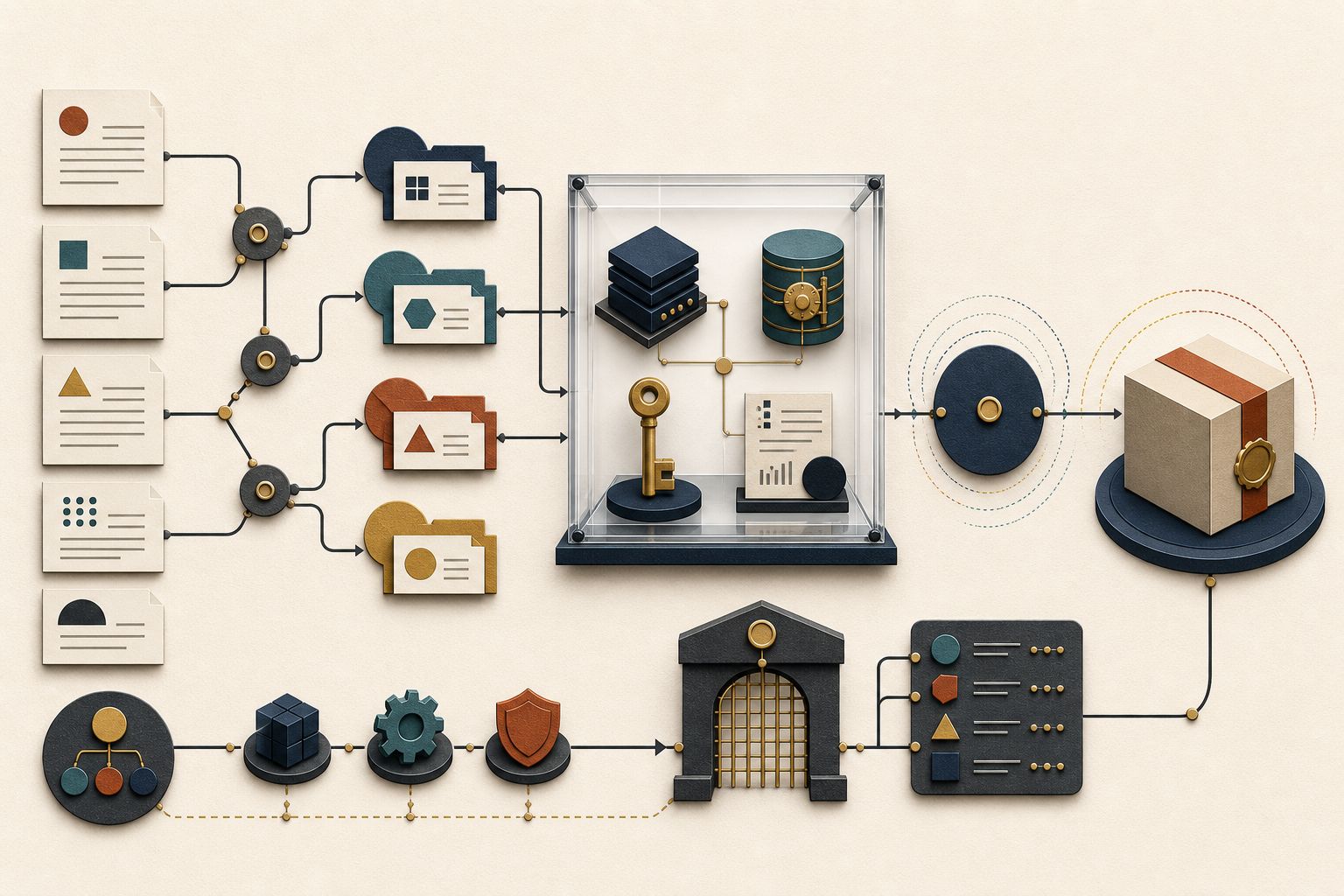
Virginia outsourcing at a glance
| Work-package signal | Buyer decision before supplier access | Evidence to retain |
|---|---|---|
| Ordinary commercial product or internal tool with no regulated or customer-restricted data | Apply proportional delivery, security, IP, continuity, and exit controls without claiming federal, Commonwealth, or CDPA requirements | Scope, data classification, named team, approved tools, buyer-owned repository, acceptance, release, support, and exit records |
| Provider processes personal data under a Virginia CDPA controller’s instructions | Convert the controller-processor relationship into executable instructions, assistance, confidentiality, assessment, deletion or return, and subprocessor controls | Applicability record, role analysis, processing schedule, rights tests, security evidence, assessment assistance, subprocessor chain, and closure |
| Processing may involve known children, sensitive data, precise geolocation, sale, targeted advertising, profiling, or another assessed activity | Stop generic intake and obtain the current purpose, consent, necessity, retention, product behavior, and assessment decision | Population and context, fields, purpose, consent or other authority, minimization, settings, assessment, tests, owner, and approval |
| Supplier will access a Commonwealth system or Commonwealth data | Read the actual agreement and current VITA/agency materials; map agency accountability into documented third-party controls and oversight | Contract and standard versions, system/data classification, controls, roles, locations, incident route, assessment/audit evidence, data return, and exceptions |
| Federal work uses only public information or ordinary commercial inputs | Preserve the classification decision; do not label ordinary company information FCI or CUI merely because the customer sells to government | Contract lineage, information source, government-purpose analysis, markings, contracting-owner confirmation, and review trigger |
| Contract or subcontract requires processing, storage, or transmission of FCI or CUI | Identify the exact clause, required CMMC level or status, approved system boundary, current identifiers/assessments, annual affirmation, and flow-down before award or access | Prime-to-subcontract clause map, CMMC UID where required, assessment/status evidence, system security plan references, approved personnel/tools, and continuous-compliance owner |
| DoD covered defense information is in scope | Follow the contract-specific DFARS path, including the applicable NIST version, cloud conditions, 72-hour report capability, 90-day preservation, and flow-down | Covered-system boundary, data and markings, incident credential and contacts, evidence-preservation plan, cloud basis, subcontract language, and exercise result |
| A CUI item may also be export controlled | Treat CUI handling and export authorization as separate decisions; do not infer that CMMC status authorizes foreign-person access | CUI category, dissemination controls, export classification, nationality/person analysis, license or exception decision, counsel/empowered official approval, and access logs |
| International contributors can build a component without restricted inputs | Create an unrestricted lane using synthetic or approved deidentified fixtures, interface contracts, isolated environments, and buyer-controlled integration | Fixture provenance, schema, prohibited fields, environment and tool inventory, tests, signed artifact/provenance evidence, acceptance, and restricted-side integrator |
| An incident is suspected | Activate every applicable clock and owner from one fact packet; the supplier’s first notice should not wait for a complete root cause | Discovery time, affected system/data, contract lanes, compromise review, containment, contacts, report IDs, preserved media, notices, updates, and decisions |
| Virginia and an overseas city collaborate across clocks | Calculate actual overlap using America/New_York and the delivery city’s maintained IANA zone for each milestone date | Named cities and zones, dated overlap, daylight transitions, decision windows, backup authority, handoff, and sustainable-hours review |
This is a routing table, not an eligibility determination. A work package can activate several rows. A consumer product operated for a federal customer may include CDPA-covered consumer data, contract-restricted data, and ordinary public documentation. Conversely, a Virginia startup does not become a defense contractor merely because it is near a federal customer or hires an overseas developer. The buyer must attach each control to a current source and a fact.
Build a contract-inheritance graph before the project brief
The most important Virginia outsourcing artifact is not a country shortlist. It is a graph showing how an obligation reaches the proposed work.
Start at the source node: a statute, customer promise, prime contract, task order, solicitation, statement of work, data-use agreement, security addendum, Commonwealth standard, or internal product baseline. Follow that source through each legal entity and contractual instrument to the work package, data, system, people, tools, incident path, release authority, and exit obligation. Record where the path stops. A clause in the prime contract is not automatically present in every unrelated task, and an obligation cannot be assumed to disappear merely because a subcontract uses a commercial label.
Use one row per inherited requirement:
| Graph field | Question | Release evidence |
|---|---|---|
| Source and version | Which current or contract-incorporated text creates the requirement? | URL or controlled copy, clause/section, effective or solicitation date, version, owner, review date |
| Applicability fact | What fact connects that source to this work package? | Customer, legal entity, role, system, information, purpose, marking, contract line item, and documented decision |
| Flow-down path | Through which prime, tier, affiliate, provider, or tool must the requirement travel? | Contract chain, exact language, deviations, approvals, responsible parties, and effective dates |
| Information boundary | What is public, ordinary confidential, personal, FCI, CUI, covered defense information, export controlled, or otherwise restricted? | Inventory, source, category/marking, classification owner, lineage, samples, and prohibited combinations |
| System boundary | Which components process, store, transmit, or protect the information? | Diagram, accounts, repositories, endpoints, networks, logs, backups, support systems, integrations, and boundary owner |
| People boundary | Which legal entities and named people may access or administer the boundary? | Role, employer, citizenship or status review where applicable, location, screening, training, least privilege, and approval |
| Tool and subprocessor boundary | Which services receive content, metadata, telemetry, prompts, artifacts, credentials, or support access? | Tenant/configuration, region, terms, flow-down, assessment, retention, model-training setting, and change notice |
| Assessment and status | Which current evaluation, identifier, affirmation, audit, or buyer review must exist? | Scope, result, date, assessor, exceptions, remediation, expiry, and relationship to the exact system |
| Incident route | Who must know what, how fast, in what form, and with which preserved evidence? | 24/7 contacts, clock trigger, initial fields, portal/credential readiness, media plan, update cadence, and drill |
| Release and exit | Who accepts, integrates, deploys, supports, returns, deletes, or preserves the result? | Acceptance record, artifact identity, provenance, production authority, export, revocation, retained evidence, and destruction/return proof |
This graph prevents three expensive category errors. First, it prevents a team from applying “CMMC” as a company-wide adjective when the operative requirement attaches to particular contractor information systems and contract performance. Second, it prevents an unrestricted supplier from receiving CUI simply because the supplier can write secure code. Third, it prevents a security team from blocking useful international delivery that can occur safely outside the restricted boundary with approved fixtures and a controlled handoff.
Assign a named contracting owner and a named system owner. Neither can substitute for the other. The contracting owner confirms clauses, customer direction, flow-down, and notices. The system owner confirms architecture, actual data movement, identity, logging, evidence, and release. Privacy, export, procurement, security, engineering, and product owners join when their facts activate a lane.
Classify information before classifying countries
Do not begin with “Which countries are allowed?” Begin with “What information and authority does this task require?” One provider may perform several packages under different boundaries, and one country decision can change when a field, customer, system, or contract changes.
Build an information register with at least these classes:
- Public and intentionally releasable material. Public documentation, open-source dependencies under their licenses, public APIs, and buyer-approved public examples. Confirm that “public” describes the actual item, not a similar item.
- Ordinary confidential business information. Roadmaps, source code, pricing, credentials, unreleased designs, customer lists, and operational logs that need contractual and security controls but are not made CUI by the company’s preference alone.
- Virginia personal data. Data whose role, consumer context, scope, exclusions, purpose, and product behavior may activate the CDPA or another privacy/security rule.
- Commonwealth data or systems. Information or technology governed by the actual public-body agreement, agency direction, current VITA materials, data classification, and other incorporated requirements.
- FCI or CUI. Federal information identified through the contract and authoritative program process, not through guesswork. Record the CUI category and any specified authority or dissemination control.
- Covered defense information. Information meeting the applicable DFARS definition and contract conditions, with the covered contractor information-system boundary recorded.
- Export-controlled or otherwise restricted material. Information that needs a separate authorization decision about release, including foreign-person access. The CUI Registry includes an Export Control category, but CUI is broader than export-controlled information and export controls can require analysis beyond a CUI marking.
For each item, record its authoritative source, creator, customer, contract, marking, category, owner, permitted purpose, approved recipients, systems, retention, decontrol or reclassification path, and reviewer. If markings are missing or inconsistent, stop and use the contracting and information owners’ formal resolution route. A developer should not make a unilateral classification decision from a filename.
Keep classification out of ordinary chat and ticket labels when those systems are not approved for the underlying details. A ticket can reference a controlled record by identifier and contain only the minimum releasable task description. This allows the delivery system to coordinate work without copying restricted content into every notification, search index, AI assistant, analytics stream, or support tool.
Keep the Virginia consumer-data lane executable
The Virginia CDPA lane is based on role and processing facts, not the supplier’s location. Before treating a provider as a statutory processor, record the contracting entities, current scope analysis, consumer context, data exclusions, controller purposes, and the operations performed under instructions. The Act contains thresholds and exemptions; a Virginia address alone does not settle applicability.
When a provider processes personal data on behalf of a controller, Section 59.1-579 requires a binding contract that clearly sets out processing instructions, nature and purpose, data type, duration, and party rights and obligations. It also addresses confidentiality, deletion or return at the controller’s direction unless law requires retention, compliance information, reasonable assessments or an independent assessment report, and written subprocessor obligations. The controller/processor determination remains fact based. If a provider decides a new purpose or ceases following instructions, a contract label cannot hide the operational role change.
Turn those requirements into a controlled processing schedule:
| Processing instruction | Operational field |
|---|---|
| Approved purpose | User outcome, business process, prohibited secondary uses, decision owner, and change route |
| Data and people | Exact fields, derived data, residency/context, known-child decision, sensitivity, source, and exclusions |
| Operations | Collect, access, infer, embed, train, test, host, transmit, support, disclose, export, delete, or return |
| Systems and locations | Tenant, repository, region, endpoint, backup, log, support path, country/city, and environment |
| Authorized people | Named role, legal employer, location, access level, confidentiality, training, and review date |
| Assistance | Consumer-rights search/action, security, incident, assessment, regulator or controller evidence, and response owner |
| Subprocessors | Entity, service, data/metadata, purpose, location, terms, approval/change process, and exit dependency |
| Closure | Active-copy return/deletion, backup expiry, legal hold, derived artifacts, access revocation, evidence, and attestation |
Test the schedule against real product paths. A privacy export that ignores support attachments, embeddings, derived profiles, model-evaluation stores, or a supplier’s approved troubleshooting copy is not proven complete. A deletion action that removes the primary record but leaves it in a search index or retry queue needs an explicit and defensible lifecycle. The buyer should retain a test fixture, expected result, actual result, exceptions, owner, and remediation.
Current Virginia controller duties also make precise purpose and population especially important. Sensitive-data processing requires the relevant consent path. Current Section 59.1-578 contains restrictions involving the sale of precise geolocation and protections for known children that reach targeted advertising, sale, significant profiling, necessity, compatible purpose, retention, and precise-geolocation behavior. Do not translate this into a vague “kid safe” ticket. Record how age or knowledge is determined, which product paths change, what is prohibited, how geolocation is collected or signaled, how retention ends, and how tests prove the behavior.
For processing that requires a data protection assessment, the controller must own the decision and evidence. A supplier can provide system facts, threat analysis, mitigations, and test results; it should not silently approve the controller’s purpose. Link the assessment to a precise feature and version. Revisit it when purpose, model, data, population, recipient, profiling consequence, security control, or supplier chain changes.
Treat Commonwealth work as a separate agreement lane
“Virginia public sector” is not one universal control set. Identify the public body, procurement path, contract, incorporated VITA rules or standards, agency-specific requirements, system classification, data owner, and exceptions. A subcontract supporting a Commonwealth agency may inherit obligations that do not apply to the supplier’s commercial customers.
That source-by-source method also prevents a regional shortcut. The South Carolina clause-activation guide shows a neighboring but different public-work model: its current procurement compendium is a clause library, so location-of-data and offshore-performance restrictions are activated only when the actual solicitation and contract include them. Virginia and South Carolina both require contract tracing; neither state’s public-sector materials should be copied into an unrelated private project or treated as interchangeable.
VITA’s current policy directory identifies the Commonwealth standards buyers should inspect. SEC530-01.2 states that agency heads remain accountable when covered services come from third parties and that agencies must enforce compliance through documented agreements and oversight. That is a strong design instruction for outsourcing: the agency cannot outsource accountability, and the provider cannot substitute a marketing security page for contract-scoped evidence.
Create a Commonwealth control annex with:
- the public body’s named contract, data, system, privacy, security, and incident owners;
- the current policies and standards incorporated by the agreement, plus the rule for later versions;
- the system inventory and boundary, data classification and sensitivity, locations, interconnections, support paths, and shared-control allocation;
- supplier and sub-tier responsibilities, proof method, reporting schedule, access review, vulnerability handling, secure-development evidence, and corrective-action route;
- suspected-breach notification language that gives the agency immediate visibility and preserves its role in investigation and external-reporting decisions;
- data ownership, export format, the contract-specific return period, deletion, media removal, retention/legal hold, and verification; and
- exception authority, expiration, compensating controls, remediation, and evidence that the exception belongs to this system and contract.
Do not overstate a control taken from a long standard. For example, a control parameter may be organization defined or apply differently to sensitive and non-sensitive systems. Cite the exact control, assigned value, applicability decision, and agency approval instead of claiming the entire document imposes one universal supplier configuration.
The practical deliverable is a shared-responsibility matrix tied to architecture. “Provider handles security” is not a control. Name who creates identities, approves access, configures logging, reviews events, patches each layer, scans code and dependencies, protects secrets, tests recovery, receives incidents, performs forensics, controls external notice, and confirms return or deletion. Require evidence at the frequency and event triggers specified by the agreement.
Follow federal and defense clauses through the exact system boundary
Federal work needs disciplined language. FCI and CUI are not synonyms for all confidential information, and CMMC is not a general quality badge. Read the solicitation and contract, identify the clauses and information, obtain direction from the authorized contracting and CUI owners, and map the requirement to each contractor information system used in performance.
The current DFARS 252.204-7021 clause describes CMMC requirements by system. Where the clause applies, the contractor must have and maintain the required current status for information systems that process, store, or transmit FCI or CUI; use the applicable CMMC UID; maintain annual affirmation; handle conditional-status closure; and flow the correct requirement to subcontracts or other instruments that will receive FCI or CUI. Before subcontract award, the prime must address the subcontractor’s appropriate current status. That makes the supplier intake sequence an award gate, not a promise to become ready after data arrives.
DFARS 252.204-7020 separately addresses the NIST SP 800-171 DoD Assessment evidence associated with covered contractor information systems. The current clause prevents award of a subcontract subject to the relevant NIST requirements when the subcontractor has not completed the required current Basic Assessment for the covered systems relevant to its offer. Preserve the score/status evidence and scope; a corporate slide saying “NIST aligned” does not show that the proposed tenant, endpoints, people, and interconnections are inside the assessed boundary.
DFARS 252.204-7012 adds a concrete covered-defense-information path. The current clause requires adequate security on covered contractor information systems, points to the NIST SP 800-171 version in effect at solicitation or authorized by the contracting officer, sets conditions for an external cloud service provider, and establishes the cyber-incident and subcontract paths. Therefore, do not assume the newest NIST publication is automatically the version incorporated into an existing contract. NIST SP 800-171 Revision 3 is the current NIST publication, but the contracting owner must record the version the operative clause requires and any authorized variance.
For each proposed federal package, require this minimum boundary record:
- contract, order, line item, statement of work, clauses, dates, and contracting-owner interpretation;
- information inventory, FCI/CUI/CDI decision, CUI category and marking, source, dissemination controls, and customer direction;
- every component that processes, stores, transmits, or protects the information, including identity, security, logging, backup, monitoring, support, and endpoint services;
- the legal entities, CAGE or other required identifiers where applicable, CMMC UID/status and affirmation, assessments, system security plan references, and open plan items permitted by the contract;
- named personnel, roles, access, locations, devices, administrators, training, and any citizenship, clearance, foreign-person, or customer-approval decision that actually applies;
- cloud/service providers, regions, equivalency or authorization basis, terms, incident cooperation, logs, preservation, and sub-tier flow-down;
- secure build, review, artifact, signing, provenance, acceptance, deployment, rollback, support, vulnerability, and change-control evidence; and
- incident credentials, 24/7 owners, compromise-review plan, report fields, portal readiness, 90-day preservation capacity, updates, and prime/customer communication.
The record must describe reality. If an engineer can paste code into an unapproved AI assistant, if a support vendor can view tenant content, if telemetry leaves the boundary, or if an administrator uses a personal endpoint, the architecture diagram is incomplete even when the primary repository is approved.
Separate CUI protection from export authorization
A common outsourcing mistake is to ask whether a country is “CMMC compliant.” Countries do not receive a CMMC status, and a CMMC status does not by itself authorize every person to receive every item. The decision belongs to the contract, information, system, legal entity, and person.
The National Archives CUI Registry lists many categories: controlled technical information, privacy, procurement, proprietary business information, and export controlled, among others. This proves why the category must be recorded. Some CUI is export controlled; not all CUI is. Some export-controlled technology may require a release analysis even when a worker only views it remotely. A security control that prevents public disclosure does not answer whether a particular foreign person is legally authorized to receive the information.
Use two independent gates:
| Gate | Owner question | Required evidence before access |
|---|---|---|
| CUI/contract gate | Does the contract permit this entity, system, tool, location, and person to process the category under the required controls? | Clause and category, customer direction, system boundary, status/assessment, flow-down, marking, dissemination, training, and access approval |
| Export/release gate | Does the proposed disclosure, access, transfer, service, or technical assistance require authorization, and is that authorization present? | Item/technology classification, jurisdiction, person and nationality/status facts, location, end use/end user, license/exception basis, provisos, empowered legal approval, and logs |
Neither gate should be decided by a sales representative or developer. Use qualified export counsel and the organization’s empowered/authorized owners for the actual program. If facts are unresolved, exclude the restricted information from supplier scope. Do not “solve” uncertainty by removing a filename, compressing a drawing, sharing a screenshot, or allowing screen-only access; access can still be a release and metadata or context can remain controlled.
Design a controlled-data enclave and an unrestricted build lane
International delivery does not require an all-or-nothing decision. When the contract permits, split the architecture so the supplier can create valuable components without receiving restricted inputs or production authority.
The controlled-data enclave contains only approved entities, systems, tools, people, and data. Its owner controls identity, administration, logging, evidence, integration, release, incident response, and exit. The boundary includes more than the application: source repositories, build services, package registries, artifact stores, CI runners, issue trackers, secrets, identity providers, endpoints, support tools, monitoring, backups, and any AI or code-analysis service that can receive content.
The unrestricted build lane uses a separate buyer-owned environment with public, synthetic, or specifically approved deidentified fixtures. It exposes interface contracts, schemas, protocols, invariants, performance budgets, accessibility requirements, error behavior, test harnesses, and threat scenarios without exposing controlled records. International contributors can implement and test components there under the buyer’s ordinary commercial, privacy, IP, and security controls.
The evidence bridge joins the lanes. A buyer-authorized integrator receives a versioned artifact rather than an uncontrolled workstation or shared account. The bridge verifies:
- source and dependency identity, license and vulnerability results, review records, build provenance, and reproducibility expectations;
- interface conformance, unit/integration/security/accessibility tests, failure behavior, performance, and rollback;
- absence of prohibited data, secrets, environment references, hidden network calls, unapproved telemetry, and unapproved model or service dependencies;
- artifact hash/signature or other identity, reviewer, time, exceptions, risk acceptance, and the exact release candidate accepted; and
- restricted-side integration, configuration, data tests, deployment, monitoring, and production authority performed only by approved owners.
This pattern is not a claim that synthetic data makes every project safe. A fixture can reproduce sensitive values, reveal a controlled schema, or become linkable when combined with public information. Give the fixture a provenance record: creator, source, transformation, privacy/security review, similarity limits, prohibited attributes, reidentification test where relevant, owner, approval, and expiry.
The interface can itself be sensitive or controlled. Let the information owner decide the minimum releasable contract. Sometimes a narrow protocol description is allowed while a full system design is not. Sometimes no meaningful component can be separated; then use only a supplier, people, and environment already approved for the restricted lane or keep the work internal.
Build one incident packet with multiple clocks
Do not make a supplier choose which law or clause applies while an incident unfolds. Require an immediate contract-defined escalation for suspected unauthorized access, acquisition, compromise, disclosure, loss, malicious software, credential misuse, or material service impact. The buyer’s incident, privacy, contracting, Commonwealth, and federal owners decide which outside duties activate.
The Virginia commercial breach statute uses “without unreasonable delay” rather than a universal fixed-hour supplier deadline. An entity maintaining data it does not own or license must notify the owner or licensee without unreasonable delay after discovery when the statutory access/acquisition condition is met or reasonably believed. Owner notice to affected Virginia residents and the Attorney General depends on the statute’s definitions and harm condition; a more-than-1,000-person notice activates the consumer-reporting-agency branch. The supplier contract should deliver facts early enough for the owner to make those decisions.
The CDPA processor lane also requires assistance relating to processing security and breach notification so the controller can meet its obligations. A Commonwealth agreement can demand immediate suspected-breach notice and preserve the agency’s investigation and external-reporting role. Do not collapse these into the commercial statute’s final legal threshold.
For covered DoD work under DFARS 252.204-7012, “rapidly report” means within 72 hours of discovery. The contractor must review for evidence of compromise, report through the required route, handle malicious software as directed, and preserve/protect images of known affected systems and relevant monitoring or packet-capture data for at least 90 days from report submission. The subcontract path also matters: the incident report number must reach the next higher tier as required.
Prepare one fact packet:
| Packet field | Why it matters |
|---|---|
| Discovery and chronology | Starts internal/contract clocks and preserves what was known at each decision point |
| Reporter and contacts | Makes 24/7 follow-up possible across supplier, buyer, prime, agency, counsel, insurer, and forensic owners |
| Systems and identities | Defines potentially affected environments, accounts, endpoints, administrators, logs, and adjacent systems for compromise review |
| Information and contracts | Connects fields, records, markings, CUI category, customer, contract, affected residents/users, and reporting lanes |
| Access/acquisition/compromise facts | Supports different statutory and contractual tests without waiting for a final conclusion |
| Containment and continuity | Records actions, approvals, operational impact, prohibited evidence destruction, safe restoration, and rollback |
| Evidence | Identifies images, logs, packet captures, artifacts, malicious software handling, chain of custody, preservation period, and access |
| Population estimates | Preserves methodology, uncertainty, Virginia-resident estimate, contract/customer estimate, and update history |
| Reports and notices | Tracks portal credentials, report IDs, recipients, exact content, authority, time, supplements, and next update |
| Decisions | Records who decided legal threshold, customer communication, law-enforcement delay, restoration, public statement, and closure |
Run a tabletop before access. Start with incomplete facts at an inconvenient hour. Verify that the supplier can reach the buyer, the prime can reach the contracting owner, required reporting credentials work, responders can identify covered systems, evidence can be preserved for the required period, and a public-relations response cannot overwrite the controlled report. A tabletop that only discusses ransomware generally does not prove the contract path.
Use Eastern-time overlap for authority, not presenteeism
Virginia buyers should calculate collaboration using America/New_York and the proposed delivery city’s actual IANA zone on the milestone dates. “Five hours ahead” can be wrong during daylight-saving transitions. Record the named city, zone identifier, dates, working windows, holidays, and responsible people.
Separate four schedules:
- Decision overlap: time when the supplier can reach the product, system, security, privacy, contracting, or export owner who can approve a consequential choice.
- Delivery time: focused implementation, analysis, testing, and documentation that may occur asynchronously.
- Release authority: the approved window and people for accepting, integrating, deploying, rolling back, or changing a controlled system.
- Incident coverage: a tested 24/7 route that does not depend on ordinary overlap or one person’s phone.
More overlap is not automatically better. A team forced into permanent unhealthy hours can create attrition, weak review, and fragile incident coverage. Prefer a sustainable core window, written decisions, small accepted batches, explicit handoffs, and a backup authority path. For controlled work, the handoff also records what information crossed the boundary and whether the next person is approved.
Select countries and providers from the package, not a ranking
A provider’s headquarters country does not reveal where the work, support, administration, or data will occur. Record the contracting entity, actual employer or subcontracting chain, named people, work cities, citizenship/status facts only where a qualified owner requires them, endpoints, repositories, cloud regions, support locations, and all subprocessors.
Use the package to shortlist:
- Ordinary delivery: capability, representative evidence, communication, IP chain, secure development, cost, continuity, buyer ownership, and exit.
- CDPA processing: instruction fidelity, rights support, assessment evidence, confidentiality, subprocessor governance, locations, incident assistance, and return/deletion.
- Commonwealth work: the actual contract and standard mapping, third-party oversight, shared controls, evidence cadence, incident authority, data ownership, and exception path.
- Federal/CUI work: applicable clauses, precise information and system scope, current status/assessment evidence, flow-down, personnel/tool boundary, reporting readiness, and customer direction.
- Export-controlled work: separately approved people, locations, end use, authorization and provisos, training, access logs, and change control.
Ask every candidate for the same boundary diagram and evidence index. Validate dates and scope with authoritative systems or documents; do not publish or rely on a badge image. Interview the people who will perform the work and the person who will administer the environment. Give candidates a sanitized representative case and score how they identify missing facts, preserve boundaries, challenge unsafe instructions, and design handoff—not how confidently they repeat compliance vocabulary.
Do not publish names of companies as clients, partners, or employers merely because their products are used in delivery. Outsourcing.ai may work with many software and AI tools and companies, but a public relationship claim needs current evidence, approved wording, and naming or logo permission. Provider selection should remain evidence based even when a familiar technology brand appears in the stack.
Run a paid boundary pilot
The pilot should prove the work package, not evade its controls. Use a deliverable that resembles production but remains inside the approved boundary. Outsourcing.ai can deliver the pilot directly under the Outsourcing.ai brand when the package fits our accepted scope and controls, or help the buyer evaluate another provider. No claim of CMMC status, clearance, Commonwealth approval, or export authorization is implied; restricted work proceeds only after the buyer’s authorized owners confirm the applicable entity, people, systems, and terms.
Before access
Freeze the contract-inheritance graph, information classification, approved environment, named people, tools, countries/cities, data/fixture, prohibited actions, acceptance criteria, incident route, buyer authority, price, schedule, and exit test. Use buyer-owned identities and repositories. Give the minimum privilege and time. If a CMMC, assessment, Commonwealth, customer, or export gate is unresolved, use the unrestricted lane or defer that portion.
During delivery
Require small versioned increments, peer review, test evidence, dependency and license records, security findings, decision logs, current risks, and a written handoff. Reconcile actual data and tools against the approved graph. A new AI coding assistant, support path, subcontractor, cloud region, telemetry sink, or administrator is a boundary change even when the code diff is small.
Acceptance scorecard
| Dimension | Pilot proof |
|---|---|
| Outcome | Representative acceptance cases pass and unresolved gaps are explicit |
| Boundary | Actual people, data, systems, tools, locations, and authority match the approved graph |
| Engineering | Review, tests, security, performance, accessibility, failure behavior, rollback, and maintainability are visible |
| Evidence | Artifact/provenance identity, decisions, findings, exceptions, and status/assessment references are retrievable and scoped |
| Communication | Updates distinguish fact, assumption, risk, decision, owner, and next action across Eastern-time handoffs |
| Incident readiness | Contacts, credentials, initial packet, compromise review, preservation, and contract flow can be exercised |
| Handover | Buyer can build, review, integrate, release or explicitly withhold release, operate, and recover without supplier-only access |
| Exit | Access revokes; work, records, and evidence export; retention is reconciled; prohibited copies are absent or handled under an approved exception |
Do not average away a failed gate. Strong code does not compensate for unapproved CUI access. Complete security documentation does not compensate for a deliverable the buyer cannot operate. Decide which dimensions are hard gates, record exceptions and authority, and expand scope only after the pilot closes them.
Design exit and de-scoping before access
Restricted and ordinary packages both need a tested exit. The difference is the evidence and authority required.
Maintain a closure manifest covering repositories, branches, artifacts, packages, registries, environments, data, prompts, embeddings, test fixtures, tickets, documents, recordings, secrets, identities, endpoints, logs, backups, support systems, subprocessors, assessment records, incident evidence, and physical media. For every item, state whether it transfers, remains under an approved retention/legal hold, expires through a documented backup lifecycle, or is deleted/destroyed and verified.
Revoke interactive and non-interactive access: user accounts, API tokens, deploy keys, service principals, signing rights, VPN, device trust, support impersonation, recovery channels, and shared secrets. Rotate credentials the supplier could know even when a dashboard says the account is disabled. Confirm that the buyer has source, build instructions, infrastructure/configuration, dependency locks, licenses, test fixtures, runbooks, current risks, support history, and authority to continue.
For a controlled enclave, the contracting and system owners approve de-scoping. Removing CUI files is not automatically enough if components continue protecting CUI, logs retain controlled content, backups remain in scope, or an account can still reach the boundary. Preserve assessment, incident, contract, and audit evidence for the required period. Record the basis and date for any system-boundary or status change.
Red flags for a Virginia buyer
Pause or reject a proposal when:
- it describes the provider, country, or generic cloud as “CMMC compliant” without the contract-specific system, status, UID, assessment scope, and current evidence;
- it treats all company confidential information as CUI, or treats missing markings as permission to share;
- it assumes CUI protection and export authorization are the same gate;
- it cannot identify the contracting entity, actual workers, work locations, administrators, subprocessors, or support paths;
- it proposes to paste contract data, code, tickets, or logs into an unapproved AI service because the service does not “train by default”;
- its Virginia privacy response is a policy link rather than processing instructions, rights tests, assessment assistance, incident facts, and closure evidence;
- its Commonwealth response quotes one control without the actual agreement, system classification, assigned parameters, agency owner, or exception authority;
- it promises to obtain a required assessment or status after subcontract award or restricted access when the operative clause requires it before;
- its incident process waits for confirmed harm or root cause before notifying the buyer, prime, or agency;
- it cannot access the required federal reporting route, preserve the required evidence, or identify the next higher-tier contact;
- it uses production or restricted records to make a “realistic” pilot when an approved fixture would test capability;
- the supplier controls the only repository, artifact, signing key, production account, runbook, or recovery channel; or
- a low price excludes buyer-side integration, compliance evidence, security operation, time-zone coordination, transition, or the restricted work that actually determines success.
Frequently asked questions
Can a Virginia company outsource software development outside the United States?
Yes, when the work, data, customer contract, systems, people, tools, and destinations permit it. Ordinary commercial work can often be delivered internationally with proportional controls. Federal, defense, Commonwealth, privacy, export, healthcare, financial, or customer-restricted packages need their own current decisions. Split the package when useful rather than giving every contributor the highest-risk access.
Does being based in Virginia make a company subject to CMMC?
No. CMMC requirements arise through the applicable federal/DoD acquisition and contract path for systems used to process, store, or transmit FCI or CUI. Read the solicitation and contract and confirm scope with authorized contracting owners. A Virginia address or government-adjacent customer base is not the test.
Can an overseas developer work on a product connected to a defense contract?
Possibly, but not from the product name alone. Classify the exact task and information, identify the operative clauses, system boundary, CMMC/assessment requirements, customer direction, and any export or personnel restrictions. An overseas team may be able to build an isolated component from approved interfaces and synthetic fixtures while an approved owner integrates it inside the controlled boundary.
Is every item of CUI export controlled?
No. The CUI Registry contains many categories, and Export Control is one category. CUI handling and export/release authorization are separate gates. Obtain a qualified, item- and person-specific decision before foreign-person access; do not infer authorization from a CMMC status or security configuration.
Does the latest NIST SP 800-171 revision automatically govern an existing contract?
Not necessarily. Revision 3 is NIST’s current publication, but DFARS 252.204-7012 points to the version in effect when the solicitation was issued or another version authorized by the contracting officer. Preserve the operative contract, solicitation date, required version, assessment method, and approved changes.
What should a Virginia CDPA processor contract include?
The current statute requires a binding agreement covering processing instructions, nature and purpose, data type, duration, and the parties’ rights and obligations, plus specified confidentiality, return/deletion, compliance evidence or assessments, and subprocessor terms. Convert that language into actual systems, fields, operations, people, tools, assistance tests, and closure proof.
Are Commonwealth systems governed by the same controls as commercial work?
Do not assume so. Inspect the public body’s contract, incorporated VITA and agency materials, system/data classification, and assigned parameters. Current SEC530-01.2 emphasizes agency accountability, documented third-party agreements, and oversight. The exact shared responsibilities and evidence must be contract and system specific.
How fast should a provider report an incident?
Use an immediate contractual escalation for suspected events so the buyer can activate the correct lane. Virginia’s commercial breach statute uses without-unreasonable-delay rules for relevant owner/non-owner duties. Covered DoD incidents under DFARS 252.204-7012 use a 72-hour rapid-report definition and at least 90 days of specified evidence preservation. Commonwealth and customer contracts can impose separate notice routes. One early fact packet should support all of them.
Can Outsourcing.ai deliver the project directly?
Yes. Outsourcing.ai can scope and deliver a paid software, automation, data, or AI pilot under the Outsourcing.ai brand when the work fits an accepted boundary. We do not claim a clearance, CMMC status, Commonwealth approval, export authorization, or prior Virginia client merely by offering delivery. Restricted work starts only after the buyer’s authorized owners approve the exact legal entities, people, systems, tools, data, and contract path.
Should a buyer select from a “best Virginia outsourcing companies” list?
Use lists for discovery only. Verify the actual entity, named team, representative evidence, work locations, delivery method, security and data boundary, contractual fit, cost, continuity, and handover. Do not treat a company name, software logo, badge, or unverified relationship claim as proof.
Next step
Write one representative work package in the project brief generator. Add a one-page contract-inheritance graph showing source, information, system, people, tools, incident route, release authority, and exit. If restricted and unrestricted work can be separated, define the fixture, interface, evidence bridge, and buyer-controlled integrator. Then compare Outsourcing.ai or other candidates with the same provider scorecard and expand only after a paid pilot proves the boundary and the handoff.
Evidence ledger
Sources used on this page
- Virginia Consumer Data Protection Act — full chapter — Virginia General Assembly. Supports: Current official chapter for CDPA definitions, scope, consumer rights, controller duties, processor responsibilities, assessments, exemptions, and enforcement. Direct source; independently sourced; commercial relationship: none. Verified 8/15/2026 by Outsourcing.ai Editorial Team. Accessed 8/15/2026.
- Virginia Code § 59.1-578 — Data controller responsibilities — Virginia General Assembly. Supports: Current 2026 controller requirements for reasonable security, sensitive-data consent, precise-geolocation restrictions, and known-child protections. Direct source; independently sourced; commercial relationship: none. Verified 8/15/2026 by Outsourcing.ai Editorial Team. Accessed 8/15/2026.
- Virginia Code § 59.1-579 — Responsibility according to role — Virginia General Assembly. Supports: Official processor assistance, written-contract, confidentiality, return or deletion, assessment, subprocessor flow-down, and fact-based role requirements. Direct source; independently sourced; commercial relationship: none. Verified 8/15/2026 by Outsourcing.ai Editorial Team. Accessed 8/15/2026.
- Virginia Code § 59.1-580 — Data protection assessments — Virginia General Assembly. Supports: Official assessment requirements for specified processing activities and the benefit-versus-risk analysis that supports a buyer-owned assessment record. Direct source; independently sourced; commercial relationship: none. Verified 8/15/2026 by Outsourcing.ai Editorial Team. Accessed 8/15/2026.
- Virginia Code § 18.2-186.6 — Breach notification — Virginia General Assembly. Supports: Current personal-information breach definitions, owner and non-owner duties, without-unreasonable-delay timing, notice content, and the more-than-1,000-person reporting branch. Direct source; independently sourced; commercial relationship: none. Verified 8/15/2026 by Outsourcing.ai Editorial Team. Accessed 8/15/2026.
- Policies, Standards & Guidelines — Virginia Information Technologies Agency. Supports: Current official directory for Commonwealth information-security, risk, audit, remote-access, media-removal, and data-classification standards. Direct source; independently sourced; commercial relationship: none. Verified 8/15/2026 by Outsourcing.ai Editorial Team. Accessed 8/15/2026.
- Information Security Standard SEC530-01.2 — Virginia Information Technologies Agency. Supports: June 17, 2025 Commonwealth standard for agency accountability, documented third-party agreements and oversight, incident provisions, secure development, data return, and security evidence. Direct source; independently sourced; commercial relationship: none. Verified 8/15/2026 by Outsourcing.ai Editorial Team. Accessed 8/15/2026.
- DFARS 252.204-7012 — Safeguarding Covered Defense Information and Cyber Incident Reporting — Acquisition.gov. Supports: Current official clause for covered defense information, applicable NIST requirements, external cloud conditions, 72-hour cyber-incident reporting, 90-day evidence preservation, and subcontract flow-down. Direct source; independently sourced; commercial relationship: none. Verified 8/15/2026 by Outsourcing.ai Editorial Team. Accessed 8/15/2026.
- DFARS 252.204-7020 — NIST SP 800-171 DoD Assessment Requirements — Acquisition.gov. Supports: Current official assessment clause, including current Basic Assessment evidence for covered systems relevant to a subcontract before award. Direct source; independently sourced; commercial relationship: none. Verified 8/15/2026 by Outsourcing.ai Editorial Team. Accessed 8/15/2026.
- DFARS 252.204-7021 — Contractor Compliance With CMMC Level Requirements — Acquisition.gov. Supports: Current November 2025 CMMC clause for required status by contractor information system, CMMC identifiers, annual affirmations, conditional-status closure, reporting, and subcontract flow-down. Direct source; independently sourced; commercial relationship: none. Verified 8/15/2026 by Outsourcing.ai Editorial Team. Accessed 8/15/2026.
- CUI Registry — National Archives and Records Administration. Supports: Authoritative federal category directory for identifying CUI and distinguishing categories such as controlled technical, privacy, procurement, proprietary, and export-controlled information. Direct source; independently sourced; commercial relationship: none. Verified 8/15/2026 by Outsourcing.ai Editorial Team. Accessed 8/15/2026.
- NIST SP 800-171 Revision 3 — National Institute of Standards and Technology. Supports: Current NIST publication and scope for protecting CUI in components of nonfederal systems that process, store, transmit, or protect CUI, subject to the version incorporated by the applicable contract. Direct source; independently sourced; commercial relationship: none. Verified 8/15/2026 by Outsourcing.ai Editorial Team. Accessed 8/15/2026.
- Secure Software Development Framework — National Institute of Standards and Technology. Supports: Maintained secure-development methodology for protected development environments, provenance, secure releases, vulnerability response, and buyer-supplier evidence. Direct source; independently sourced; commercial relationship: none. Verified 8/15/2026 by Outsourcing.ai Editorial Team. Accessed 8/15/2026.
- IANA Time Zone Database — Internet Assigned Numbers Authority. Supports: Maintained time-zone identifiers and transitions for calculating actual Eastern-time overlap between Virginia buyers and proposed delivery cities. Direct source; independently sourced; commercial relationship: none. Verified 8/15/2026 by Outsourcing.ai Editorial Team. Accessed 8/15/2026.
- Directory of Intellectual Property Offices — World Intellectual Property Organization. Supports: Official destination-country intellectual-property office links for researching contributor and rights-chain questions without assuming one U.S. contract resolves every jurisdiction. Direct source; independently sourced; commercial relationship: none. Verified 8/15/2026 by Outsourcing.ai Editorial Team. Accessed 8/15/2026.
Next scheduled review: October 15, 2026. Corrections: hello@outsourcing.ai.