
Alaska buyer guide
Outsourcing software development from Alaska
An Alaska guide to international software and AI outsourcing: work locations, State procurement waivers, information custody, disposal, and distant handoffs.
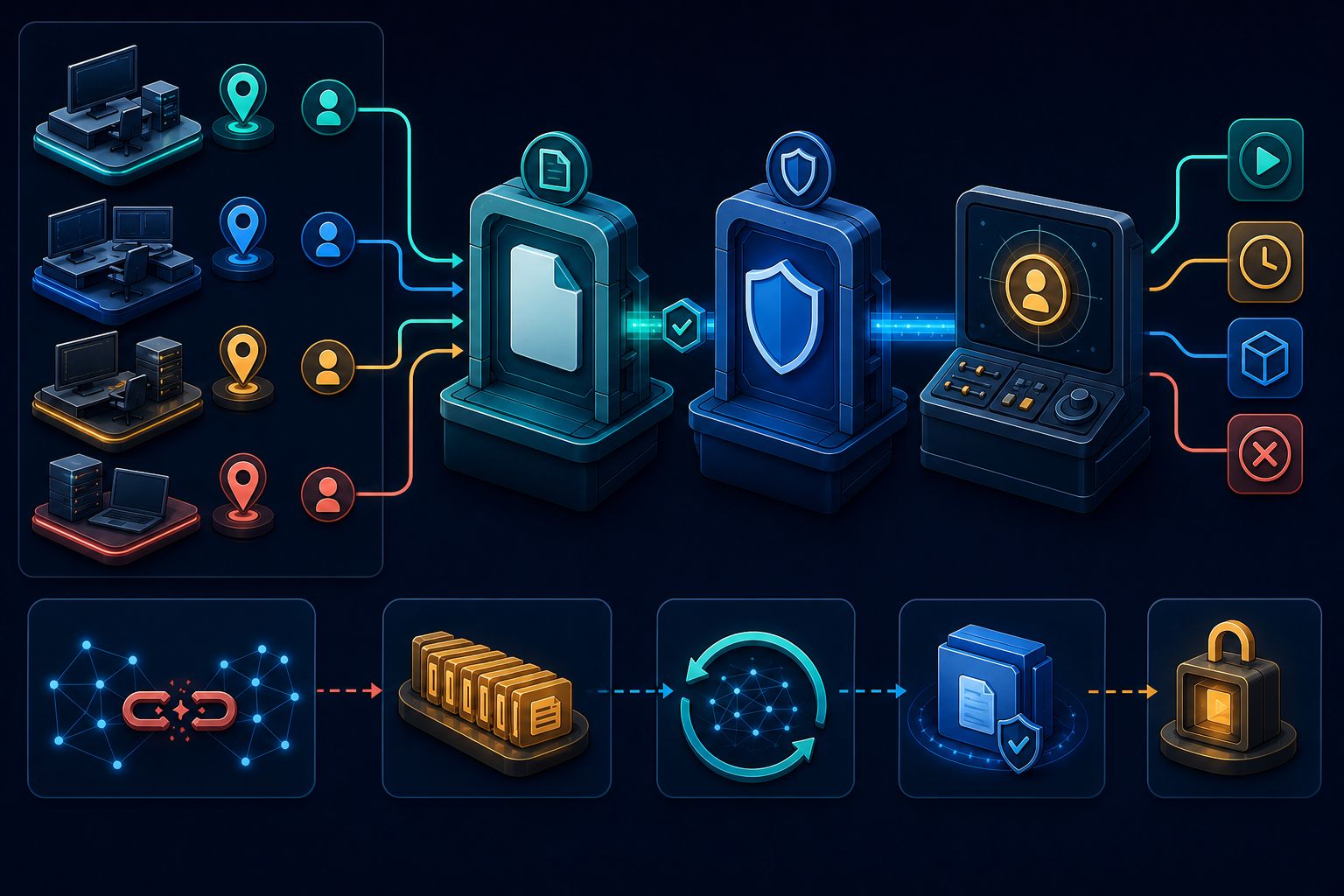
Alaska outsourcing at a glance
| Work-package signal | Decision before supplier access | Evidence to keep |
|---|---|---|
| Private commercial application with no State contract and no restricted customer data | Use proportional delivery, security, IP, continuity, and exit controls; do not import State procurement rules merely because the buyer is in Alaska | Scope, legal entities, named team, countries, systems, approved tools, buyer repository, acceptance, release, support, and exit records |
| State of Alaska professional or non-professional services contract above the policy threshold | Read the solicitation and contract; determine whether every contractor and subcontractor service will be performed in the United States or whether the agency must seek a waiver | Solicitation version, clause, work-location manifest, value and service classification, questions to procurement officer, waiver status, and signed contract |
| Proposed State work outside the United States | Give the procurement officer a detailed description early enough for the stated process: portion of work, location, people, necessity, best-interest basis, and mission effect | Written request, submission date, facts, decision, conditions, certified country list, percentage allocation where requested, and procurement-file copy |
| State information or information assets may be accessed, or State data may be stored outside the United States | Treat security review as a separate approval path; do not assume a procurement waiver authorizes data access or storage | Data/system inventory, architecture, people and administrator locations, proposed storage/support regions, State Security Office decision, conditions, and attachment to waiver when applicable |
| State IT purchase or service uses a product whose policy status is uncertain | Check the latest official IT procurement classification and obtain the required written exception before procurement if the item is not currently approved | Product/version, classification date, department IT manager route, security-policy reference, exception, compensating controls, and expiry |
| Supplier may encounter Alaska-resident personal information | Classify whether the buyer owns/licenses the information or the supplier maintains it as an information recipient; prebuild the immediate recipient-to-distributor escalation | Data elements, resident logic, owner/licensee, recipient, systems, encryption, contacts, trigger facts, notice authority, and exercise result |
| Buyer considers a no-harm determination after a breach | Reserve the decision for the covered person’s authorized legal and incident owners; collect facts for an appropriate investigation and the required written records | Investigation, attorney-general notification record, written determination, approval, evidence basis, five-year retention control, and re-evaluation trigger |
| Provider destroys records or media containing personal information | Separate operational deletion from regulated record destruction; perform applicable third-party diligence, contract for destruction, and reconcile custody | Records and media, transfer manifest, provider diligence, written contract, chain of custody, destruction result, exception, and buyer validation |
| Alaska and an international team share little live time | Schedule authority rather than attendance: define dated decision windows, deferred defaults, emergency routes, and backup decision-makers | Named cities and IANA zones, milestone dates, overlap calculation, decision queue, backup authority, response targets, handoff receipt, and sustainable-hours review |
| Buyer, field site, or supplier can lose connectivity | Design a degraded-connectivity mode that prevents stale instructions, duplicate writes, unreviewed release, and loss of evidence | Offline permissions, local queue behavior, idempotency, conflict rule, last-known instruction, expiry, reconnect reconciliation, drill, and owner acceptance |
| Country or contributor changes | Stop access until the manifest, rights chain, data path, clock model, and any State approval are reassessed | Change request, old/new entity and location, purpose, data, tools, IP analysis, screening, approval, access log, and effective date |
The table is a router, not a legal conclusion. State procurement conditions do not become universal rules for every Alaska startup, nonprofit, or private buyer. Conversely, calling a State work package “commercial” does not remove a clause that is actually in the solicitation or contract. The controlling question is which facts and instruments reach the proposed people, systems, data, and deliverables.
Build the work-location manifest before comparing countries
Many outsourcing proposals reduce location to a sales-office address or a provider’s headquarters. That is inadequate for an Alaska buyer and especially inadequate for public work. A legal entity may contract in one country while developers, reviewers, cloud administrators, support personnel, model providers, and backup operators work elsewhere. A product may be hosted in the United States while logs are viewed abroad. A subcontractor may receive repository access even though the prime provider’s proposal says “domestic delivery.”
Create one row per work activity, not one row per vendor:
| Manifest field | Question | Required precision |
|---|---|---|
| Work package | What bounded outcome or operation is being performed? | Feature, migration, evaluation, support queue, data labeling, security test, deployment, or incident task |
| Performing entity | Which legal entity employs or contracts the person? | Full legal name, contracting role, subcontract tier, country of formation, and approved agreement |
| Person and role | Who can read, change, approve, deploy, administer, or export? | Named person where feasible, role, employer, least privilege, screening/training, start/end date, and backup |
| Physical work location | Where will the person perform the work? | Country and city; remote-work changes require a controlled update rather than a casual message |
| System location | Where do repositories, build runners, issue trackers, model services, logs, support consoles, backups, and artifacts operate? | Account, service, region, tenant, data path, support access, and administrator location |
| Information | What input, metadata, derived content, credential, or output crosses the boundary? | Field or artifact category, source, resident/customer link, classification, purpose, retention, and prohibited combinations |
| Authority | What may the person or service decide without waiting? | Read/write/deploy limits, spend ceiling, incident containment, rollback, customer communication, and expiry |
| Time path | When is a decision available in the buyer’s actual Alaska zone? | Named IANA zones, dated window, expected response, deferred default, emergency route, and backup owner |
| Change control | What happens if any entity, person, city, system, tool, subprocessor, or purpose changes? | Advance request, reviewer, evidence refresh, approval, access activation, and audit record |
| Exit | How does this row close? | Handover, repository and account transfer, credential revocation, return/deletion, retained exception, verification, and date |
The manifest must describe reality. Do not copy an old proposal into the contract if the delivery organization has changed. Ask the provider to reconcile the manifest against identity accounts, repository membership, cloud roles, support access, subprocessors, invoices, and observed login geography. A mismatch is a control event: investigate it, update or revoke access, and decide whether contractual or procurement notice is needed.
The manifest also makes country comparison more honest. “India,” “the Philippines,” “Colombia,” or “Poland” is not an operating model. The buyer needs a proposed city, team, employer, work schedule, environment, data boundary, price basis, backup plan, and rights chain. Compare those named facts to the required work instead of attributing uniform traits to a whole country.
Keep private work separate from the State foreign-outsourcing path
The State of Alaska’s current Procurement Information Messages compilation describes PIM 71 as guidance for foreign outsourcing in State contracts for services. It says the policy affects State solicitations and contracts above $50,000 for professional and non-professional services, including alternate and exempt procurements, and excludes contracts for supplies as defined there even when purchased items may include foreign warranty or maintenance activity. It further states a U.S.-performance policy unless the Chief Procurement Officer or the specified designee approves a waiver.
Those are specific State procurement conditions. They are not a general Alaska ban on private companies using international teams. A private seafood business, energy company, healthcare operator, logistics firm, professional practice, or software startup must still evaluate its own contracts, laws, data, sanctions, export controls, employment model, taxes, and intellectual-property chain, but it should not claim that PIM 71 itself governs merely because the company operates in Alaska.
For proposed State work, do not paraphrase the rule from memory. Obtain the current solicitation, amendments, shell language, contract, applicable administrative manual, PIM compilation, and agency instructions. Confirm at least:
- whether the purchase is a professional service, non-professional service, supply, mixed item, or another category under the controlling documents;
- the total contract value and whether amendments, renewals, options, or related work affect the applicable threshold or clause;
- whether every service by the contractor and every subcontract tier will be performed in the United States;
- whether remote administration, customer support, incident response, model review, data labeling, build service, or after-hours coverage counts within the service work described;
- whether an actual statutory exemption or foreign-office path applies, rather than merely sounding similar;
- which official may decide the waiver, which procurement officer owns communication, and what lead time the solicitation requires;
- whether information access or foreign storage creates a second security-approval path;
- which approved countries, percentages, people, and conditions must remain consistent after award.
PIM 71’s sample solicitation language says a bidder unable to certify all contractor and subcontractor services will be performed in the United States must contact the procurement officer in writing to request a waiver at least 10 days before the bid or proposal deadline. The request must detail the portion performed outside the United States, where, by whom, and why the waiver is necessary. The same guidance describes the agency’s best-interest and public-mission justification, a certified list of countries if approved, and potential consideration of the percentage of work outside versus inside the United States when numerical scoring is used.
Treat those as bid-design inputs, not last-minute disclosure. Ten days is a stated minimum in the sample process, not a sensible project-planning target. A credible provider should expose the proposed model before pricing is final so the buyer or agency can reject, revise, or route it without destabilizing the procurement.
Build a waiver packet that can survive delivery changes
A waiver request is not only a country name. It should let the procurement owner understand what capability will leave the United States, why that design is needed, and how the approved facts will remain controlled after award.
Use a packet with five linked views:
- Scope view. Break the service into work packages and estimate the portion performed in and outside the United States. State whether the measure uses labor hours, fees, deliverables, or another defensible basis. Do not mix methods silently.
- Location view. List each performing entity, subcontract tier, country, city, role, and planned change process. Distinguish physical work, system hosting, storage, administration, and support.
- Necessity view. Explain why the proposed foreign work is in the State’s best interest and why restricting competition to U.S. performance could damage the agency’s public mission, using facts specific to the acquisition.
- Security view. Inventory State information and assets, access paths, storage, tools, environments, administrators, incident routes, and required State Security Office review. A procurement justification is not a security authorization.
- Control view. Describe contract flow-down, identity and access, approved tools, monitoring, change approval, country-list reconciliation, acceptance, incident facts, return/deletion, and termination.
If the waiver is approved, convert its facts into operating controls. Compare repository membership and access telemetry to the approved work-location list. Block unapproved personal accounts and automatic tool integrations. Require a change request before moving a task to a new country or subcontractor. Reconcile invoices and time records to the stated allocation without turning surveillance into a substitute for governance. Put the agency’s remedy and stop-work authority in the contract.
Do not promise that Canada or any other country will be approved. PIM 71 describes special consideration for Canadian services due to Alaska’s border, cooperation, trade, proximity, logistics, and availability considerations, but approval remains a procurement decision on the actual request. “Nearshore” is not a waiver status.
The PIM also identifies limited paths that may not require a waiver, including the cited statutory exemption for contracts performed outside the country requiring knowledge of that area’s customs, procedures, rules, or laws, and work for State foreign offices. Do not stretch those categories. Record the exact statutory and factual basis, obtain the procurement owner’s conclusion, and keep it with the file.
Route State information through a separate security gate
The most consequential sentence in PIM 71 is the special note after the waiver procedure. It says Office of Information Technology Security Policy 112 requires State Security Office review and approval before business with third parties that have authorized access to State of Alaska information and information assets operating within or on behalf of the State. It further says that when a foreign-outsourcing waiver involves such access or State data stored outside the United States, the State Security Office approval must be attached to the waiver.
This produces two independent questions:
- May the services be performed outside the United States under the procurement path?
- May these exact people, systems, tools, support paths, and storage locations access or hold State information under the security path?
A yes to one is not a yes to the other. A U.S.-hosted cloud service may still expose State data to a foreign support team. A developer may never download a database but still see live records through an admin console. A model service may retain prompts or telemetry. A monitoring provider may receive identifiers in logs. A backup may be copied to a region not shown in the architecture. Treat each as an access or storage fact for the authorized State owners to review.
Create a State-information boundary table:
| Boundary component | What to document | Stop condition |
|---|---|---|
| State data | Fields, records, attachments, derived data, logs, prompts, outputs, and classification | Unknown source, sensitivity, purpose, or approved location |
| State system | Production, lower environment, integration, support, identity, repository, build, logging, backup, and recovery systems | Component omitted from the approved diagram or inherits broader access than represented |
| Human access | User, administrator, support, reviewer, incident responder, and subcontractor access | Unapproved identity, employer, role, country, city, device, or privilege |
| Machine access | API, service account, integration, agent, model, scanner, export, and replication path | Unapproved endpoint, region, recipient, credential, retention, or training/reuse behavior |
| Evidence | Logs, access reviews, configuration, test results, incident records, exceptions, and change history | Evidence cannot be attributed to the exact tenant, period, system, or legal entity |
| Exit | Export, return, deletion, backup expiry, credential revocation, administrator removal, and validation | Supplier alone can declare completion without buyer-verifiable evidence |
The current OPPM Information Technology Center page also instructs agencies to use the latest State IT security policies and identifies procurement categories based on whether a standard is approved, procurement is allowed without a standard, or procurement is pending and requires a security-policy exception. That classification can change. Capture the product and version, page date, policy or standard, agency IT route, written exception, conditions, and recheck trigger. Do not present a historical approval as permanent authorization for a different release or service configuration.
Preserve confidential State information and incident facts
PIM 79 in the current compilation provides another State-specific branch. It describes a confidentiality clause for small, alternate, and exempt procurement contracts, regardless of amount, when a contractor might access confidential information such as technology infrastructure, architecture, financial data, trade secrets, equipment specifications, user lists, passwords, research data, or technology data. The clause text addresses limited use, reasonable physical and electronic care, third-party access, and prompt written notice of storage, disclosure, loss, unauthorized access, or use.
Do not turn that example into a universal private-sector clause or assume it is the only term in a State agreement. Read the actual solicitation and contract. Then make the operating interface specific:
- define which categories are confidential and how the provider recognizes them;
- put work in buyer-approved accounts, repositories, identity systems, and environments;
- prohibit copying into personal email, consumer storage, unsanctioned AI tools, unmanaged devices, or informal messaging;
- distinguish safe containment authority from destructive remediation and public communication authority;
- require the first written incident message on suspected facts, not a completed root cause;
- preserve logs, identity events, messages, tickets, builds, artifacts, and affected images before they rotate;
- identify the State and supplier contacts, monitored channels, backup route, and acknowledgement target;
- require updates on a fact-controlled cadence and preserve who decided what and when;
- exercise the route with a realistic scenario before production access.
The supplier should be able to say “suspected unauthorized support-console access began at this time; these accounts and records may be affected; we disabled this token; evidence is preserved here; this is the next update time” without deciding the State’s legal notice, public statement, law-enforcement, or procurement response. Speed and epistemic discipline matter together.
Turn Alaska’s personal-information law into two supplier interfaces
The Alaska Legislature’s official codification currently displayed as Alaska Statutes 2024 creates a breach interface and a disposal interface. It is not a broad comprehensive consumer privacy law equivalent to every state privacy statute, and proposed bills should not be described as enacted requirements. Scope each duty from the official text and current legal review.
For a covered person that owns or licenses Alaska-resident personal information, AS 45.48.010 describes disclosure after discovering or being notified of a breach, in the most expeditious time possible and without unreasonable delay, subject to the stated investigation, integrity-restoration, and law-enforcement paths. The section also contains a no-harm branch: after an appropriate investigation and written notification to the Alaska attorney general, the covered person may determine there is not a reasonable likelihood of harm; the determination must be written and maintained for five years.
AS 45.48.070 gives the supplier relationship a useful structure. When a breach occurs in an information system maintained by an information recipient, the recipient generally does not perform the owner-side notices described there. Instead, immediately after discovery it must notify the information distributor that owns the personal information or licensed its use and cooperate as necessary, subject to protected confidential business information or trade secrets. The distributor then handles the resident-notice path as described by the statute.
Translate this into an immediate recipient-to-distributor interface:
| First-packet field | Supplier responsibility | Buyer responsibility |
|---|---|---|
| Discovery | Preserve the earliest observed time, signal, reporter, and system | Decide which internal incident record and clock apply |
| Relationship | Identify information recipient, distributor/owner or licensee, contracts, systems, and contacts | Confirm legal roles and affected entities rather than relying only on labels |
| Information | Identify potentially affected fields, record sets, residents, encryption, keys, and exposure mode | Determine statutory and contractual classification and population logic |
| Access and acquisition | Preserve factual indicators, identity events, exports, queries, downloads, screenshots, and limitations | Direct investigation and decide what conclusions the evidence supports |
| Containment | Take pre-authorized safe actions and record their effects | Approve destructive, availability-affecting, customer-facing, or legally sensitive actions |
| Cooperation | Provide requested system facts, evidence, personnel, and updates through protected channels | Coordinate legal, forensics, insurer, customer, attorney-general, resident, and agency decisions |
| No-harm path | Supply evidence without declaring the legal conclusion | Own appropriate investigation, written attorney-general notification, determination, approval, and five-year retention when that path is used |
The supplier contract should set an operational internal notice target that is much faster than the buyer’s outer legal analysis. “Without unreasonable delay” is not a service-level objective. For a material system, require immediate or near-immediate escalation through a monitored 24/7 channel, acknowledgement, an initial fact packet, preservation, and scheduled updates. Avoid wording that lets a provider wait until it confirms every affected person or completes root-cause analysis.
Make disposal a custody process, not a delete button
AS 45.48.500 through .590 addresses disposal of records containing defined personal information. The provisions call for reasonable measures against unauthorized access or use; identify destruction or erasure measures; describe a due-diligence path and written contract for a third party in the record-destruction business; require written disposal policies and procedures; and define records broadly across physical and electromagnetic forms. The definitions and exemptions matter, so the buyer’s qualified owner must decide applicability.
Software projects create disposal events in places teams overlook:
- database snapshots, exports, migration staging, and failed import files;
- developer fixtures copied from production;
- support attachments and recorded calls;
- prompt histories, evaluation sets, embeddings, model outputs, and human-review queues;
- logs containing account, employment, medical, insurance, payment, or identity details;
- laptops, removable media, mobile devices, build caches, and local containers;
- issue trackers, chat exports, email, screen recordings, and observability tools;
- backup media, disaster-recovery replicas, cold storage, and vendor support bundles;
- sold, donated, returned, reassigned, or discarded equipment.
Separate three events. Operational deletion removes data from an active product path. Retention expiry makes a record eligible for disposal under the approved schedule. Verified destruction makes covered content unreadable or unreconstructable through the approved method and closes custody. A dashboard showing “deleted” may prove only the first event.
For an applicable third-party destruction service, document the diligence method described by the statute: an independent audit, reliable references and a recognized trade-association certification, review of information-security policies and procedures, or another appropriate competency and integrity measure. The law says one or more; the buyer should select evidence proportional to the media, sensitivity, volume, transport, and consequence. Certification is not the only possible route and never replaces verifying the exact entity and service.
Use a destruction manifest:
| Manifest element | Evidence |
|---|---|
| Source and owner | System, repository, device, record owner, legal entity, and approved retention schedule |
| Contents | Record classes and personal-information categories without unnecessarily reproducing the sensitive data |
| Quantity and identifiers | Counts, media or container IDs, export hashes, device serials, and reconciliation basis |
| Custody transfer | Date/time, sender, recipient, carrier, seal or encryption, route, exceptions, and receipt |
| Method | Approved physical destruction, secure erasure, cryptographic erasure, or other method mapped to media and reconstruction risk |
| Provider basis | Diligence evidence, written contract, locations, subcontractors, insurance or other relevant risk terms, and review date |
| Result | Completion date, certificate or machine evidence, exception/failure, retry, witness or reviewer, and residual backup treatment |
| Buyer validation | Reconciled quantities, sampled evidence, access revocation, system checks, retained exceptions, and closure approval |
A destruction certificate is one input. If the scope says 300 drives and the certificate says “media destroyed,” reconciliation is incomplete. If an export persists in an unlisted backup, the active database deletion is incomplete. If a provider can restore the data from a support system after certifying deletion, the control failed.
Design an authority relay across Alaska’s actual clocks
Alaska is not one generic “Pacific-ish” business schedule. The official State overview describes two time-zone paths: most of Alaska follows Alaska time, while part of the Aleutian region follows Hawaii-Aleutian time. Use maintained IANA identifiers for actual calculations, typically America/Anchorage and America/Adak, plus the delivery city’s correct zone. Confirm the buyer location; do not infer a zone from the state name, phone number, or company registration.
The operating challenge is larger than a two-zone label. An Anchorage owner and a developer in Manila, Bengaluru, Bogotá, Warsaw, or another city may have very different live windows, and daylight transitions can change the interval. An Aleutian operation may add another hour. Travel, seasonal work, field operations, and unreliable links can narrow availability further. The objective is not to force everyone online simultaneously. It is to place decisions where they can be made safely.
Define four authority classes:
- Proceed. The supplier may continue within an accepted design, budget, data boundary, and test suite.
- Defer. The supplier records the question and moves to another approved task without making the decision.
- Contain. The supplier may take reversible steps to prevent imminent damage, preserve evidence, or reduce exposure, then escalate.
- Stop. The supplier must halt because the instruction is expired, boundary is unclear, data or location changed, test failed, or approval is absent.
For each class, state the person, backup, channel, acknowledgement, evidence, and expiry. A phrase like “use your judgment” is not delegated authority. A person who can approve a UI detail may not approve a new data field, model provider, country, production deployment, customer notice, or destruction action.
Build a daily relay:
- The Alaska owner publishes a signed or attributable decision queue before leaving the primary window.
- Each item includes context, exact question, options, recommendation, evidence links, risk, deadline, default, and authority class.
- The supplier acknowledges the queue, rejects ambiguity, and works only inside active instructions.
- Decisions and exceptions go into the system of record, not only a meeting or private message.
- The supplier returns small tested artifacts, open questions, incidents, and the next required decisions before its handoff.
- The Alaska owner accepts, rejects, or redirects with evidence and records the next queue.
- Backup owners take over through a documented trigger, not informal availability.
Measure decision latency, not screen presence. Useful metrics include median time to acknowledge a ready decision, percentage of handoffs accepted without clarification, blocked hours attributable to missing buyer authority, work performed against expired instructions, incident acknowledgement, rollback time, and sustainable-hours exceptions. A full calendar can hide an empty authority path.
Make degraded connectivity an explicit delivery mode
Some Alaska projects touch remote operations, field teams, vessels, facilities, or communities where continuous connectivity cannot be assumed. The buyer may also lose access during a regional disruption while an international supplier remains online. An ordinary cloud collaboration process can then fail in two dangerous ways: the supplier continues on stale instructions, or everyone stops without knowing who can safely preserve service.
Define degraded mode before it happens:
| Control | Design question | Test evidence |
|---|---|---|
| Instruction freshness | How does a worker know the last approved instruction, its version, owner, issue time, and expiry? | Signed/attributable record, local availability, expiry behavior, and stale-instruction test |
| Offline action | Which reads, captures, queues, calculations, or safe local operations may occur without the buyer? | Permission matrix, data minimization, encrypted storage, time limit, and scenario result |
| Prohibited action | Which deployment, deletion, disclosure, new access, purchase, model call, or external communication must stop? | Enforced gate, attempted-action test, message, and override logging |
| Queue integrity | Can the system retry without duplicate orders, records, notices, or financial actions? | Idempotency key, sequence, deduplication, replay test, and reconciliation report |
| Conflict | What happens when buyer and supplier changed the same object or rule while disconnected? | Version rule, human review threshold, preserved alternatives, and resolution log |
| Evidence | Are timestamps, identities, local changes, alerts, and decisions preserved through reconnection? | Tamper-evident or attributable log, clock treatment, export, and restoration test |
| Reconnect | Who reviews queued work, conflicts, errors, and changed permissions before normal mode resumes? | Checklist, named authority, sampled reconciliation, exception closure, and sign-off |
Offline capability does not mean copying unrestricted datasets onto personal laptops. Minimize data, encrypt approved devices, expire local access, prevent uncontrolled exports, and design remote wipe or revocation where appropriate. If identity validation or policy cannot be refreshed, the system should reduce authority predictably. The buyer decides which safety or continuity need justifies each offline action.
Run the exercise with actual clocks and roles. Disconnect the buyer owner during a decision-heavy milestone. Let the supplier encounter an expired instruction, a queued duplicate, a suspected security event, and an urgent release request. Verify that the team stops the correct action, contains only within authority, preserves facts, reaches the backup, and reconciles without silent data loss.
Choose a delivery country from the manifest, not a stereotype
Once the work boundary and authority relay are explicit, compare proposed teams. A nearshore location may offer more Alaska business-hour overlap but less overnight progress. A farther team may create a strong follow-the-sun relay but require better written decisions and a separate incident route. One country may support a particular language, domain, travel path, or talent pool. None of those advantages is universal across providers or individuals.
Score the actual proposal:
- legal entity, financial resilience, insurance, and subcontract chain;
- named delivery and backup people, employment/contracting model, turnover exposure, and role fit;
- city-level clocks on milestone dates, sustainable hours, local holidays, and emergency coverage;
- work-location transparency, remote-work controls, access evidence, and country-change procedure;
- architecture, tenant ownership, repositories, build and release path, data regions, support access, logs, and recovery;
- secure-development practice, code review, dependency provenance, secret management, testing, vulnerability response, and artifact integrity;
- Alaska-resident information handling, immediate incident cooperation, retention, return, disposal, and backup expiry;
- contributor IP agreements under each relevant jurisdiction, pre-existing materials, open-source obligations, model/tool terms, and buyer-use rights;
- complete cost: discovery, management, overlap, travel, security, rework, tooling, taxes, transition, continuity, and exit;
- evidence quality: current, attributable to the exact entity/system/team, scoped, exception-aware, and independently verifiable.
Use country guides as research starting points. Our Philippines guide examines service delivery and time design, the India guide focuses on evaluating a vast and varied market, and the Latin America guide compares a region without treating it as one country. None replaces diligence on the proposed entity and work location.
Contract for change, not only the starting snapshot
The work-location manifest is valuable only if it remains true. Put material changes behind advance written review. At minimum, cover a new legal entity, subcontractor, country, city, remote-work location, data category, system, cloud or model service, storage/support region, administrator, purpose, production privilege, or retention behavior.
The agreement and work order should state:
- the accepted work packages, deliverables, exclusions, assumptions, dependencies, price basis, and acceptance evidence;
- performing entities, approved countries and locations, subcontract tiers, named critical roles, replacement conditions, and flow-down;
- buyer-owned or transferable repositories, accounts, domains, credentials, build definitions, artifacts, documentation, and audit exports;
- data instructions, prohibited data, production-access controls, approved services, retention, logging, incident cooperation, return, and deletion;
- State procurement and security approvals only where applicable, including the process for preserving the approved facts;
- contributor assignment, pre-existing IP schedule, open-source and third-party materials, model/tool inputs and outputs, and jurisdiction-specific rights review;
- availability, backup authority, degraded mode, recovery objectives, continuity tests, and support boundaries;
- vulnerability reporting, remediation priority, provenance, release approval, rollback, and customer communication authority;
- change request, objection, suspension, stop-work, cure, termination assistance, transition, and survival terms.
Avoid publishing provider, platform, client, or partner names as relationship proof merely because a tool appears in the architecture. A named product may be something the delivery team uses, not a sponsor, customer, certified partner, or endorser. Outsourcing.ai applies a fail-closed publication rule: a public relationship name requires exact approved wording, current evidence, named review, and written naming or logo permission.
Run a paid Alaska authority-relay pilot
The pilot should prove the work-location and decision system under realistic delay. Outsourcing.ai can deliver a bounded software, automation, data, or AI pilot directly under the Outsourcing.ai brand when the work fits our accepted scope and controls, or help the buyer evaluate another provider. We do not imply an Alaska office, State supplier status, waiver, security approval, or prior Alaska client by offering delivery.
Choose a two-to-four-week artifact that resembles production but avoids unapproved sensitive or State data. Examples include a synthetic-data workflow, integration adapter, internal approval queue, offline-capable field form, evaluation harness, observability component, migration rehearsal, or buyer-owned release pipeline. Do not choose a disposable demo that avoids the hard handoffs.
Before access
Approve the outcome, work-location manifest, data and system boundary, authority classes, actual clocks, degraded-mode rules, incident route, repository, tool inventory, IP schedule, acceptance scorecard, change triggers, and exit checklist. If State work is proposed, the authorized procurement and security owners must resolve the applicable waiver and access/storage path before foreign work begins.
During delivery
Run at least three decision relays, one delayed-owner scenario, one location or tool change request, one expired-instruction stop, one incident exercise, and one disconnected or unavailable-buyer interval. Require small tested commits, attributable decisions, reproducible builds, dependency records, review evidence, and buyer-controlled acceptance. Observe the named team rather than only account managers.
Acceptance scorecard
| Capability | Passing evidence |
|---|---|
| Location truth | Every observed contributor, administrator, system, and service matches the approved manifest, or an approved change predates access |
| Delivery | The artifact meets written behavior, quality, accessibility, performance, security, and operational acceptance criteria |
| Authority | The supplier proceeds, defers, contains, and stops correctly across delayed Alaska decisions |
| Degraded mode | Stale instructions expire, prohibited actions stop, queued work is idempotent, evidence survives, and reconnection reconciles |
| Security | Approved accounts and tools are used; secrets, dependencies, artifacts, logs, vulnerabilities, and exceptions are controlled |
| Incident | The correct owner receives a prompt fact packet through the primary or backup route, and evidence is preserved |
| Custody | Data sources, copies, derived artifacts, retention, return, deletion, backups, and destruction events reconcile |
| Handover | The buyer can build, test, deploy or operate, rollback, revoke provider access, and continue without hidden supplier accounts |
Scale only after closing exceptions or accepting them through a named buyer authority. A strong demo with an unverified team or hidden data path is not a passed pilot.
Plan exit before the first credential
Alaska’s distance makes supplier dependency expensive when an incident, dispute, provider failure, or connectivity loss occurs. Define exit as an acceptance test, not an administrative promise.
The buyer should be able to obtain and use:
- current source, history, branches, tags, dependency locks, build definitions, signed or attributable artifacts, infrastructure configuration, and deployment instructions;
- architecture, interfaces, schemas, migrations, runbooks, decision records, threat and risk records, known defects, vulnerability status, and support history;
- data exports in documented formats, field definitions, lineage, model/evaluation assets, consent or instruction records where relevant, and reconciliation totals;
- account ownership, role inventory, service and recovery credentials, domain and certificate control, billing ownership, logs, alerts, and vendor contacts;
- contributor and third-party rights records, pre-existing materials, licenses, notices, model/tool terms, and exceptions;
- open incidents, evidence holds, retained-record requirements, active State or customer conditions, and notification responsibilities;
- return/deletion/destruction scope, backup expiration, failed deletion, retained exceptions, access revocation, and buyer verification.
Test a partial exit during the pilot: remove one provider administrator, rotate a secret, rebuild in a buyer-controlled environment, restore an approved backup, export a decision log, and reconcile one deletion or disposal event. If continuity depends on a private provider account, undocumented local machine, or person who is always asleep during Alaska hours, the buyer does not yet control the service.
Red flags for an Alaska buyer
- “U.S. company” is offered as proof that all services are performed in the United States.
- The proposal names a headquarters but not the people, cities, subcontractors, administrators, support paths, or system regions.
- A provider waits until after award to disclose overseas work on an applicable State contract.
- A procurement waiver is described as automatic approval for State data access or storage abroad.
- A security review is treated as proof that the procurement path is satisfied.
- The provider cannot produce the approved country list, allocation method, or change history for applicable State work.
- Current IT product/security classification is inferred from an old purchase or a different version.
- Incident notice waits for confirmed harm, a final root cause, or a complete resident count.
- The supplier makes the Alaska no-harm determination or contacts residents without buyer authority.
- “Deleted” means removed from one application while exports, logs, support copies, prompts, or backups remain untracked.
- A destruction certificate cannot be reconciled to specific media, records, quantities, locations, and exceptions.
- “Alaska time” is used without a named buyer city, maintained zone, milestone date, and daylight-transition check.
- Offshore staff are expected to stay awake for all Alaska hours while also delivering a full local day.
- The team continues on stale chat instructions when the buyer is disconnected.
- The provider owns the only repository, cloud tenant, build pipeline, domain, recovery account, or deployment knowledge.
- A software-company name or logo is used to imply partnership, certification, client history, or endorsement without permission and evidence.
Frequently asked questions
Can an Alaska company outsource software development outside the United States?
Yes. There is no general rule in the State procurement guidance that converts every private Alaska project into a U.S.-only engagement. A private buyer should classify its actual data, customers, contracts, export/sanctions exposure, engagement model, IP chain, security, taxes, and operations. State of Alaska service contracts follow a separate procurement path when the current solicitation, value, service category, and clause make that path applicable.
Does every State of Alaska contract need a foreign-outsourcing waiver?
No. The current PIM 71 guidance describes a policy for State professional and non-professional service solicitations and contracts above $50,000, discusses supplies separately, and identifies limited no-waiver paths. The actual solicitation and contract control the procurement. Ask the procurement officer; do not self-declare an exemption or split work to avoid review.
What should a State waiver request say?
The current guidance calls for a detailed description of the portion of work outside the United States, where and by whom it will be performed, and why the waiver is necessary. It also describes an agency best-interest/public-mission basis, a certified country list after approval, and possible percentage scoring. A useful packet also maps entities, subcontractors, systems, data, security approval, change control, and evidence.
Does a foreign-outsourcing waiver allow State data to be accessed abroad?
Not by itself. PIM 71 describes a separate State Security Office review and approval when a vendor may access State information or information assets or store State data outside the United States, with the approval attached to the waiver when applicable. The authorized State owners must decide the exact access and storage boundary.
How quickly must an outsourced provider report a suspected breach involving Alaska data?
The provider’s contract should require a prompt internal fact handoff, commonly immediate or near-immediate for material systems. The statute’s owner/licensee and information-recipient provisions allocate legal duties and use terms such as immediately and without unreasonable delay in specific places, but they do not replace an operational response target. The supplier should not wait for a final root cause or harm conclusion.
Can a provider decide that a breach is unlikely to cause harm?
The buyer’s authorized covered-person, legal, and incident owners should control that statutory path. AS 45.48.010 describes an appropriate investigation, written notification to the Alaska attorney general, a written no-harm determination, and five-year retention. A provider supplies facts and cooperation; it should not make the buyer’s legal conclusion unless it is itself the relevant covered person and acts through its own authorized process.
Does ordinary cloud deletion satisfy Alaska’s record-disposal provisions?
Not automatically. Determine whether the definitions and provisions apply, then reconcile all relevant records and media. Active deletion, retention expiry, and verified destruction are different events. The statutory disposal article includes reasonable protection, written policies, and an optional third-party destruction path with due diligence and a written contract.
Which time zone should an Alaska project use?
Use the buyer’s actual location and maintained IANA zone. Most Alaska buyers will calculate from America/Anchorage; relevant Aleutian locations may use America/Adak. Confirm the location and milestone date, then calculate against each delivery city. Put authority, backup, and expired-instruction behavior into the handoff.
Is a nearshore team always better for Alaska?
No. Greater live overlap may help decision-heavy discovery or operations, while a farther team may support an effective overnight relay. Compare named people, actual clocks, work locations, evidence, data boundaries, continuity, complete cost, and the kind of authority the work needs.
Can Outsourcing.ai deliver the project directly?
Yes. Outsourcing.ai can scope and deliver a paid software, automation, data, or AI pilot under the Outsourcing.ai brand when the work fits an accepted boundary. We do not claim an Alaska office, State approval, a foreign-outsourcing waiver, State Security Office approval, or previous Alaska client. Applicable State or restricted work begins only after the buyer’s authorized owners approve the entities, people, locations, systems, data, tools, and terms.
Should we list software companies we work with?
Only when the relationship is real, relevant, current, documented, and approved for public naming in exact wording. Using a company’s product does not make that company a client, partner, or endorser. Until the evidence and written permission exist, keep the name out of relationship claims and describe the capability or tool category accurately.
Next step
Start with one representative work package. Record the buyer city and zone, outcome, performing entities and people, every physical and system location, data, tools, authority classes, incident route, degraded-mode behavior, acceptance evidence, and exit. If a State of Alaska contract may be involved, send the fact pattern to the authorized procurement and security owners before proposing foreign access.
Use the project brief generator to structure the scope, the provider scorecard to compare named evidence, the outsourcing RFP guide to expose work locations during procurement, and the offshore-team guide to design the daily relay. If you want Outsourcing.ai to deliver the pilot, submit the bounded package through the project-intake path; acceptance depends on the verified work, data, system, country, and authority boundary.
If the dominant risk is not interrupted connectivity or State procurement but an expiring approval during a long overnight relay, use the Hawaii outsourcing guide for its authority-capsule, release-sentinel, and immediate-incident-bypass model.
Evidence ledger
Sources used on this page
- Procurement Information Messages — current compilation — State of Alaska Office of Procurement and Property Management. Supports: Official May 2024 compilation, including PIM 71's State service-contract foreign-outsourcing policy, waiver request fields, certified country list, scoring guidance, exemptions, and separate State Security Office approval note; and PIM 79's IT confidentiality clause guidance. Direct source; independently sourced; commercial relationship: none. Verified 8/15/2026 by Outsourcing.ai Editorial Team. Accessed 8/15/2026.
- Documents and Forms — State of Alaska Office of Procurement and Property Management. Supports: Current official procurement forms directory showing the Foreign Outsourcing Request waiver memo and maintained solicitation and contract forms. Direct source; independently sourced; commercial relationship: none. Verified 8/15/2026 by Outsourcing.ai Editorial Team. Accessed 8/15/2026.
- Information Technology Center and TOPS — State of Alaska Office of Procurement and Property Management. Supports: Official route for current State IT procurement standards, security-policy classifications, and written exception handling through agency IT management. Direct source; independently sourced; commercial relationship: none. Verified 8/15/2026 by Outsourcing.ai Editorial Team. Accessed 8/15/2026.
- Alaska Statutes 2024 — AS 36.30.850 and related procurement provisions — Alaska State Legislature. Supports: Official codified procurement exemptions and definitions referenced by the State's foreign-outsourcing guidance; the official site currently labels its codification Alaska Statutes 2024. Direct source; independently sourced; commercial relationship: none. Verified 8/15/2026 by Outsourcing.ai Editorial Team. Accessed 8/15/2026.
- Alaska Statutes 2024 — AS 45.48.010 through AS 45.48.590 — Alaska State Legislature. Supports: Official codified breach, information-recipient escalation, notice, no-harm determination, five-year record, personal-information disposal, third-party destruction diligence, written policy, and definition provisions; the official site currently labels its codification Alaska Statutes 2024. Direct source; independently sourced; commercial relationship: none. Verified 8/15/2026 by Outsourcing.ai Editorial Team. Accessed 8/15/2026.
- Identity Theft and Privacy — Alaska Department of Law Consumer Protection Unit. Supports: Current official consumer-protection topic page linking the Alaska Personal Information Protection Act and state privacy resources. Direct source; independently sourced; commercial relationship: none. Verified 8/15/2026 by Outsourcing.ai Editorial Team. Accessed 8/15/2026.
- Contract Review — State of Alaska Division of Risk Management. Supports: Official explanation that contract terms, insurance, and risk treatment should be tailored to the unique activities rather than forced into one uniform format. Direct source; independently sourced; commercial relationship: none. Verified 8/15/2026 by Outsourcing.ai Editorial Team. Accessed 8/15/2026.
- Alaska Time Zones — State of Alaska. Supports: Official overview that Alaska uses two time-zone paths, with most of the state on Alaska time and part of the Aleutian region on Hawaii-Aleutian time. Direct source; independently sourced; commercial relationship: none. Verified 8/15/2026 by Outsourcing.ai Editorial Team. Accessed 8/15/2026.
- IANA Time Zone Database — Internet Assigned Numbers Authority. Supports: Maintained time-zone identifiers and transition rules for calculating actual overlap using the buyer's and delivery team's named locations, including Alaska and Aleutian paths. Direct source; independently sourced; commercial relationship: none. Verified 8/15/2026 by Outsourcing.ai Editorial Team. Accessed 8/15/2026.
- Secure Software Development Framework — National Institute of Standards and Technology. Supports: Maintained secure-development methodology for protected environments, provenance, release integrity, vulnerability response, and buyer-supplier evidence. Direct source; independently sourced; commercial relationship: none. Verified 8/15/2026 by Outsourcing.ai Editorial Team. Accessed 8/15/2026.
- Directory of Intellectual Property Offices — World Intellectual Property Organization. Supports: Official destination-country intellectual-property office links for researching contributor and rights-chain questions without assuming a U.S. agreement resolves every jurisdiction. Direct source; independently sourced; commercial relationship: none. Verified 8/15/2026 by Outsourcing.ai Editorial Team. Accessed 8/15/2026.
Next scheduled review: October 15, 2026. Corrections: hello@outsourcing.ai.