
Iowa buyer guide
Outsourcing software development from Iowa
An Iowa buyer guide to international software and AI outsourcing: consumer-data instructions, breach evidence, insurance investigations, State-system logs, cost, and exit.
Iowa outsourcing at a glance
| Proposed work | First buyer decision | Evidence required before access |
|---|---|---|
| Ordinary software, automation, analytics, support, or AI work without covered personal, insurance, or State data | Prove the clean boundary and keep release authority with the buyer | Work package, identities and locations, repositories, synthetic test data, secrets boundary, dependencies, build path, acceptance, deployment owner, recovery, and exit |
| Personal-data processing potentially within Iowa Code chapter 715D | Determine entity, threshold, record, exemption, operation, controller, processor, and instruction | Applicability record, purpose and field inventory, written instruction, rights support, safeguards, contract, subprocessors, compliance evidence, deletion or return, and change triggers |
| Possible compromise of Iowa personal information | Route technical facts immediately without asking the supplier to decide the legal result | Discovery time, system and record owner, fields, encryption and key facts, acquisition indicators, scope, containment, restoration, affected-person estimate, decision owner, and updates |
| Work for a covered Iowa insurance licensee | Determine the licensee, exemption, nonpublic information, system, supplier role, and applicable program before access | Risk assessment linkage, due diligence, written safeguards, access, application test, audit trail, incident plan, investigation packet, commissioner route, update cadence, five-year record custody, and destruction schedule |
| Work on an Iowa State agency system | Read the actual solicitation, executed agreement, agency boundary, current approved standards, and any variance | Clause and standard register, data classification, approved identities and endpoints, monitored access, protected logs, timestamps, alert owner, current retention decision, release approval, revocation, and closeout |
These are classification prompts, not conclusions. Chapter 715D, chapter 715C, chapter 507F, a State standard, a contract, and a destination-country rule do not automatically share scope. An organization, record, system, or operation may be excluded from one and covered by another. Preserve the reasoning and have qualified owners determine the actual perimeter.
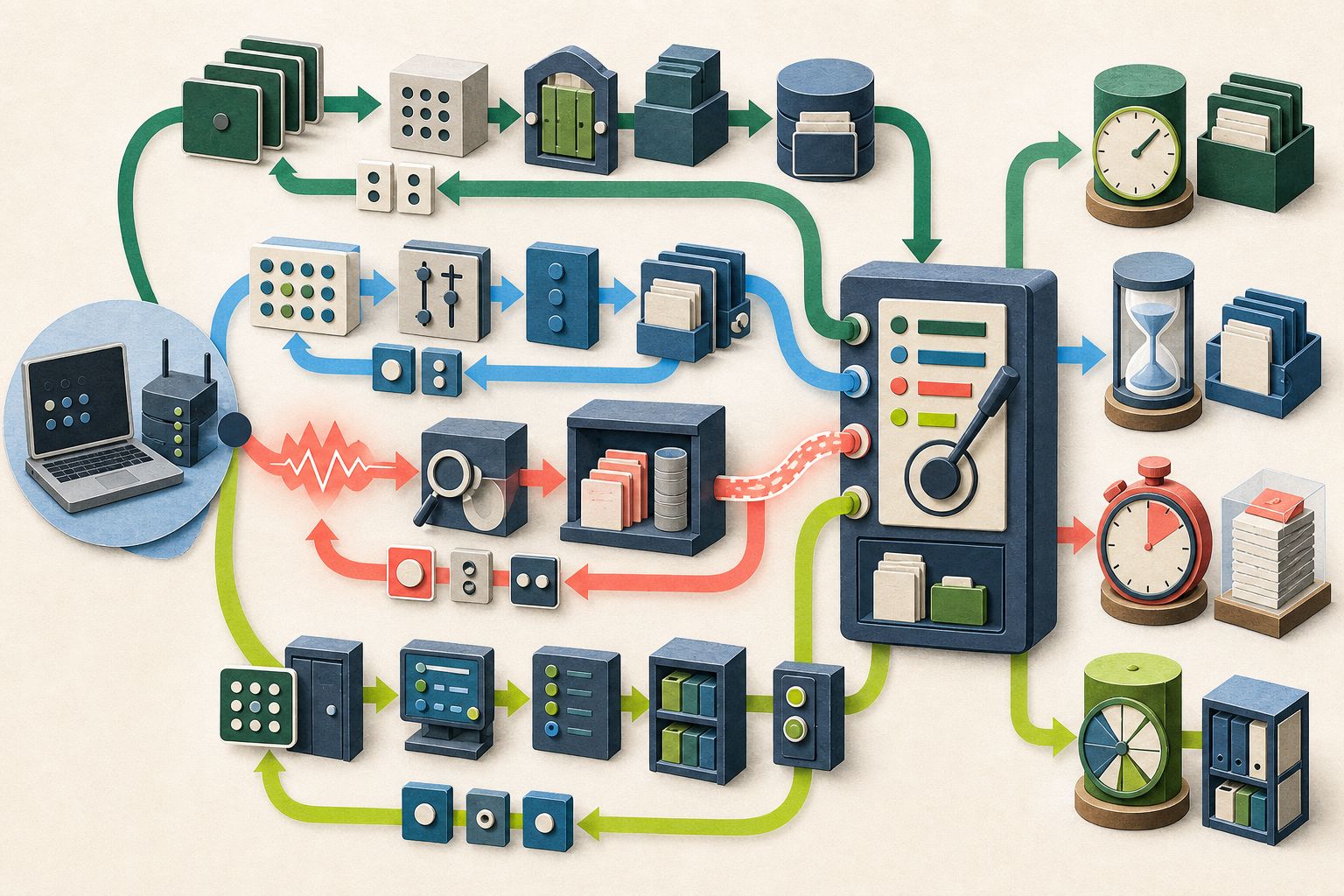
The distinct Iowa model: an evidence-retention relay
The Iowa-specific decision is not simply whether to outsource. It is which evidence stream must exist, who may create it, who controls it, how quickly it must move, and how long it must remain usable.
That distinction matters because an outside team often touches several technical layers during one engagement: a code repository, ticket system, hosted test environment, support console, personal-data view, insurance application, cloud log service, or State-managed system. The supplier may call all of them “the project.” The buyer cannot.
Build four independently controlled lanes:
- Ordinary delivery evidence: scope, identity, change, review, test, provenance, acceptance, release, rollback, and handover.
- Consumer-data operation evidence: applicability reasoning, instruction, data purpose, rights support, safeguards, subprocessor flow-down, assessment support where needed, and deletion or return.
- Insurance evidence: licensee risk linkage, third-party safeguards, access and application controls, investigation facts, regulator-ready updates, remediation, and retained investigation records.
- State-system evidence: only the agency and contract controls actually activated, including approved identities, access, monitoring, logging, timestamps, retention, review, exception, revocation, and acceptance.
The lanes can reuse trustworthy technical systems, but they should not reuse authority blindly. A central evidence store may hold records from several lanes if access, classification, retention, legal hold, export, deletion, and regulator production remain enforceable per record. A single shared folder with permanent supplier access is not a relay; it is an uncontrolled archive.
At the center, assign a buyer evidence owner and a decision owner for each lane. The evidence owner keeps the packet complete and retrievable. The decision owner approves access, accepts residual risk, determines release or recovery, and calls qualified privacy, insurance, procurement, or legal reviewers when needed. The supplier contributes timely facts. It does not become the buyer’s regulator, records authority, or incident spokesperson by default.
Start with a work-package and evidence ledger
Before comparing destinations or hourly rates, create one row for every meaningful supplier operation: repository read, data query, transformation, model call, prompt evaluation, support view, export, privileged session, deployment, incident action, deletion, and return.
Record at least:
- buyer entity, business process, system, product, environment, dataset, model, repository, accountable owner, and applicable lane;
- purpose, fields, people represented, sensitivity, source, location, replicas, logs, backups, retention, prohibited reuse, and deletion mechanism;
- supplier entity, subprocessor, contributor name, employer or contractor relationship, city, country, account, device, network path, and approved hours;
- permitted read, write, transform, model, export, command, build, deploy, and support actions, plus prohibited actions and stop conditions;
- chapter, contract, policy, standard, assessment, exemption, or reviewer decision that supports the lane assignment without claiming universal applicability;
- evidence item, format, source system, frequency, owner, protected location, minimum and maximum retention, legal hold, access, production, and destruction decision;
- incident signal, severity-independent relay, investigation owner, decision owner, communication owner, backup, and update cadence;
- branch, review, test, build, artifact, provenance, signing, acceptance, release, recovery, rollback, and return-to-service controls; and
- change triggers: new purpose, field, consumer group, model, recipient, provider, contributor location, privilege, environment, log source, retention period, or release path.
Translate approved rows into systems: identity groups, short-lived tokens, repository permissions, data views, network routes, model policies, logging rules, protected buckets, retention jobs, CI checks, deployment approvals, incident automation, and offboarding. Compare configuration and logs back to the ledger. The evidence packet should reveal drift while there is still time to correct it.
Lane one: ordinary software delivery still needs durable proof
An operation outside a particular privacy, insurance, or State perimeter is not evidence-free. Proprietary code, credentials, unreleased strategy, vulnerability information, build infrastructure, and production authority remain valuable.
Create a clean engineering lane with:
- synthetic, masked, minimized, or deliberately constructed test data;
- separate development, test, support, and production identities;
- no production secrets in code, tickets, screenshots, prompts, sample payloads, or chat;
- allowlisted dependency sources, automated composition checks, and recorded exception review;
- protected branches, peer review, reproducible builds, artifact provenance, and buyer-controlled signing;
- acceptance cases for success, failure, degraded operation, rollback, restoration, and data reconciliation;
- decision logs that explain important product, architecture, security, cost, and operational choices; and
- an exit packet containing current code, build instructions, environments, credentials inventory, open risks, runbooks, ownership, and revoked access evidence.
Store enough evidence to reproduce why an increment was accepted, not every low-value keystroke. Evidence volume without decision structure raises cost and obscures material events. A good packet identifies the approved work, contributors, reviewed change, test results, artifact, exceptions, acceptance, and release authority.
Use the project brief generator to define outcomes, systems, constraints, proof, and acceptance before requesting estimates. Compare proposals with the provider scorecard, weighting evidence quality, continuity, handover, and authority rather than résumé count alone.
Lane two: make Iowa processor instructions executable
Iowa Code chapter 715D is a current comprehensive consumer-data law, but “Iowa data” is not an applicability conclusion. Review the entity, thresholds, records, people, exemptions, purpose, and operation. Employment and commercial contexts, particular entities, and specified data can be treated differently. Record the conclusion and its reviewer.
For an operation classified as controller-to-processor work, section 715D.5 provides the implementation spine. The processor follows controller instructions and assists with consumer rights, security, and information needed for the controller’s duties. The contract addresses the processing instructions, nature and purpose, data type, duration, rights and obligations, confidentiality, deletion or return, compliance information, assessments, and subprocessor obligations.
Turn that into observable evidence:
| Processing concept | Evidence returned to the Iowa buyer |
|---|---|
| Instruction | Versioned operation ID, permitted fields, purpose, input, output, tool, model, recipient, retention, and prohibited actions |
| Rights support | Tested locate, access, portability, deletion, and appeal-support path across primary stores, derived data, logs, queues, caches, and subprocessors |
| Security assistance | Identities, least privilege, encryption, secrets, logging, vulnerability workflow, relay path, recovery, and current exceptions |
| Confidentiality | Contributor roster, relationship, training, signed obligation, account, device, termination, and access-review evidence |
| Deletion or return | Inventory, execution result, replica and backup treatment, subprocessor confirmation, exception or hold, and buyer acceptance |
| Compliance information | Evidence mapped to the operation, scope and date, known gaps, remediation owner, underlying record location, and independent-assessment details when used |
| Subprocessor | Exact entity, service, location, data, purpose, terms, safeguards, incident route, evidence, change notice, and offboarding |
Add a purpose-drift stop. If the supplier proposes to reuse data, retain prompts or output beyond instruction, combine datasets, select a new recipient, train or improve a model, move to another country, or make an independent release decision, pause the operation. Reclassify it, update the instruction and contract, obtain any required review, change technical controls, and record the new evidence requirements before resuming.
Keep general breach response separate from routine privacy operations
Iowa Code chapter 715C uses its own definitions and notification path. Do not assume that chapter 715D applicability, an insurance classification, or a contractual “security incident” definition settles the chapter 715C analysis.
The supplier’s contract should use a fast operational signal that is broader than a final statutory determination. Require immediate reporting of suspected unauthorized acquisition, access, use, disclosure, change, loss, or material availability impact involving buyer systems or information. The buyer can then determine which legal and contractual branches apply.
The first evidence capsule should contain:
- discovery time and reporter;
- affected account, system, environment, dataset, record owner, and service owner;
- known and suspected access, acquisition, disclosure, modification, destruction, and availability facts;
- field categories, encryption, key exposure, backup, replica, and affected-person estimates;
- identity, endpoint, network, cloud, application, database, model, ticket, and communication records preserved;
- containment already taken, business effect, safe-continuity option, and actions requiring buyer approval;
- supplier, subprocessor, hosting, and customer dependencies;
- uncertainty, next investigative step, named owners, update time, and protected evidence location.
Do not wait for perfect facts. Mark each fact as observed, inferred, reported, or unknown; update it without overwriting the history. The buyer’s qualified owners determine the relevant owner or licensee, notification, Attorney General, insurer, customer, law-enforcement, and other-jurisdiction paths.
Lane three: insurance work needs investigation-grade records
Iowa Code chapter 507F creates a distinct lane for a covered insurance licensee and its nonpublic information and systems. Confirm the actual licensee, exemption, system, information, and event facts. Do not apply the lane to every Iowa company, and do not assume an exempt entity has no contractual or other security duties.
For covered work, connect the supplier to the licensee’s written information-security program and risk assessment. Section 507F.4 addresses the program, information retention and destruction, foreseeable threats including information accessible to or held by third parties, access controls, secure development and testing considerations, audit trails, incident response, continuity, and oversight. Section 507F.5 addresses third-party service-provider arrangements. Those are not procurement slogans; they should change architecture and evidence.
Before access, require:
- the exact licensee owner and covered system boundary;
- nonpublic-information and information-system inventory;
- risk-assessment linkage and named program owner;
- supplier due diligence, contract safeguards, subprovider path, and evidence rights;
- least-privilege identities, managed endpoints, secrets, encryption, network route, monitoring, and review;
- externally developed application testing, dependency, vulnerability, change, build, and release evidence appropriate to the work;
- audit trail protection and enough event context to reconstruct access, changes, administrative actions, exports, failures, and restoration;
- retention and destruction decisions tied to business and applicable-law needs rather than supplier defaults;
- incident investigation, commissioner, consumer, producer, reinsurer, customer, and other routes evaluated by qualified licensee owners; and
- tested revocation, recovery, return, deletion, and five-year investigation-record custody where section 507F.6 applies.
Section 507F.6 permits a designated outside vendor or third-party provider to conduct the prompt investigation, and requires the licensee to investigate or confirm and document a provider investigation for a provider system. That makes evidence quality central. A supplier report that merely says “resolved” cannot support scope, compromised information, restoration, oversight, or later production.
Where section 507F.7’s facts trigger notice, the licensee’s three-business-day commissioner clock begins from confirmation of the cybersecurity event, and the report can require the supplier’s specific roles and responsibilities, event timing, exposure, recovery, source, affected information and consumers, control review, remediation, and further updates. The supplier should deliver evolving decision-ready facts quickly. The licensee retains confirmation and notice authority unless an approved agreement explicitly assigns a permitted action.
Lane four: activate State controls only for actual State work
The Iowa Department of Management publishes enterprise IT standards for participating State agencies. The Information Security Standard covers State information and systems, purchased services, off-site storage, contractors, temporary personnel, and access agreements within its scope. The Logging Security Standard adds logging, protection, alert, timestamp, retention, review, and provider expectations. The standards index is the safer entry point because the applicable set, version, agency policy, procurement, agreement, and approved variance can change.
Do not turn those materials into a claim that every Iowa buyer or every contractor is governed by the State lane. Activate it only when the real agency, system, contract, policy, and current approval do so.
For an activated State lane:
- build a clause-and-standard register from the solicitation, executed agreement, system classification, agency policy, current enterprise index, and written variance;
- map each requirement to an owner, configuration, record, review cadence, exception, acceptance condition, and closeout item;
- approve every contributor identity, location, device, account, endpoint, network path, role, session window, and supervisor where required;
- keep State data, credentials, logs, screenshots, exports, prompts, and backups inside the approved boundary;
- protect logs from unauthorized access, change, and deletion; preserve synchronized timestamps and the context needed to reconstruct events;
- route alerts and incident facts to the named agency and contract owners without letting the supplier decide public notification;
- document current retention requirements from the actual standard and contract rather than freezing an old website number into a permanent system default; and
- revoke accounts, recover State artifacts, reconcile records, dispose or return information as authorized, and obtain buyer acceptance at closeout.
The best architectural pattern is a protected enclosure for State-controlled data and actions plus a narrow evidence bridge for eligible artifacts. The bridge can accept reviewed source changes, test results, build attestations, or documentation when the contract permits. It must not become a covert route around location, access, monitoring, or data-handling restrictions.
One incident intake, several decision branches
A practical engagement uses one technical signal intake and preserves separate authority branches:
- Signal: the supplier reports suspected compromise, misuse, material outage, unsafe change, or evidence loss immediately under the operational contract.
- Preserve: protect logs, snapshots, identity records, cloud events, code, builds, data lineage, model configuration, provider tickets, and communications.
- Classify: identify ordinary, chapter 715C, chapter 715D, chapter 507F, State, contract, federal, customer, and destination-country branches without treating one as a substitute for another.
- Investigate: establish scope, information, acquisition indicators, business effect, root cause, supplier roles, remediation, uncertainty, and next steps.
- Operate safely: contain, rotate secrets, restrict access, use a known-good continuity path, recover, validate, and reconcile under named buyer authority.
- Decide: qualified buyer owners determine confirmation, regulator, resident, consumer, customer, insurer, law enforcement, public communication, and return to service.
- Update: supply fixed-cadence updates and retain the approved packet according to the applicable lane, hold, and destruction decision.
Do not force every branch onto the longest or shortest retention period. Over-retention can enlarge exposure and conflict with deletion commitments; premature destruction can erase investigation, contract, or regulator evidence. Store a retention decision with every record class and make changes reviewable.
Contributor location, intellectual property, and access remain separate
“The provider is in country X” is incomplete. Record the legal supplier, every subprovider, every contributor’s employer or contractor relationship, physical work city and country, system location, data destination, support route, and backup operator. Reapprove changes before access moves.
The master agreement should address confidentiality, inventions, deliverables, pre-existing materials, open-source components, moral-rights treatment where relevant, sublicensing, further assignment, assistance, repositories, credentials, and exit. Then verify destination-country law and the contributor chain using current official sources, such as the WIPO directory and the relevant national office. Do not assume an Iowa choice-of-law clause alone produces the intended rights everywhere.
Enforce access technically: named accounts, phishing-resistant authentication where appropriate, managed devices, least privilege, separate environments, scoped secrets, network restrictions, short-lived privileged sessions, monitoring, protected logs, periodic review, and immediate revocation. A signed assignment and a permanent administrator account solve different problems.
Schedule authority, not only meetings
Iowa buyer operations generally use U.S. Central time, but the engagement still needs maintained zone identifiers for the actual buyer and contributor cities. Calculate overlap for dated periods because daylight-saving transitions can differ by country and date.
Publish an authority calendar with:
- normal collaboration window and named participants;
- daily decision cutoff and written handoff deadline;
- after-hours deploy, support, incident, and rollback permissions;
- action limits when the buyer owner is offline;
- urgent escalation route, backup owner, and acknowledgement target;
- holiday and leave coverage by actual location; and
- change windows, freezes, continuity exercises, and exit dates.
Asynchronous work is valuable when it returns a decision-ready packet: change, reason, test, risk, unresolved question, evidence link, recommended next action, and named approver. It is dangerous when an outside team uses buyer sleep hours as implied production authority.
Compare complete cost, not supplier rate
Build a scenario range instead of publishing a false Iowa-specific rate. Include:
Supplier delivery
- discovery, engineering, design, data, AI, QA, support, technical leadership, documentation, and handover;
- provider management, specialist review, subprovider overhead, travel, equipment, and transfer fees; and
- overlap, on-call, incident, continuity, and replacement coverage.
Buyer-retained work
- product decisions, architecture and risk acceptance, privacy and insurance review, procurement, State-system approvals, data preparation, acceptance, production release, and customer communication;
- evidence review, exception management, regulator readiness, records production, retention and destruction decisions, and audits; and
- internal change management, training, downstream integration, and benefits realization.
Control and platform cost
- identity, managed devices, repository, CI, artifact, observability, security, testing, model evaluation, data environments, log storage, protected evidence store, backup, recovery, and egress;
- duplicate or lane-specific environments needed to prevent consumer, insurance, or State boundaries from collapsing; and
- supplier exit, access revocation, replacement, record transfer, reconciliation, and recovery exercises.
Use three scenarios: expected delivery, control-intensive delivery, and transition or failure. Compare total cost over the decision horizon, not a headline hourly rate. A lower bid that excludes evidence, buyer review, incident support, and exit can be the more expensive operating model.
Run a six-to-eight-week evidence-relay pilot
Choose one representative but bounded work package. It should exercise real engineering and enough evidence complexity to test the model without giving the supplier broad standing access.
Week 1: classify and baseline
- approve the work-package ledger, applicable lanes, identities, locations, data, systems, roles, evidence clocks, decisions, and stop conditions;
- inventory code, environments, interfaces, dependencies, records, models, known defects, and recovery state; and
- agree measurable outcome, acceptance cases, control evidence, retained records, and exit artifacts.
Week 2: establish controls
- issue named least-privilege access with expiry;
- configure repositories, test data, secrets, logs, evidence storage, reviews, build, release, and deletion paths; and
- rehearse incident relay, rights support where applicable, restoration, and account revocation.
Weeks 3–6: deliver small accepted increments
- demonstrate working changes at least weekly;
- return each lane’s evidence packet with the increment;
- measure lead time, accepted throughput, escaped defects, rework, review latency, unresolved risk, incident responsiveness, evidence completeness, and buyer effort; and
- stop and reclassify any new purpose, data, provider, location, privilege, system, or retention need.
Weeks 7–8: recover and decide
- run failure, rollback, restore, deletion or return, supplier-loss, and owner-unavailable scenarios;
- reconcile code, artifacts, data, logs, investigation records, decisions, accounts, and documentation;
- test whether a replacement team can build, operate, investigate, and recover from buyer-held material; and
- continue, redesign, narrow, or exit using recorded evidence.
Put operating promises into the agreement
A usable agreement and work order should cover:
- exact entities, services, systems, environments, data, purpose, roles, locations, subprocessors, contributors, and change approval;
- lane-specific instructions, safeguards, evidence, assessment support, rights support, audit, investigation, regulator support, retention, destruction, return, and closeout;
- confidentiality, intellectual property, pre-existing materials, open source, credentials, repositories, and further assignment;
- service levels for ordinary acknowledgement, urgent relay, evidence update, restoration, decision escalation, and handover;
- buyer-retained decisions for scope, architecture exceptions, production, confirmation, notice, regulator communication, retention, legal hold, recovery, and acceptance;
- fees, currency, tax responsibility, invoicing, acceptance, change control, suspension, termination, transition assistance, and record production; and
- order of precedence among the agreement, data terms, security schedule, insurance requirements, State terms, work order, approved exception, and current instruction.
Test the agreement against real actions. Who can approve a new model endpoint? Where are incident records stored? Can the supplier delete them? Who starts the insurance investigation? Which owner approves a State-system privileged session? How does a subprovider change? If the answer lives only in an unowned clause, the control is incomplete.
Iowa outsourcing red flags
Pause or reject a proposal when:
- “Iowa compliant” appears without entity, threshold, record, operation, exemption, role, source, and qualified review;
- one permanent administrator account crosses ordinary, consumer, insurance, and State lanes;
- the supplier controls the only code, build, key, log, investigation record, backup, or runbook copy;
- consumer-data instructions do not reach prompt stores, derived data, caches, logs, backups, and subprocessors;
- a supplier can decide independently to reuse buyer data or model output;
- an insurance proposal offers a certificate but no risk linkage, application evidence, audit trail, investigation packet, update path, or retained records;
- a State-work proposal cites an old standard without checking the current index, agency policy, contract, and approved variance;
- incident notice waits for the supplier’s final legal conclusion;
- every record inherits one indefinite retention period or one automatic deletion period;
- offshore work location, subproviders, or support paths can change without approval;
- time-zone overlap is described without cities, dated calculation, authority limits, and backup owner; or
- exit means a source archive without build, data, logs, decisions, credentials inventory, recovery proof, and revoked access.
Frequently asked questions
Can an Iowa company outsource software development overseas?
Yes. The buyer should classify the actual work and maintain control of scope, data, identities, evidence, incidents, production, recovery, intellectual property, and exit. No single state page can determine the complete federal, state, sector, contract, export, sanctions, employment, tax, or destination-country perimeter.
Does Iowa Code chapter 715D apply to every Iowa business and dataset?
No. It has defined scope, thresholds, contexts, entities, and data exemptions. Review the current codified chapter and the exact operation. An exclusion from chapter 715D does not prove that chapter 715C, chapter 507F, a federal rule, a contract, or another jurisdiction is irrelevant.
Why separate the general breach and insurance paths?
They use different definitions, owners, triggers, investigation duties, report content, timing, update, and record expectations. A shared technical intake is efficient, but the buyer should preserve separate legal and regulator decisions.
Can the outside provider conduct an insurance cybersecurity investigation?
Section 507F.6 contemplates a designated outside vendor or third-party provider conducting the investigation. The licensee still needs the applicable investigation completed or confirmed and documented, usable facts, restoration evidence, retained records, and its own qualified decisions.
Is every provider required to keep incident records for five years?
No. The cited five-year rule belongs to the section 507F.6 insurance investigation lane. Applicability and custody should be determined for the actual licensee and event. Other lanes can have different minimum, maximum, hold, and destruction decisions.
Do Iowa State IT standards govern private-company work?
Not merely because the buyer is in Iowa. Use the State lane only when an actual participating agency, system, procurement, contract, current standard, or approved requirement activates it. Private buyers may voluntarily adopt useful practices without describing them as a State mandate.
Is nearshore automatically safer than offshore?
No. Nearshore delivery may improve overlap, but legal entity, contributor chain, data location, access, evidence, resilience, and exit still require verification. Offshore delivery may support follow-the-clock work but needs explicit handoffs and offline authority limits. Compare actual operating models in the nearshore-versus-offshore guide.
What is the best first outsourced project for an Iowa buyer?
Choose a bounded, representative increment with measurable business value, reversible access, manageable information, real integration, evidence requirements, failure cases, and a credible exit. Avoid a trivial demo that proves nothing and a critical migration that makes learning unsafe.
How should an Iowa buyer select a delivery country?
Compare verified contributor availability, overlap by actual city, legal and IP chain, data route, payment, business continuity, communication, evidence, and replacement options. Country is one input, not a quality score. Use the country-selection model before narrowing providers.
The exit test
Before scale, prove that the Iowa buyer can operate without the supplier. The buyer should be able to retrieve and validate:
- repositories, branches, accepted artifacts, build definitions, dependencies, provenance, release history, rollback packages, and open defects;
- data inventory, schema, lineage, prompts, models, evaluations, transformations, exports, replicas, backups, and deletion or return status;
- consumer-operation instructions, rights tests, subprocessor records, safeguards, compliance evidence, exceptions, and purpose-change history;
- general incident facts and decisions, plus insurance investigation records, updates, remediation, and protected custody where applicable;
- State-system accounts, sessions, logs, alerts, exceptions, approvals, acceptance, retention, and closeout evidence where activated;
- architecture, interfaces, credentials inventory, monitoring, runbooks, recovery results, decisions, risks, owners, and support history;
- contributor and subprovider roster, confidentiality and IP chain, locations, devices, accounts, tokens, and revocation proof; and
- invoices, acceptance, transition obligations, returned property, destruction evidence, holds, and unresolved claims.
Have a replacement team reproduce a build, explain one material decision, process a representative rights or evidence request, investigate a simulated event, restore a failed component, and execute a controlled release using buyer-held material. If it cannot, the engagement is not yet portable.
The durable Iowa model is not the supplier with the largest archive. It is the operating system that returns the right evidence to the right buyer owner, on the right clock, under the right retention and destruction decision—while keeping outside-U.S. delivery useful, reversible, and governed.
Evidence ledger
Sources used on this page
- Iowa Code 2026, Chapter 715D — Consumer Data Protections — Iowa Legislature. Supports: Current Iowa consumer-data definitions, scope and exemptions, rights, controller duties, processor duties, permitted processing, enforcement, and preemption. Direct source; independently sourced; commercial relationship: none. Verified 8/15/2026 by Outsourcing.ai Editorial Team. Accessed 8/15/2026.
- Iowa Code 2026, section 715D.5 — Processor duties — Iowa Legislature. Supports: Current controller-instruction, rights, security, contract, confidentiality, deletion or return, compliance-information, assessment, and subprocessor provisions for covered processor operations. Direct source; independently sourced; commercial relationship: none. Verified 8/15/2026 by Outsourcing.ai Editorial Team. Accessed 8/15/2026.
- Iowa Code 2026, Chapter 715C — Personal Information Security Breach Protection — Iowa Legislature. Supports: Current Iowa breach definitions, owner or licensee notice, resident notification, Attorney General notification where the statutory threshold is met, timing, investigation, and documentation boundary. Direct source; independently sourced; commercial relationship: none. Verified 8/15/2026 by Outsourcing.ai Editorial Team. Accessed 8/15/2026.
- Iowa Code 2026, section 507F.4 — Insurance information security program — Iowa Legislature. Supports: Current insurance-licensee scope and exemptions, risk assessment, nonpublic-information controls, retention and destruction, access, application security, audit trails, incident response, and oversight requirements. Direct source; independently sourced; commercial relationship: none. Verified 8/15/2026 by Outsourcing.ai Editorial Team. Accessed 8/15/2026.
- Iowa Code 2026, section 507F.5 — Third-party service provider arrangements — Iowa Legislature. Supports: Current insurance-licensee due-diligence and contractual safeguard expectations for third-party service providers. Direct source; independently sourced; commercial relationship: none. Verified 8/15/2026 by Outsourcing.ai Editorial Team. Accessed 8/15/2026.
- Iowa Code 2026, section 507F.6 — Cybersecurity-event investigation — Iowa Legislature. Supports: Current prompt insurance-event investigation, scope, compromised-information, restoration, third-party investigation confirmation, and five-year investigation-record provisions. Direct source; independently sourced; commercial relationship: none. Verified 8/15/2026 by Outsourcing.ai Editorial Team. Accessed 8/15/2026.
- Iowa Code 2026, section 507F.7 — Cybersecurity-event notification and report — Iowa Legislature. Supports: Current conditional three-business-day insurance commissioner notification, report contents, supplier-role evidence, estimates, remediation facts, and continuing update obligation. Direct source; independently sourced; commercial relationship: none. Verified 8/15/2026 by Outsourcing.ai Editorial Team. Accessed 8/15/2026.
- Iowa Information Security Standard — Iowa Department of Management. Supports: Official minimum information-security boundary for participating State agencies and covered employees, contractors, temporary personnel, purchased services, off-site storage, systems, and connectivity; used only when actual State work activates it. Direct source; independently sourced; commercial relationship: none. Verified 8/15/2026 by Outsourcing.ai Editorial Team. Accessed 8/15/2026.
- Iowa Enterprise Logging Security Standard — Iowa Department of Management. Supports: Official State-work logging, protection, alert, timestamp, retention, review, and third-party-provider boundary; used only for an applicable agency system and current approved standard. Direct source; independently sourced; commercial relationship: none. Verified 8/15/2026 by Outsourcing.ai Editorial Team. Accessed 8/15/2026.
- Iowa Enterprise IT Standards — Iowa Department of Management. Supports: Official index of Iowa enterprise standards and IT-procurement review used to confirm the current State-system control set rather than relying on one isolated standard. Direct source; independently sourced; commercial relationship: none. Verified 8/15/2026 by Outsourcing.ai Editorial Team. Accessed 8/15/2026.
- IANA Time Zone Database — Internet Assigned Numbers Authority. Supports: Maintained zone identifiers and transition rules for calculating dated overlap between the Iowa buyer and every proposed contributor city. Direct source; independently sourced; commercial relationship: none. Verified 8/15/2026 by Outsourcing.ai Editorial Team. Accessed 8/15/2026.
- Secure Software Development Framework — National Institute of Standards and Technology. Supports: Maintained methodology for secure-development requirements, protected environments, provenance, release integrity, vulnerability response, and buyer-supplier evidence. Direct source; independently sourced; commercial relationship: none. Verified 8/15/2026 by Outsourcing.ai Editorial Team. Accessed 8/15/2026.
- Directory of Intellectual Property Offices — World Intellectual Property Organization. Supports: Official destination-country intellectual-property office links for investigating contributor and assignment questions rather than assuming an Iowa contract resolves every jurisdiction. Direct source; independently sourced; commercial relationship: none. Verified 8/15/2026 by Outsourcing.ai Editorial Team. Accessed 8/15/2026.
Next scheduled review: October 15, 2026. Corrections: hello@outsourcing.ai.