
Minnesota buyer guide
Outsourcing software development from Minnesota
A Minnesota buyer guide to international software and AI outsourcing: processor evidence, data inventory, assessments, Central-time delivery, cost, and exit.
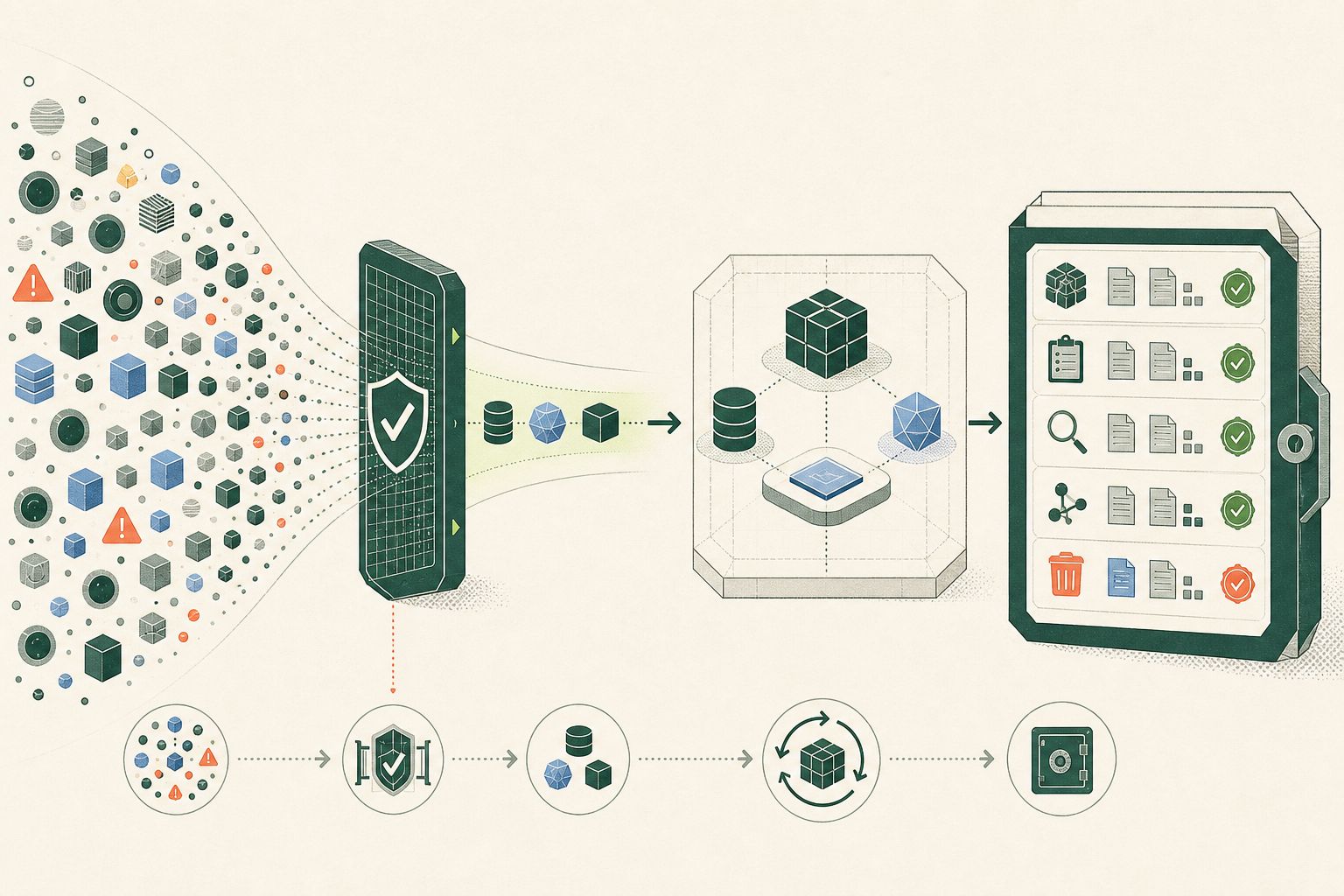
Minnesota outsourcing at a glance
| Minnesota buyer condition | Supplier control to design | Evidence before production or scale |
|---|---|---|
| The work may involve Minnesota consumer personal data | Determine actual MCDPA scope, exclusion, small-business treatment, controller/processor role, and other applicable law | Entity and threshold record, data and purpose map, role decision, exemptions, owner, current sources, and qualified review |
| An international provider processes on the buyer’s behalf | Bind the real processing to documented instructions and a clear responsibility allocation | Purpose, data types, duration, systems, people, confidentiality, security responsibilities, subprocessors, deviations, changes, and signatures |
| The buyer must respond to a consumer right or security event | Make assistance an executable workflow, not a contract slogan | Secure intake, identity and record match, locate/correct/delete/export or other applicable action, propagation, event facts, evidence preservation, status clock, and named owner |
| A data privacy and protection assessment may be required | Require the processor to supply use-specific data, system, risk, test, and control information | Processing and algorithm identifier, data inventory, people and effect, vendor chain, benefits, risks, safeguards, evaluation, residual risk, change triggers, and reviewer |
| The buyer asks for compliance evidence | Use the contractual information, assessment, inspection, or qualified independent-assessor path appropriate to the actual relationship | Current scope, control standard, service and locations covered, exceptions, remediation, assessor independence, report access, and follow-up |
| The service ends or purpose expires | Exercise buyer choice for return or deletion, subject to current law and approved retention | Copy ledger, instruction, returned artifact, deletion method, backups and residuals, subprocessor evidence, exception owner, completion date, and access revocation |
| The team works outside Central time | Protect product, privacy, release, and incident authority across real cities and dates | IANA zones, named people, sustainable schedule, shared windows, written handoffs, escalation, and backup coverage |
This table is an operating aid, not a legal conclusion. The Attorney General says businesses must first determine whether the entity or data is subject to the MCDPA and what role the business plays. Coverage depends on current statutory thresholds, exclusions, definitions, facts, and other applicable rules.
Establish scope and role before choosing a provider label
The current Minnesota statute applies its consumer-data-privacy sections to specified entities doing business in Minnesota or targeting Minnesota residents that meet a threshold. The statute currently describes 100,000 consumers, excluding data processed solely to complete payment transactions, or more than 25% of gross revenue from personal-data sales plus 25,000 consumers. It includes exclusions and special treatment for small businesses. The Attorney General’s business page emphasizes that controllers determine purposes and means while processors act on a controller’s behalf and only at its direction.
Create a dated applicability record with the legal entities, prior-year volumes, revenue path, payment-only data, consumer context, data categories, exclusions, education or other sector status, small-business analysis, purposes, and actual decision authority. Do not say a company is covered merely because a Minnesota resident uses the product, and do not infer exemption from headcount alone. Use the current statute and qualified advice.
Role is processing-specific. The statute says the determination is fact-based and that a processor that begins determining purposes and means becomes a controller for that processing. One vendor can operate under different roles for different services. Map each data path rather than assigning one label to the company.
Do not apply that consumer-data role analysis as a substitute for a neighboring state’s sector-specific rule. For example, the Nebraska guide separately traces producer-owned agricultural data through authorized service, consent, security, AI, and exit.
The current Revisor chapter page notes 2026 changes elsewhere in Chapter 325M. Before a material design, contract, or publication decision, recheck the current sections, session-law effective dates, Attorney General resources, and any applicable education, social-media, child, biometric, health, breach, or sector rules. A saved 2025 PDF should not be the only source for a 2026 release.
Build one processor evidence packet per processing path
Minnesota’s current Section 325M.13 links processor direction, controller assistance, contract instructions, confidentiality, subprocessor controls, risk-appropriate security, return or deletion, compliance information, and assessment or inspection. Procurement should preserve that chain as one versioned packet.
Use a packet index with:
- buyer legal entity, accountable privacy owner, system owner, and supplier entity;
- exact processing purpose and prohibited purposes;
- consumer context, data categories, sensitive fields, sources, and recipients;
- duration, retention triggers, systems, environments, regions, accounts, local copies, logs, backups, and model services;
- controller instructions and a process for ambiguity, illegality, infeasibility, or deviation;
- named supplier roles, confidentiality, least privilege, devices, access review, and offboarding;
- subprocessor list, advance proposal, objection path, flow-down terms, and evidence;
- technical and organizational security responsibilities allocated to each party;
- consumer-rights, security-event, breach-notification, and assessment assistance procedures;
- information, assessment, inspection, independent-assessor, remediation, and change evidence;
- return, deletion, legal-retention exception, residual access, and reconciliation;
- version, approval, effective date, linked artifacts, open gaps, and next review.
The packet should point to live evidence, not copy every artifact into a stale PDF. A responsibility can link to the contract section, data inventory entry, architecture record, access report, control assessment, ticket, runbook, or test result. Keep immutable acceptance records for releases and material decisions.
Require the supplier to identify conflicts. If the statement of work permits analytics but the processing instruction prohibits secondary use, neither party should guess. The provider stops the affected processing and routes the discrepancy to the named owner.
Maintain the inventory that makes the controls possible
Section 325M.16 currently connects reasonable administrative, technical, and physical safeguards with maintaining an inventory of data that must be managed for those responsibilities. Section 325M.18 repeats inventory within documented privacy policies and procedures. Treat the inventory as a control plane, not a compliance spreadsheet assembled after an incident.
For each data object or useful class, record:
- person and interaction context;
- raw field, document, message, image, event, identifier, prompt, output, inference, and metadata;
- purpose, legal or policy basis where applicable, and consumer expectation;
- source, collection point, transformation, and system of record;
- controller, processor, affiliate, model host, support tool, analyst, and subprocessor;
- account, environment, region, replica, cache, queue, index, log, backup, export, test copy, and local device;
- sensitivity, access role, encryption or other safeguard, and monitoring;
- consumer-right and third-party-disclosure lookup path;
- retention trigger, current age, disposal method, exception, and evidence;
- linked assessment, incident, change, and packet version.
Automate discovery and reconciliation where proportionate, but do not claim that a scanner knows the processing purpose or legal role. Compare the declared inventory to cloud resources, data catalogs, code, model settings, telemetry, support tools, access logs, and subprocessor invoices. Assign unresolved items to an owner.
Inventory derived values and prompts. A provider may delete a source record while retaining an embedding, classification, extracted field, support transcript, evaluation case, or model log capable of affecting the person or revealing the original content. State whether each artifact remains personal data based on current facts and qualified analysis.
Make rights assistance executable through the supplier chain
The statute currently requires processors, taking account of the processing and feasibility, to assist controllers with consumer-rights requests. Minnesota’s rights include access, correction, deletion, portability in specified circumstances, opt-outs, a right to question certain profiling results and seek correction and reevaluation, and information about specific third-party disclosures. The buyer needs a provider interface that can support the rights applicable to its actual path.
Design a secure request workflow:
- buyer receives and authenticates the request through its approved channel;
- a request identifier—not unnecessary identity data—is sent to the named supplier contact;
- the inventory identifies relevant systems, processors, derived records, and third parties;
- the supplier locates and returns structured results, exceptions, and uncertainties;
- the buyer makes the legal and consumer-communication decisions;
- approved correction, deletion, export, opt-out, or reevaluation actions propagate;
- each system and subprocessor returns completion or exception evidence;
- the buyer reconciles and closes the record.
For profiling that may produce legal or similarly significant effects, make the supplier preserve the input version, output, relevant model or rules version, reason data, correction path, and reevaluation capability needed for the buyer’s current obligations. Do not promise a particular explanation until qualified reviewers determine what applies.
The Attorney General’s February 2026 enforcement update says the early 30-day notice period ended and describes a secure and reliable consumer-request channel that does not require a new account. Treat request tests as production readiness, not future backlog.
Connect security and event assistance to real evidence
Section 325M.13 currently calls for processor assistance with security and breach-notification obligations, considering the nature of processing and information available to the processor. The supplier should report observable facts quickly without deciding the buyer’s legal conclusion.
Define a secure 24-hour event path with primary and backup contacts, acknowledgment, severity, containment authority, evidence preservation, status cadence, and decision log. The initial report should include discovery time, reporter, systems, accounts, possible data and people, observed behavior, credentials or services involved, containment already performed, subprocessors, preserved artifacts, gaps, and next update.
Separate supplier escalation from the buyer’s determination of whether an event is a statutory breach, which notifications apply, and what communications are accurate. A provider should not wait for a complete root-cause analysis before reporting a suspected material event, nor send public notices without buyer authority.
Use the inventory during the tabletop. If the team cannot identify which Minnesota consumer records, derived values, backups, or subprocessors may be affected, the inventory is not operational.
Supply assessment inputs before higher-risk processing
Section 325M.18 currently requires assessments for listed activities such as targeted advertising, sale, sensitive-data processing, processing presenting heightened risk, and specified profiling risks. It describes an assessment weighing benefits against consumer risks and safeguards, considering data type, sensitivity, context, reasonable expectations, and the controller-consumer relationship. Section 325M.13 requires processor information needed for the controller to conduct and document required assessments.
Before the supplier enables a candidate activity, require an assessment-input bundle:
- precise use and version, affected people, decision or effect, and distribution;
- input data, inventory links, derived values, provenance, quality, corrections, and retention;
- model, rules, prompts, thresholds, intended use, limitations, and foreseeable misuse;
- benefits and evidence supporting them;
- privacy, security, discrimination, financial, physical, reputational, autonomy, and intrusion risks appropriate to the actual use;
- mitigations, tests, representative cases, results, gaps, residual risk, human authority, and appeal or correction path;
- subprocessors, model hosts, data regions, secondary use, and change process;
- monitoring, complaint, incident, rollback, retirement, and record owner.
The buyer owns the assessment decision when acting as controller. A vendor template can contribute evidence but cannot know the buyer’s consumer relationship, expectations, complete data path, other systems, or acceptable residual risk. Complete the review early enough to narrow or stop the design.
Set reassessment triggers for a material change in purpose, data, model, threshold, people, outcome, recipient, subprocessor, region, or control. Contract for advance notice and a stable version long enough to review.
Make inspection and independent evidence useful
The current statute describes reasonable controller assessments and inspections, with an alternative under which a processor may arrange for a qualified independent assessor to conduct at least an annual assessment at the processor’s expense and provide a report on request. Do not translate that into “every supplier must buy any certificate” or “a certification proves compliance.” Select the evidence route for the actual service and contract with qualified review.
For an independent report, check the legal entity, service, systems, locations, control period, standard, procedure, assessor, subservice organizations, complementary buyer controls, exceptions, remediation, and bridge period. Determine whether the report can be shared with relevant reviewers and retained as needed.
For a buyer assessment or inspection, define reasonable scope, notice, security, confidentiality, records, access, costs, remediation, and emergency exceptions. Use a staged request: packet index and existing independent evidence first, targeted artifacts and interviews next, controlled technical validation when necessary. An intrusive visit that reveals other customers’ data is not good assurance.
Track exceptions to closure. A clean cover page with a material excluded system is weaker than a transparent report with a verified remediation plan.
Design Central-time delivery around accountable owners
Use the Minnesota buyer’s actual city and an IANA identifier—commonly America/Chicago—with every proposed supplier city and relevant date. Daylight transitions do not occur everywhere on the same schedule. Recalculate overlap rather than treating Central time as a fixed offset.
Protect separate windows for product decisions, privacy instructions, assessment review, release approval, inspection evidence, and incident command. Latin American teams may offer broad same-day overlap depending on the cities. European teams can align with a Minnesota morning. Asia-Pacific teams can support follow-the-sun delivery when written packages and authority are complete. Judge named people and sustainable schedules.
Each handoff should identify the accepted outcome, current artifact, packet and inventory version, evidence produced, open risk, blocked decision, responsible person, deadline, and next authorized action. The supplier must not invent a new purpose or retain data because the Minnesota owner is offline.
Test urgent and ordinary paths. Start an event tabletop outside the shared window and a rights request inside it. Measure acknowledgment, inventory lookup, facts returned, buyer decision time, subprocessor coordination, evidence quality, and backup-owner performance.
Choose the engagement model and buyer control plane
A freelancer can fit a bounded prototype when the buyer owns the data path and continuity. Staff augmentation can fit when Minnesota owners can direct and inspect work. A managed provider can fit a defined outcome when it supplies accountable delivery, privacy, security, and evidence roles. The label does not determine controller or processor status.
Write a responsibility matrix for purpose, instruction, inventory, rights, assessment, security, incident escalation, subprocessor approval, inspection, release, monitoring, acceptance, return or deletion, and exit. Name people on both sides. Keep repositories, cloud tenants, identity, package registries, model and evaluation accounts, domains, analytics, backups, and recovery methods under buyer governance.
Only then compare countries. Verify the contracting entity, named people and cities, employment and subcontracting relationships, data and tool locations, transfer and sector restrictions, holidays, infrastructure, rights chain, continuity, and complete cost. Country averages cannot prove that a named team will maintain the Minnesota evidence packet.
Evaluate secure delivery and intellectual-property evidence
Ask the proposed team to walk through a comparable change from instruction to operation: purpose, data inventory, source or configuration, peer review, tests, secure-development evidence, release record, monitoring, incident response, and handover. NIST’s Secure Software Development Framework can organize supplier questions, but the evidence must map to this service.
Separate buyer background materials, provider background materials, new deliverables, open-source and commercial components, data, prompts, models, evaluation sets, documentation, and operating records. Verify assignments or licenses through each contributor and relevant country. WIPO’s directory can locate official intellectual-property offices; it does not prove ownership.
Test buyer control. The buyer should be able to reproduce an accepted release from buyer-controlled accounts, revoke one contributor, obtain current inventory and assessment evidence, and continue operation without the provider’s private credentials.
Calculate complete cost and recovery exposure
Normalize proposals for the same outcome and responsibility allocation. Include labor, delivery leadership, buyer coordination, privacy and qualified legal review, inventory work, rights testing, assessment inputs, security assurance, cloud and model usage, travel, currency, taxes or fees, rework, support, incident exercises, inspection and remediation, transition, and replacement.
Track accepted outcomes, buyer hours, decision delay, inventory discrepancies, rights completion, assessment gaps, control exceptions, incident-report latency, schedule sustainability, and exit readiness. A low rate is not a saving if the buyer must reconstruct every supplier system for an Attorney General request or consumer deletion.
Model downside: a subprocessor changes, the supplier cannot explain a profiling result, an independent report excludes the production service, a backup survives the deletion promise, or a provider exits with the only build credentials. Price prevention and recovery.
Run a Minnesota evidence-packet pilot
Use synthetic or approved nonproduction records. Give the named team one small processing instruction and require a complete packet: purpose, data map, inventory, responsibility allocation, subprocessor path, security evidence, release artifact, rights runbook, assessment inputs, inspection-ready index, and exit procedure.
Then submit a test access or correction request, inject a suspected security event, and request a processing change that would add a subprocessor. Observe whether the supplier locates relevant records and derived values, preserves facts, follows buyer authority, updates the inventory, supplies assessment information, and waits for approval.
At the end, choose return or deletion for the test data. Reconcile active systems, logs, exports, backups, and subprocessors; state justified residuals and revoke access. End with a continue, revise, or stop decision.
Do not scale if the named team was absent, the packet points only to sales documents, inventory misses supplier tools, rights assistance is manual guesswork, the assessment bundle lacks use-specific evidence, an assurance report excludes the service, the buyer cannot exercise inspection rights reasonably, or exit cannot be proved.
Minnesota buyer red flags
- The vendor calls itself a processor but reserves broad rights to choose purposes or train models.
- The contract repeats statutory nouns without a working assistance interface.
- Inventory covers databases but omits prompts, outputs, logs, exports, support systems, models, and subprocessors.
- The supplier cannot identify the specific third-party path for a test record.
- A profiling system cannot preserve reason data, corrected input, or reevaluation evidence.
- Assessment inputs are a generic model card unrelated to the buyer’s people and purpose.
- A certificate’s scope, period, exceptions, or excluded services are unavailable.
- Return or deletion ignores backups, derived values, local copies, and subprocessor evidence.
- Central-time coverage depends on an account manager rather than named technical and incident roles.
- The buyer owns code on paper but not the accounts, keys, build path, or recovery records.
Frequently asked questions
Does the MCDPA apply to every Minnesota business or project?
No. The current statute has thresholds, exclusions, definitions, role distinctions, and small-business provisions. Determine the actual entities, prior-year processing, data, purposes, and relationship from current sources with qualified counsel.
Must every Minnesota processor obtain a specific certification?
The statute describes assessments and inspections and an alternative qualified independent-assessor path. It does not make any marketing badge a universal answer. Determine the appropriate contract and evidence for the actual service with qualified review.
Why does the buyer need its own data inventory?
The current statute links inventory to controller security and privacy policies. Operationally, the buyer needs it to protect data, respond to rights, assess processing, investigate events, manage retention, and verify exit across suppliers.
Can the supplier perform the data privacy and protection assessment?
The supplier can provide required information and valuable analysis. The controller should not outsource its accountable use-specific decision to a vendor template. Confirm roles and obligations under current law.
What is the best outsourcing country for a Minnesota company?
There is no universal best country. Define the outcome, Central-time authority, skills, data path, evidence duties, security, complete cost, rights chain, destination constraints, continuity, and exit, then compare named teams consistently.
Is Outsourcing.ai located in Minnesota?
No local presence is claimed. This is an online buyer guide, not a Minnesota office, local-business listing, or representation of local employees or clients.
Evidence ledger
Sources used on this page
- IANA Time Zone Database — Internet Assigned Numbers Authority. Supports: Maintained time-zone identifiers and transitions for calculating actual overlap between Minnesota buyer cities and proposed international delivery cities. Direct source; independently sourced; commercial relationship: none. Verified 8/15/2026 by Outsourcing.ai Editorial Team. Accessed 8/15/2026.
- Uniform Time — U.S. Department of Transportation. Supports: Federal oversight of U.S. time zones and daylight-saving observance, supporting date-aware Central-time collaboration design. Direct source; independently sourced; commercial relationship: none. Verified 8/15/2026 by Outsourcing.ai Editorial Team. Accessed 8/15/2026.
- Minnesota Consumer Data Privacy Act — Information for Businesses — Minnesota Attorney General. Supports: Current official business overview of MCDPA roles, processor direction, small-business treatment, applicability questions, and statutory limitations. Direct source; independently sourced; commercial relationship: none. Verified 8/15/2026 by Outsourcing.ai Editorial Team. Accessed 8/15/2026.
- Minnesota Statutes Chapter 325M — Minnesota Office of the Revisor of Statutes. Supports: Current official statutory text for MCDPA scope, roles, processor contracts and assistance, consumer rights, inventories, retention, assessments, enforcement, and effective-date notes. Direct source; independently sourced; commercial relationship: none. Verified 8/15/2026 by Outsourcing.ai Editorial Team. Accessed 8/15/2026.
- Minnesota Consumer Data Privacy Act takes full effect — Minnesota Attorney General. Published 2/5/2026. Supports: Current official enforcement update describing the end of the 30-day notice period, early enforcement activity, consumer-rights request channel expectations, and complaint activity. Direct source; independently sourced; commercial relationship: none. Verified 8/15/2026 by Outsourcing.ai Editorial Team. Accessed 8/15/2026.
- Secure Software Development Framework — National Institute of Standards and Technology. Supports: A maintained framework for requesting supplier evidence about secure development, provenance, review, releases, vulnerability response, and protection of software. Direct source; independently sourced; commercial relationship: none. Verified 8/15/2026 by Outsourcing.ai Editorial Team. Accessed 8/15/2026.
- Directory of Intellectual Property Offices — World Intellectual Property Organization. Supports: Official destination-country intellectual-property office links for researching contributor and rights-chain questions without assuming one contract works everywhere. Direct source; independently sourced; commercial relationship: none. Verified 8/15/2026 by Outsourcing.ai Editorial Team. Accessed 8/15/2026.
Next scheduled review: November 15, 2026. Corrections: hello@outsourcing.ai.