
North Carolina buyer guide
Outsourcing software development from North Carolina
A North Carolina buyer guide to international software outsourcing: disposal-vendor diligence, breach handoffs, Eastern-time delivery, evidence, and exit.
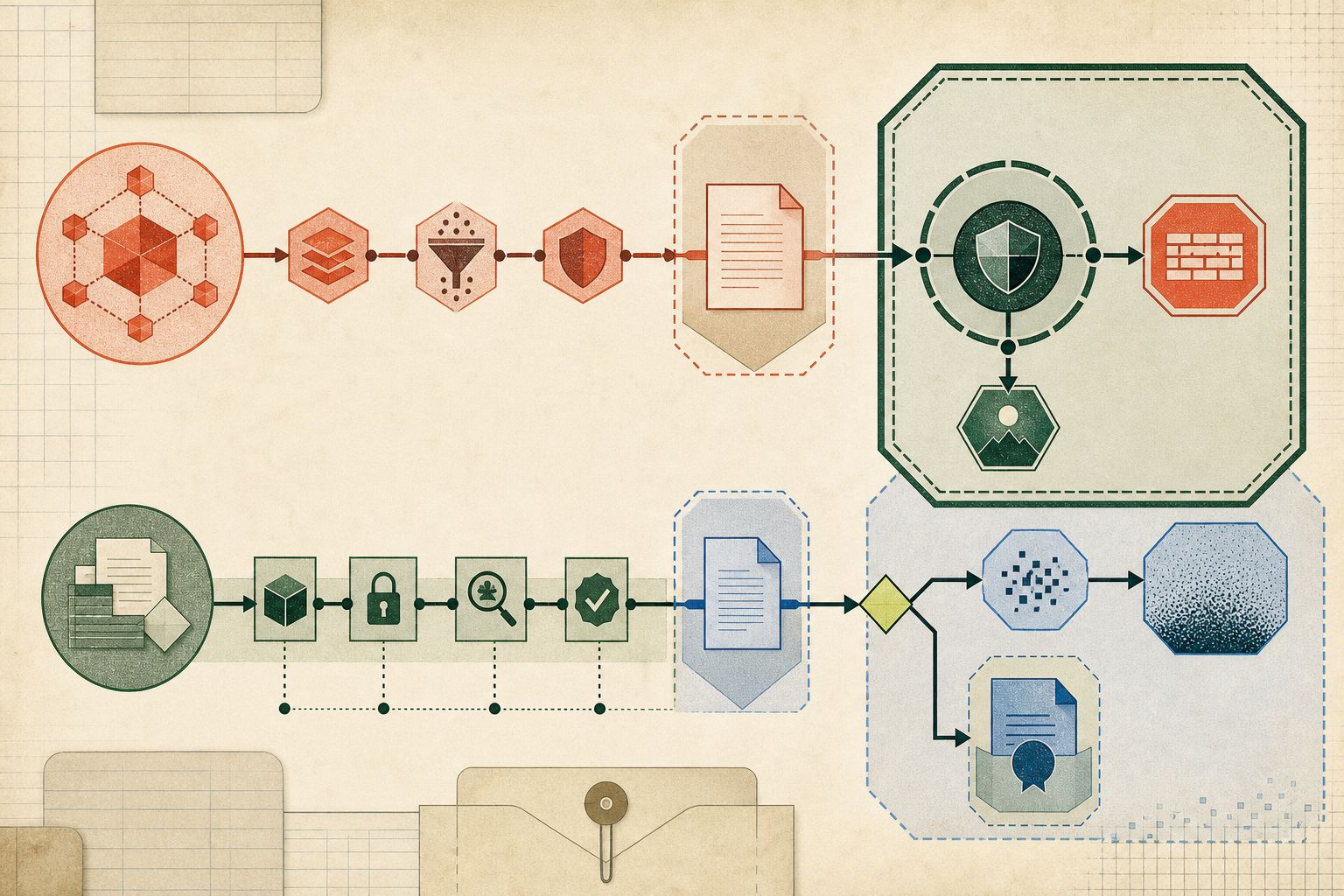
North Carolina outsourcing at a glance
| Buyer condition | Stop or release gate | Evidence to retain |
|---|---|---|
| A provider will possess North Carolina resident personal information it does not own | Name the owner or licensee and create the immediate breach-report path before access | Record map, role record, 24-hour contacts, event definition, secure reporting channel, containment boundary, timestamps, and buyer acceptance |
| A provider or specialist will delete electronic or paper records | Trace the written disposal policy into the actual work order | Covered records, systems and media, approved method, reconstruction test, backup and log treatment, accountable people, exception path, and evidence format |
| A separate destruction business collects or transports records | Complete due diligence, a written contract, and monitoring design before transfer | Audit or certification evidence, references, security policies, competence and integrity review, custody record, transport controls, monitoring result, and disposal certificate or equivalent evidence |
| A project is ending or a contributor is leaving | Reconcile identities, accounts, devices, repositories, exports, local copies, backups, and subprocessors | Access revocation, transfer record, retained-record exception, deletion evidence, buyer-controlled build, current runbook, and recovery test |
| The team works outside Eastern time | Protect breach, disposal, product, security, release, and acceptance authority | Named people and cities, IANA zones, dated overlap, urgent escalation, written handoff, and sustainable schedules |
This is an operational triage table, not a coverage determination. G.S. 75-64 and 75-65 include definitions, conditions, exclusions, remedies, and notice details that require current review for the actual business and records.
Start with custody, not geography
International outsourcing often creates several copies before anyone notices: a production table, support export, ticket attachment, debug log, analytics event, model prompt, local development fixture, backup, and subprocessor record. Country labels do not reveal who owns those copies or who must act when something goes wrong.
Create a custody ledger before supplier discovery. For every relevant record or field, list the person context, source, purpose, owner or licensee, maintainer, environment, approved location, approved people, transfer, log, backup, retention, disposal method, and incident contact. Record disputed classifications and send them for qualified review; do not let a vendor choose its own role by writing “processor” in a proposal.
G.S. 75-65 draws an especially useful operating boundary. A business that maintains or possesses North Carolina resident personal information it does not own or license must notify the owner or licensee of a security breach immediately following discovery, subject to the statute’s law-enforcement condition. Procurement should convert that boundary into a real clock and communications path.
The contract should define who can discover an event, what triggers escalation, how the supplier reports uncertainty, which secure channel is used, and who acknowledges receipt. “Promptly” or “as required by law” is not an operating interface. The buyer needs a named 24-hour route that works when the account manager is unavailable.
Build the immediate custodian-to-owner handoff
The supplier’s first report need not contain a finished legal conclusion. Requiring certainty can cause dangerous silence while an overseas team investigates. Define an initial event report that can say “suspected” and includes:
- discovery time, reporter, system, and observed behavior;
- possible North Carolina resident records and approximate scope;
- whether the supplier owns the data or maintains it for the buyer;
- affected accounts, credentials, devices, services, exports, and subprocessors;
- containment already performed and any action awaiting buyer authority;
- evidence preserved, gaps, and the next update time;
- a continuously updated decision and communications log.
Separate provider escalation from the buyer’s determination about affected-person, Attorney General, consumer-reporting-agency, law-enforcement, contractual, or sector notices. G.S. 75-65 assigns detailed obligations to owners or licensees in relevant circumstances and also addresses law-enforcement delay. The international provider should deliver facts and preserve evidence; qualified buyer-side owners should decide the legal path.
Run a tabletop with the people named in the contract. Start outside the ordinary overlap window. Introduce an ambiguous log, an unavailable manager, and a subprocessor. Measure discovery-to-report time, acknowledgment, authority, evidence quality, status cadence, and whether the buyer can determine the affected record owners without searching old proposals.
Turn disposal policy into an executable work order
G.S. 75-64 requires reasonable measures in connection with or after disposal and identifies written policies and procedures for paper, electronic, and other nonpaper media. A generic contract clause saying “delete data on termination” does not describe the work.
For each system or media type, the disposal work order should identify:
- record classes and North Carolina resident fields;
- active database, object storage, queues, search indexes, logs, tickets, analytics, backups, replicas, test data, local devices, and exports;
- method that makes information not practicably readable or reconstructable;
- who performs the step, who observes or validates it, and who approves exceptions;
- dependencies such as legal holds, fraud evidence, security investigations, or required retention;
- time from request or termination to completion;
- how a record reaches backup expiration and how access is restricted in the meantime;
- subprocessor instructions and returned evidence;
- failure, retry, discrepancy, and escalation handling;
- final reconciliation against the custody ledger.
Do not promise physical shredding for a cloud database or immediate erasure from an immutable backup when that is not how the system works. State the actual architecture, method, residual period, access controls, and validation. The objective is an accurate, monitored process that can be reviewed—not comforting language that operations cannot perform.
Qualify a destruction business as a separate supplier
North Carolina’s disposal section is unusually specific about a business using another party engaged in record destruction. It describes due diligence that can include reviewing an independent audit, checking several references or reliable sources and recognized certification, evaluating security policies, or taking other measures to determine competence and integrity. It also calls for a written contract and compliance monitoring.
Treat that destruction business as its own risk boundary even when the software provider hires it. Record the legal entity, locations, people or roles, collection vehicles or transfer channels, staging facilities, subcontractors, methods, incident history, insurance if relevant, independent evidence, certification scope and date, written contract, monitoring owner, and exit path. Confirm whether the evidence actually covers the service, geography, and media in the buyer’s work order.
The statute also addresses protection during collection and transportation. A certificate after destruction does not explain an unexplained gap in custody. Require pickup or transfer identifiers, sealed-container or encrypted-transfer controls as appropriate, departure and receipt times, exceptions, access records, and reconciliation of the quantity or media transferred.
Certification can support due diligence; it does not replace the buyer’s selection, contract, or monitoring. A glossy certificate with an expired date, excluded facility, or unrelated scope is weak evidence.
Design Eastern-time authority and follow-the-sun evidence
Use the North Carolina buyer’s actual city and an IANA identifier, commonly America/New_York, with every proposed supplier city and the dates that matter. Daylight transitions do not occur everywhere on the same dates. Recalculate overlap rather than treating Eastern time as a fixed UTC offset.
Create separate windows for product decisions, access approval, disposal exceptions, security escalation, legal review, release acceptance, and incident command. A team in Latin America may offer broad same-day overlap for many city pairs. Europe may align with a North Carolina morning. Asia-Pacific can provide follow-the-sun monitoring or delivery when authority and handoffs are explicit. Judge named people and a sustainable schedule.
For disposal and incidents, asynchronous work must produce evidence, not just status. Each handoff should include the current record set, action taken, remaining copy or risk, preserved artifact, blocked decision, named owner, deadline, and authorized next step. The supplier must not destroy potential incident evidence merely because the routine retention clock expired, and it must not retain ordinary records indefinitely because no buyer was awake to approve deletion.
Choose the engagement and control plane
A freelancer can fit a bounded build when the buyer owns architecture, access, records, review, release, and continuity. Staff augmentation can fit when North Carolina buyer teams can direct and inspect the work. A managed provider can fit a defined outcome when it supplies accountable delivery and operational roles. None of those labels decides who owns a record or performs disposal.
Write a responsibility matrix for data approval, account creation, device management, secure development, record ownership, breach discovery, immediate escalation, legal determination, communications, retention, disposal instruction, destruction-provider selection, monitoring, evidence acceptance, and exit. Name people on both sides and an alternate for time-sensitive work.
Keep source repositories, cloud tenants, identity, domains, package registries, model and analytics accounts, backups, and recovery methods under buyer governance. Give individuals least-privilege identities. Prohibit shared accounts where attribution matters. Require approval before new tools, storage regions, or subprocessors receive data.
Only then compare countries and providers. Verify the contracting entity, named team, city, employment or subcontracting relationships, rights chain, holidays, infrastructure, data path, export and sanctions constraints, continuity, and complete cost for the actual arrangement.
Evaluate secure delivery and ownership evidence
Ask the named team to walk through a relevant change from request to operation: decision record, threat or misuse analysis, code or configuration, peer review, tests, secure-development evidence, release record, monitoring, incident response, and handover. NIST’s Secure Software Development Framework can organize questions, but the evidence must fit the buyer’s project.
Separate buyer background materials, provider background materials, new deliverables, open-source software, commercial components, data, prompts, evaluations, models, documentation, and operating records. Verify assignments or licenses through every employee and subcontractor under the relevant countries. WIPO’s directory can locate official destination-country offices; it does not prove that the proposed rights chain is complete.
Test reproducibility and exit. The buyer should be able to build or deploy the accepted version from buyer-controlled accounts, revoke one contributor without halting the project, identify retained records, issue an approved disposal instruction, and receive usable evidence. Paper ownership is weak if the supplier alone controls the keys and process.
Calculate complete cost and recovery
Normalize proposals for the same accepted outcome and responsibility allocation. Include labor, delivery leadership, buyer coordination, security, qualified legal review, custody mapping, incident rehearsal, disposal engineering, destruction-vendor diligence, monitoring, evidence review, cloud and model usage, travel, currency, taxes or fees, rework, support, transition, and replacement.
Price uncertainty honestly. A supplier that cannot identify its tools, record copies, disposal path, or 24-hour escalation will require discovery work. A lower hourly rate can be more expensive when the buyer must reconstruct custody during an event or manually chase deletion across accounts.
Track accepted outcomes, decision delay, buyer hours, defects, access exceptions, unapproved copies, event-report latency, disposal discrepancies, monitoring results, schedule sustainability, and exit readiness. Model downside: a laptop is lost, a subprocessor finds an exposed export, a destruction pickup lacks custody evidence, a backup outlives the stated period, or the provider exits before handover.
Run a North Carolina disposal-chain pilot
Use synthetic or approved nonproduction records. Have the named team create the intended copies through development, testing, support, logging, backup, and one approved subprocessor. Give the buyer a disposal request and require the supplier to locate every copy, execute the documented method, state justified residuals, collect subprocessor evidence, and reconcile the ledger.
During the same milestone, inject a suspected breach into a record the supplier maintains but does not own. Start the clock at discovery. Observe the initial report, secure channel, owner identification, preserved evidence, containment authority, status updates, and buyer acknowledgment. The exercise should not send real public notices.
End with a continue, revise, or stop decision. Do not scale if the named team was absent, the custody ledger is incomplete, the supplier waits for certainty before reporting, disposal evidence is merely self-attestation, a destruction business lacks meaningful diligence, critical accounts remain provider-owned, or the accepted release cannot be reproduced and handed over.
North Carolina buyer red flags
- The provider cannot say whether it owns, licenses, maintains, or merely accesses each record set.
- “Notify as required by law” replaces a named immediate custodian-to-owner reporting path.
- A breach report waits for the supplier’s final root-cause analysis.
- The disposal clause does not identify electronic media, logs, backups, local exports, or subprocessors.
- A destruction business is selected only on price and supplies no current scope-specific evidence.
- A certificate of destruction exists without collection, transport, and exception reconciliation.
- Routine deletion could destroy incident evidence, or an incident becomes an excuse for indefinite retention.
- Eastern-time coverage depends on one account manager rather than named technical and security roles.
- Shared supplier accounts prevent attribution and clean offboarding.
- The buyer owns deliverables on paper but cannot build, deploy, revoke access, or verify disposal.
Frequently asked questions
Must every North Carolina software project use a record-destruction business?
No. G.S. 75-64 describes reasonable disposal measures and permits a business, after due diligence, to contract with another party engaged in record destruction. The appropriate method depends on the actual covered records and media. Determine scope and exceptions with qualified review.
What should an international provider report first after discovering a possible breach?
The provider should follow the agreed secure escalation path with discovery time, affected systems and possible records, observed facts, containment, preserved evidence, current scope, and next update. The buyer should not require a complete legal conclusion before an initial report.
Can a North Carolina company outsource disposal internationally?
Geography alone does not decide suitability. Review the statute and actual arrangement, record types, ownership, due diligence, written contract, monitoring, custody, transport, method, evidence, subprocessors, destination requirements, and incident path with qualified advisers.
Is a destruction-vendor certification sufficient due diligence?
Not by itself. The statutory examples also include audits, references or reliable sources, security-policy review, and other measures concerning competence and integrity. Check current scope, dates, locations, media, exclusions, contract, and monitoring.
What is the best outsourcing country for a North Carolina company?
There is no universal best country. Define the outcome, Eastern-time authority, skills, record custody, security, engagement model, complete cost, rights chain, continuity, and exit. Then compare named teams in eligible countries using one evidence model.
Is Outsourcing.ai located in North Carolina?
No local presence is claimed. This is an online buyer guide, not a North Carolina office, local-business listing, or representation of local employees or clients.
Evidence ledger
Sources used on this page
- G.S. 75-64 — Destruction of personal information records — North Carolina General Assembly. Supports: Current statutory text on reasonable disposal measures, written policy, destruction-business due diligence and contracts, compliance monitoring, transport, and disposal of North Carolina resident personal information. Direct source; independently sourced; commercial relationship: none. Verified 8/15/2026 by Outsourcing.ai Editorial Team. Accessed 8/15/2026.
- G.S. 75-65 — Protection from security breaches — North Carolina General Assembly. Supports: Current statutory text on owner and licensee notices, the immediate non-owner-to-owner breach notification boundary, notice content and methods, law-enforcement delay, and Attorney General reporting. Direct source; independently sourced; commercial relationship: none. Verified 8/15/2026 by Outsourcing.ai Editorial Team. Accessed 8/15/2026.
- Chapter 75 — Monopolies, Trusts and Consumer Protection — North Carolina General Assembly. Supports: Official chapter context and current enacted text for North Carolina consumer-protection provisions, including personal-information disposal and security-breach sections. Direct source; independently sourced; commercial relationship: none. Verified 8/15/2026 by Outsourcing.ai Editorial Team. Accessed 8/15/2026.
- IANA Time Zone Database — Internet Assigned Numbers Authority. Supports: Maintained time-zone identifiers and transitions for calculating actual overlap between North Carolina buyer cities and proposed international delivery cities. Direct source; independently sourced; commercial relationship: none. Verified 8/15/2026 by Outsourcing.ai Editorial Team. Accessed 8/15/2026.
- Uniform Time — U.S. Department of Transportation. Supports: Federal oversight of U.S. time zones and daylight-saving observance, supporting date-aware Eastern-time collaboration design. Direct source; independently sourced; commercial relationship: none. Verified 8/15/2026 by Outsourcing.ai Editorial Team. Accessed 8/15/2026.
- Secure Software Development Framework — National Institute of Standards and Technology. Supports: A maintained framework for requesting supplier evidence about secure development, releases, vulnerability response, provenance, and software protection. Direct source; independently sourced; commercial relationship: none. Verified 8/15/2026 by Outsourcing.ai Editorial Team. Accessed 8/15/2026.
- Directory of Intellectual Property Offices — World Intellectual Property Organization. Supports: Official destination-country intellectual-property office links for researching contributor and rights-chain questions without assuming one agreement works everywhere. Direct source; independently sourced; commercial relationship: none. Verified 8/15/2026 by Outsourcing.ai Editorial Team. Accessed 8/15/2026.
Next scheduled review: February 15, 2027. Corrections: hello@outsourcing.ai.